To get to the border post, we had to drive back to make a U-turn. We saw a huge double lane line of trucks. We saw drivers sitting outside together playing cards or making breakfast. That meant they were not going to move soon.
There was still a lane left for the regular cars, so I took that one. The worst that could happen, would be that they would send you back in line. We entered the first control point, where there were only cars (we hardly fit between the road dividers). The soldiers checked the papers and checked inside to see whether we were not smuggling anybody out of Iraq.
We drove to a big parking lot where we had to park and get a piece of paper. That paper we had to fill out (passport numbers and vehicle info). Then we continued to the next point, immigration, to stamp out of Iraq. When we got back, the customs officers asked for a paper, which I did not understand, we did not have it. Nobody spoke English, until they found someone who did. It turned out we by-passed a station, we simply missed it. But considering the measurements of the truck, we couldn’t turn to go back to that station. So we had to walk a few hundred meters back. (Luckily they made a phone call to that station about our situation, so that we did not have to bring the truck there as well).
The officer there was a bit of a grumpy guy and didn’t understand our vehicle registration. He started to make phone calls and that took quite some time. At the end it was okay and then we had to go to another window to pay a “departure fee”. My biggest worry was to make sure the guy of the first window would stamp out our CdP document correctly. When we left Kuwait, the Kuwaities only stamped out and didn’t take out the coupons. When we entered Iraq, the Iraqis stamped where the Kuwaities were supposed to stamp into Kuwait. Luckily this guy understood. He stamped the next pages and took all the coupons from that page. So at least, for our customs deposit on the CdP, we were now officially out of Iraq.
When we came back to the truck, we still got a search by the customs, but after that, we were good to go. We were out of Iraq (with the truck!). The border between Iraq and Turkey at this point is a river. When we left the last control point from Iraq, we were straight in the lane with the cars. The trucks were on the other lane and were seemingly going much faster. We spent almost 5 hours waiting on the bridge, going very slowly towards the Turkish border control. While waiting we had numerous conversations with other people waiting with their vehicles on the bridge. It was weekend (and I thought let’s go on Friday, because it wouldn’t be that busy) and its was vacation time for the Iraqi Kurds. At least it killed the time a bit and slowly but surely we got closer to Turkey.
In the meantime the people I spoke with, explained that it always takes long at this border post (hence the reason I saw so many cars parked on the Iraqi side and Iraqi buses bringing passengers to the border. When you go as a person without a vehicle it goes much faster. That’s why there were also so many Turkish taxis waiting near the border). Sometimes it could even take 16 hours to cross, I was told. The reason why it takes so long, is that there is only one gate for cars and every car is being checked for smuggling. There is a lot of smuggling happening from Iraq to Turkey, because so many items are a lot cheaper in Iraq. They check for cigarettes, mobil phones, electronics etc. And really, we saw that every car was checked, one more than the other, and all luggage was opened. The customs officers carry screwdrivers with them, to even open up door panels.

Finally it was our turn. We first had to make our own paper to write down our name, country and the vehicle information. Then we had to get our passports stamped. In order to continue, we had to get vehicle insurance, but that was easy. And then came the first real test since transporting the truck out of Sint Maarten. The customs officers asked for the vehicle passport. I showed him what we have, all documents we get from the authorities in Sint Maarten and that doesn’t look very impressive in Europe. And getting into discussion, or giving explanations,with officers, who only speak Turkish, is not easy. There was, however, a random Turkish guy who understood that we were Dutch from an island, that is part of the Dutch Kingdom and that because of the small size and limited amount of cars on this island, we use only the vehicle registration documents we were showing. Mind you, we most probably are the first Sint Maarten vehicle crossing this border. After some jokes and being creative with the registration of the vehicle in the system (Sint Maarten was not even an option to chose in the Turkish computer registration), we were allowed to enter Turkey (after more then 7 hours since we left entered the Iraqi border post).
Where the trucks leaving Iraq were going fast through the border posts, the trucks going in where waiting for days. There was a line of almost 8 kilometers of trucks waiting to get into Iraq. Big difference is that almost all trucks leaving Iraq are empty Turkish trucks (they all leave there loading area doors open, so its easy for the customs officers to check). Iraq produces almost nothing and has to import almost everything.
It was already late in the afternoon, so first thing was to look for a camp spot. Since we didn’t know yet what was allowed or not, we parked on an abandoned road construction site, a bit off the main road.
Next day we continued our trip through Turkey. We did not want to spend too much time in Turkey (Turkey is too big and we want to make a separate trip for that). Our goal now was to go to Armenia and Georgia. The area we drove through is a Turkish Kurdish area, which is a turbulent area. There are Turkish rebels fighting against the Turkish government for an independent or autonomous country for the Turkish Kurds. On almost every hill or mountain top we saw a Turkish army base or post, able to overlook the entire area. Our passports were checked at a few checkpoints of the Yandarma (kind of military police) but that was it. We passed through villages, looking like they are from the middle ages. So old, so poor. Every house had a pile of cow dong and a pile of hay next to it.


We arrived at the city of Sirnak, but not before we were stopped at another checkpoint. It seemed like a combined security services checkpoint, since a lot of different guys were competing for my attention. One asked for my drivers license (traffic police), but then others started waving that I had to move forward and park on the side of the road, which (since they look like presenting the majority with guns), I did.
The moment I parked, one guy run to the truck on Marja’s side, trying to open the boxes under the truck frame and the door of the unit (which all of them I always keep locked). He also commanded Marja in a pretty rude way to get out of the truck, which she did. He jumped in the cabin of the truck, and started knocking on the ceiling of the truck, the dashboard and the door panels (to find out whether there were hidden compartments).

Meanwhile I was kept busy on my side (I also had the get out of the truck). The traffic officer was checking my license plate and my drivers license, another officer was in the meantime sitting on my drivers seat, also checking for hidden compartments. Another officer, who spoke English and looked like a detective or secret agent, started a conversation with me, analyzing and profiling me. All in all a rather chaotic situation. When I told him, after he asked me what my occupation was, that I had a construction company employing hundreds of people, he right away ordered a stop to the search of truck. He apologized and wished us a good journey, but told us to be careful. Luckily the search guys didn’t have a chance to start working with their tools taking the truck apart. This was up till now the most unpleasant checkpoint. I found it very unprofessional and disrespectful. If they just normally ask, we cooperate with all they ask, we have nothing to hide and would have open all doors and compartments.
We later found out that Sirnak is a very sensitive city. In February (a few weeks before we arrived), all protest and demonstrations organized by the political wing of the PKK were banned by the Government. Sirnak is the capital of the area, which is inhabited mostly by Kurds. The PKK is listed in the US, EU and Turkey as a terrorist organization. Hence the tight controls and security measures in the area. The PKK frequently attacks state institutions and representatives of the Turkeys Government.
It was a warning for us to stay alert. Even though it all looks calm, things can change in moments. We drove through Sirnak to find a bank or ATM machine, but didn’t find one and now familiar with the situation, we didn’t want to hang around too long. The situation felt much more fragile than in Iraq.
We drove away from Sirnak towards the town of Eruh, where we tried again. According to our Google Map info, there was supposed to be an ATM in that town, but the roads towards it were getting smaller and smaller, like a mouse trap, so we skipped this one as well.

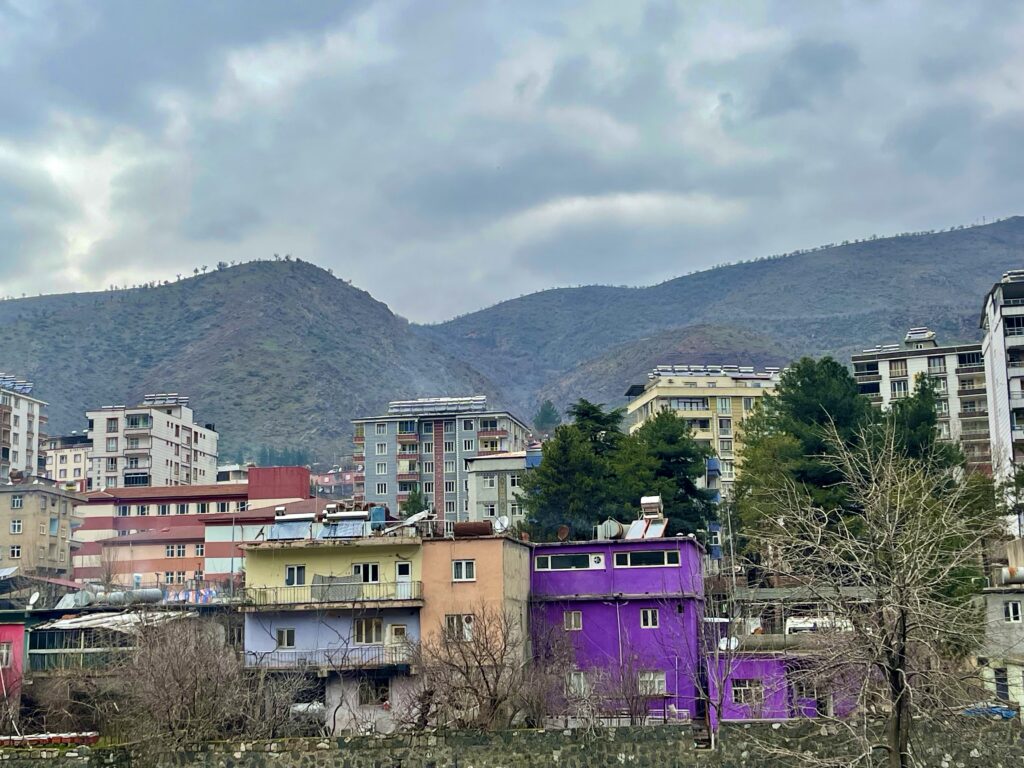
Next city was Siirt, a city surrounded by forest and it is an important oil city. Once a center of administration for a large part of Turkey, Syria and Iraq, during the times of the Ottoman Empire. Here we were able to find an ATM and get some Turkish Liras. From Siirt we also left the tense Turkish area. All checkpoints we now encountered were either towards that area or away from it. We didn’t see army posts or base on mountain tops anymore. It made the traveling a lot more relaxed.

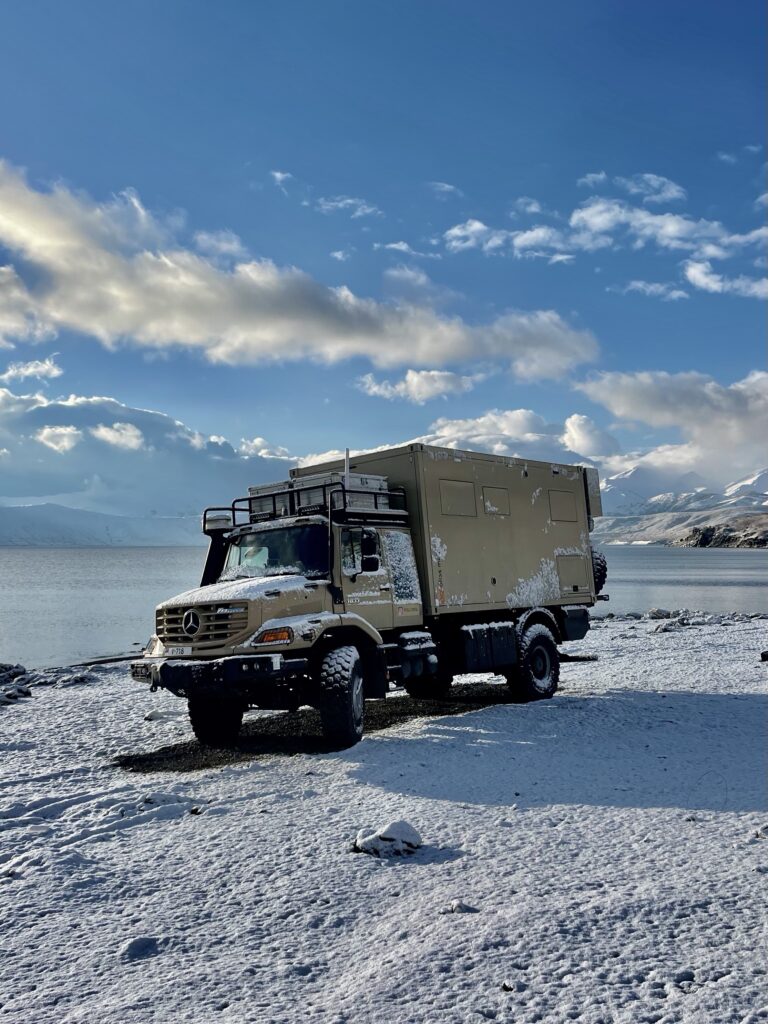
Driving in Northern direction, it became colder and we saw more snow on the mountain tops. After reaching the city of Tatvan, we drove along Turkey’s largest lake, lake Van. The lake side has many beaches where you could camp. We found a nice one, which had a great view on the opposite snow covered mountains. Despite the freezing temperatures, the lake is not frozen, because its a saline soda lake (the water is not fresh and not really salt, but more brackish). It covers 38% of Turkish surface water and is one of the few lakes in the world without an outlet.

We did a little walk through the area, but the cold wind and snow fall, pushed us back in the truck. After a while somebody knocked on the door (normally you would think police or army again). No, now it was somebody who asked for help. A young lovers couple spending some time on the beach in their sedan, got stuck on the beach and couldn’t get out anymore. Too deep in the sand.

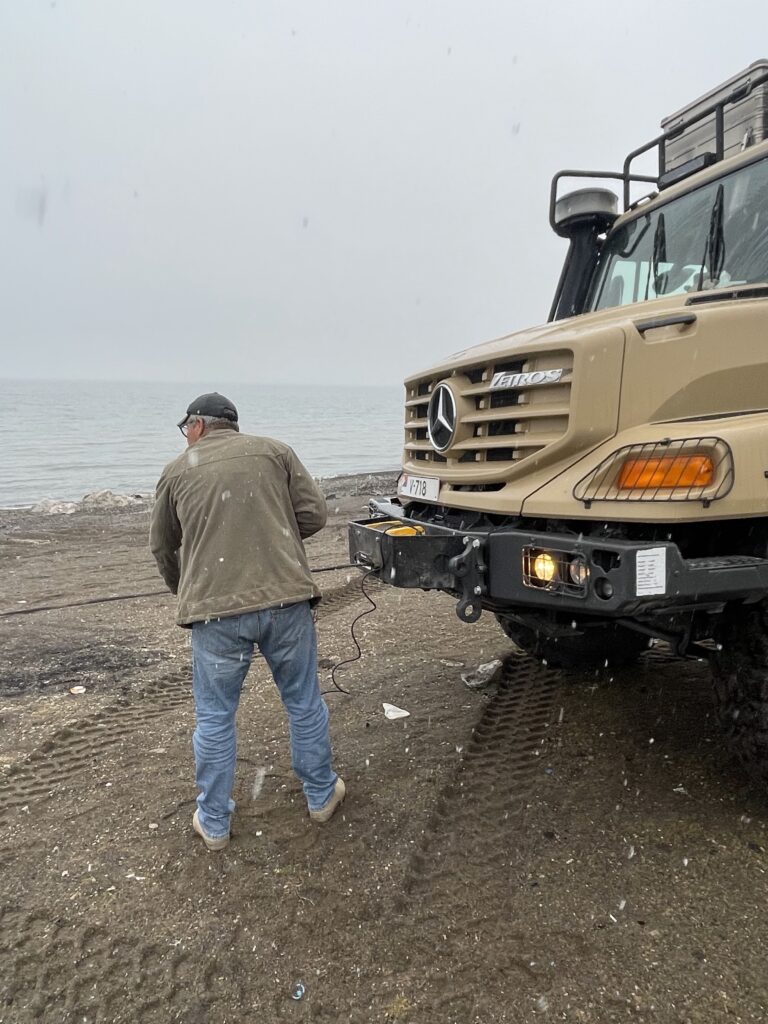
Well, I have a winch (the one on the front, which I had never used yet), so I was happy to help them. We stored all loose items in the unit first, and moved the truck in position. Got the winch uncovered and powered up and rolled the rope to the car. It was a piece of cake for the winch to get the vehicle out of the heavy beach sand. The last few meters, I pulled the the car towards the road, while driving the truck backwards. This all was done while the snowfall increased. The young couple was very grateful and I was happy to be able to help them, and at the same time to have tested the winch.

The next morning when we woke up, we were in Winter Wonderland. During the night the snowfall had continued and due to the freezing temperatures, the snow remained. It was beautiful. There was also no more wind, so the lake was like a mirror, with the mountains being mirrored on its surface. With the wind gone, the sun shining and having all the privacy in the world, it was time for my haircut. I had the most beautiful hair-salon of the world that day!

When the sun came up, the temperature started to rise and pretty fast the snow around, and on top of the truck started to disappear. Within two hours all snow was gone in the low areas. Was better for driving the roads.
Since the distance from the border crossing to the border crossing with Georgia was about 900, I wanted to make some distance that day, so I hit the pedal and we were on the move again. We drove through an poor are of Turkey but also had beautiful mosques. End of the day we camped at an abandoned quarry for the night.

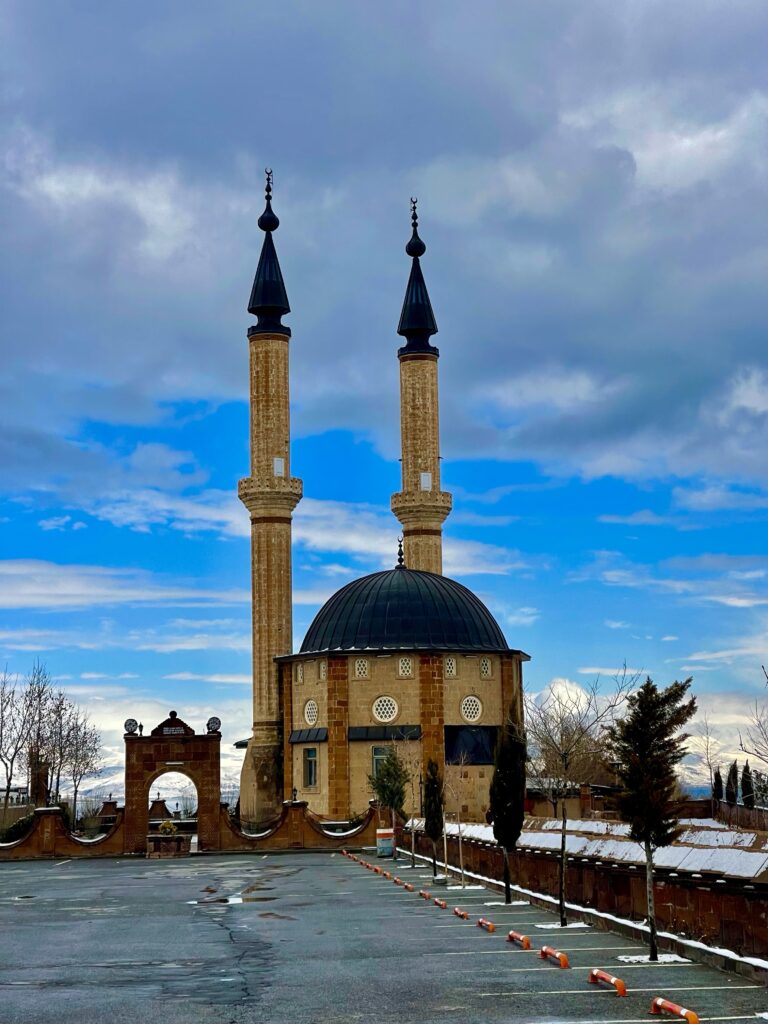
Next day we planned to cross the border into Georgia, but along the way we saw a sign, pointing towards an historical site. We quickly Googled it and were surprised to see that it was a huge UNESCO site. So for this we diverted from our plan not to visit any interesting sites in Turkey due to our plan to go to Armenia and Georgia.
We took the turn off and drove towards the border with Armenia. The UNESCO site is literally on the border with Armenia. The road stops there as well. There is a border post, but the crossing is closed. Armenia and Turkey have a violent past with each other and there is no way you can get into Armenia over land via Turkey.
The road winds through a beautiful landscape of rolling hills, with hardly any habitation. You reach a small village with old little farm houses and brick pavers roads. At the end there is a large modern complex with a big parking. It’s the entrance to the ruines of the ancient city of Ani.
The visitor complex looks deserted with many empty spaces (for shops or food places). There is a small police post and a guy with an electric horse coach like looking vehicle (for driving visitors around the site). The site is far from mayor city centers and it also was not really the time of the year to have many visitors now. But we like that. Ani is a unique place. Due to the presence of many (ruins) churches, it used to be called “the city of thousand churches”. Once a city of almost 200.000 people (in the 10th century AD) on the famous Silk Road, it was the capital of the Armenian Empire and part of the Byzantine Empire. It is also considered as the end of Christianity and start of Islamic Turkey after the conquering by the Seljuks.
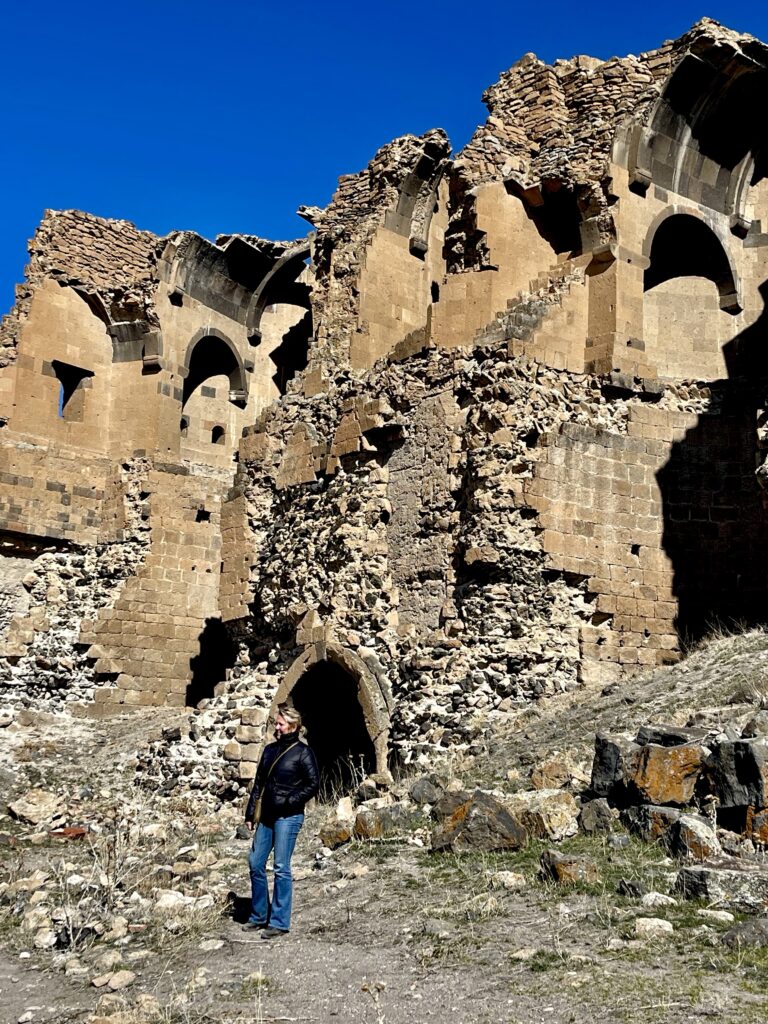
Earthquakes are still a serious threat for the remaining ruins of the old town. Some of them have been re-enforced with metal structures to avoid further damage, like the impressive Cathedral of Ani, built around 1000 years ago. The Christian Cathedral was converted into a mosque when the Seljuks conquered the city. Later is was converted back as an Armenian church. The Cathedral was damaged by an earthquake in 1319 and again in 1988.
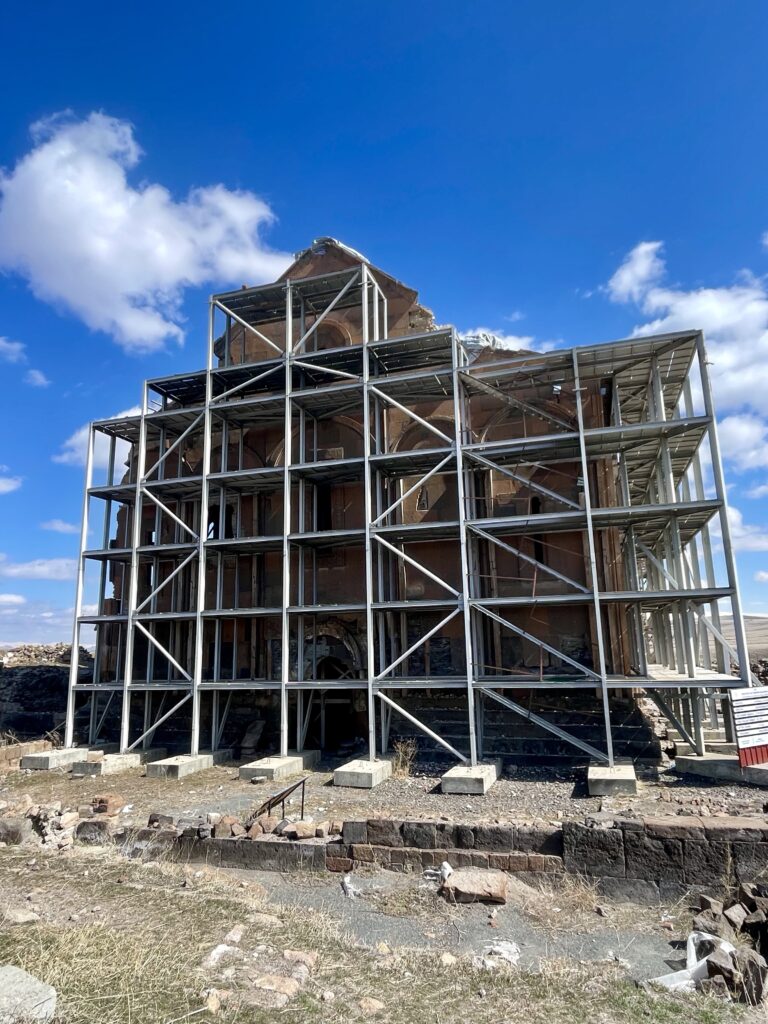
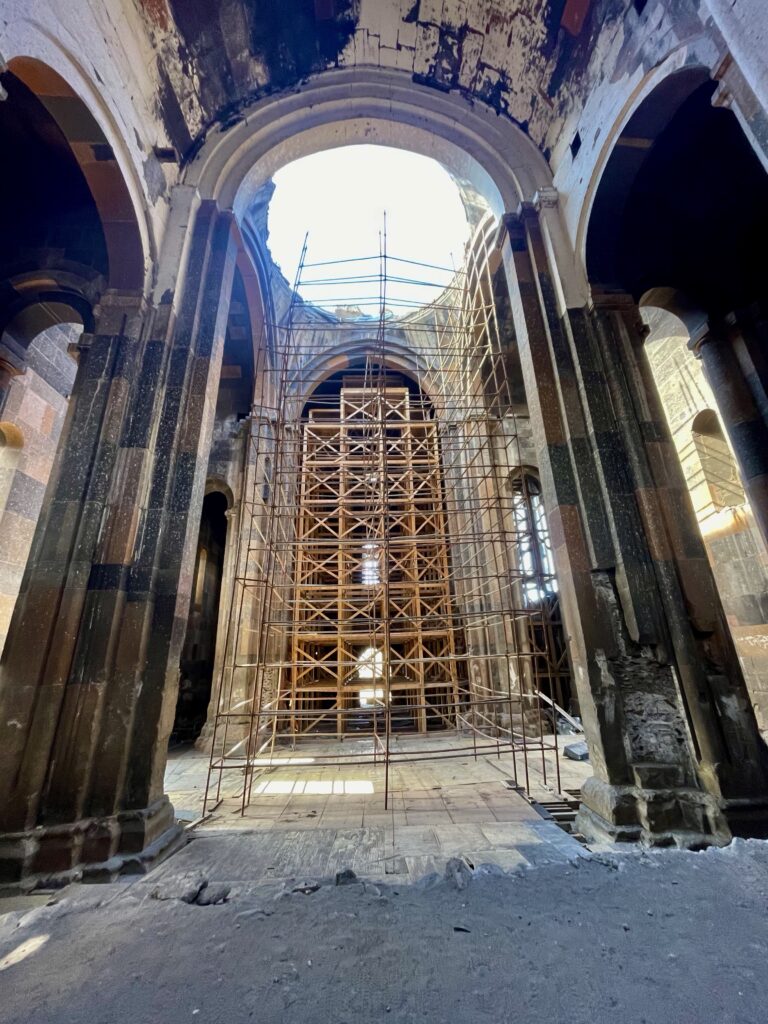

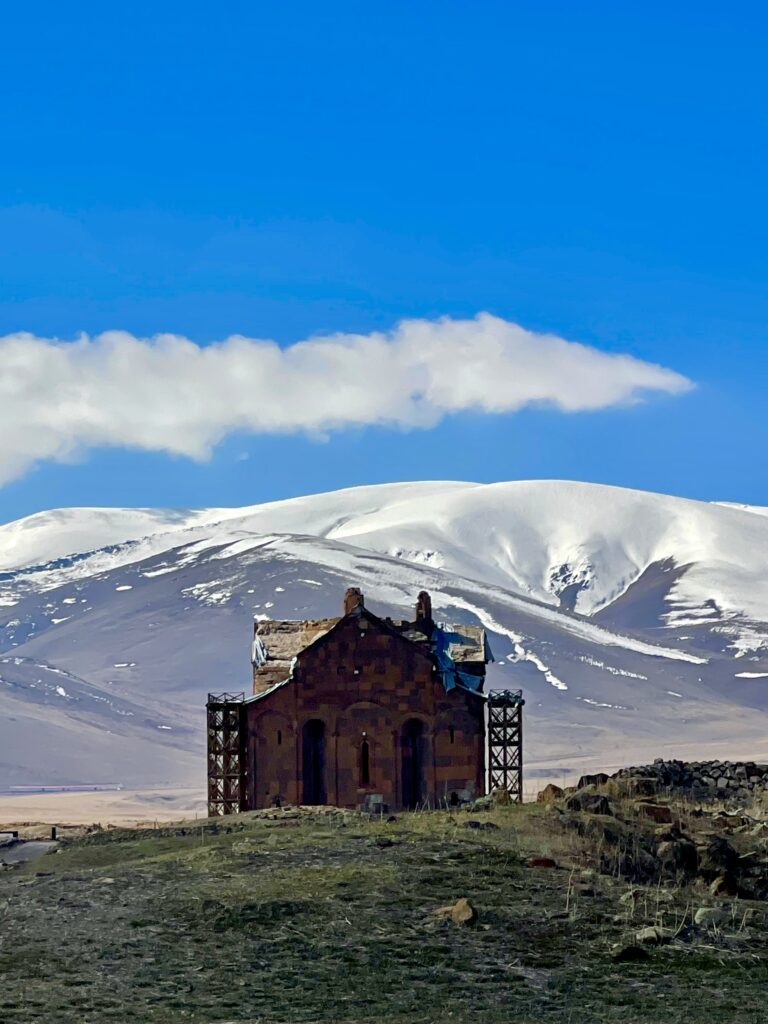
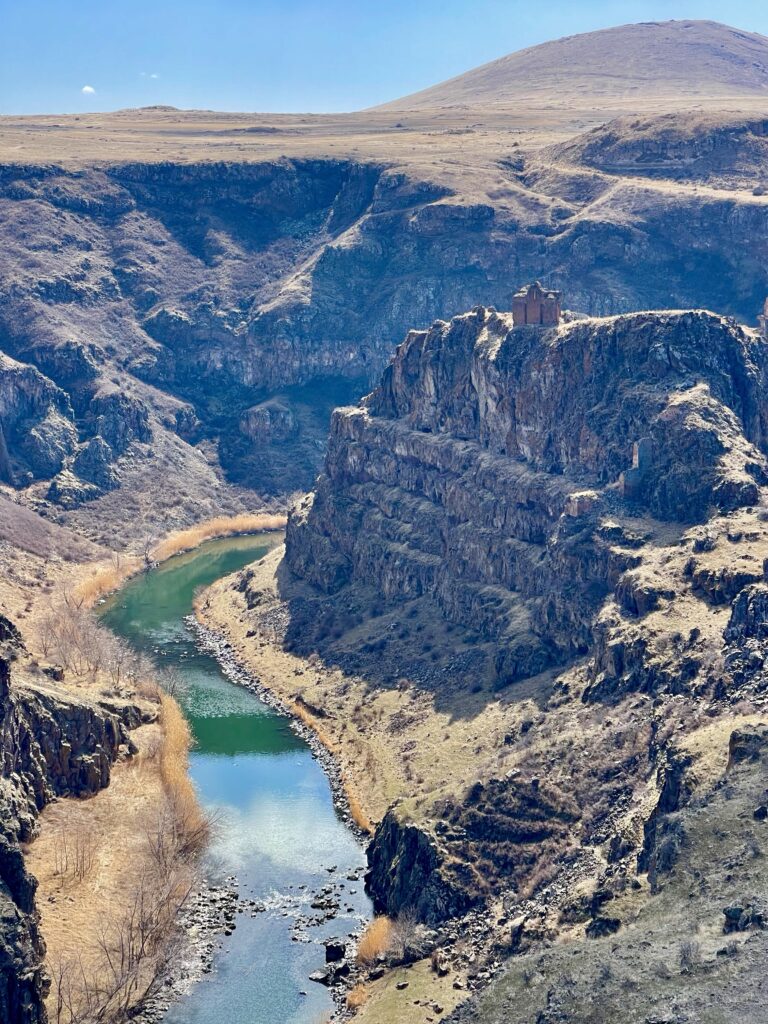

Once Ani was within Armenian territory but since 1921 its Turkish. Besides its historical importance, it is also political. Sometimes Turks hold masses in the Cathedral as if it is a mosque or do parades with people dressed as Ottoman soldiers, just to piss off the Armenians on the other side of the border. History is never finished!
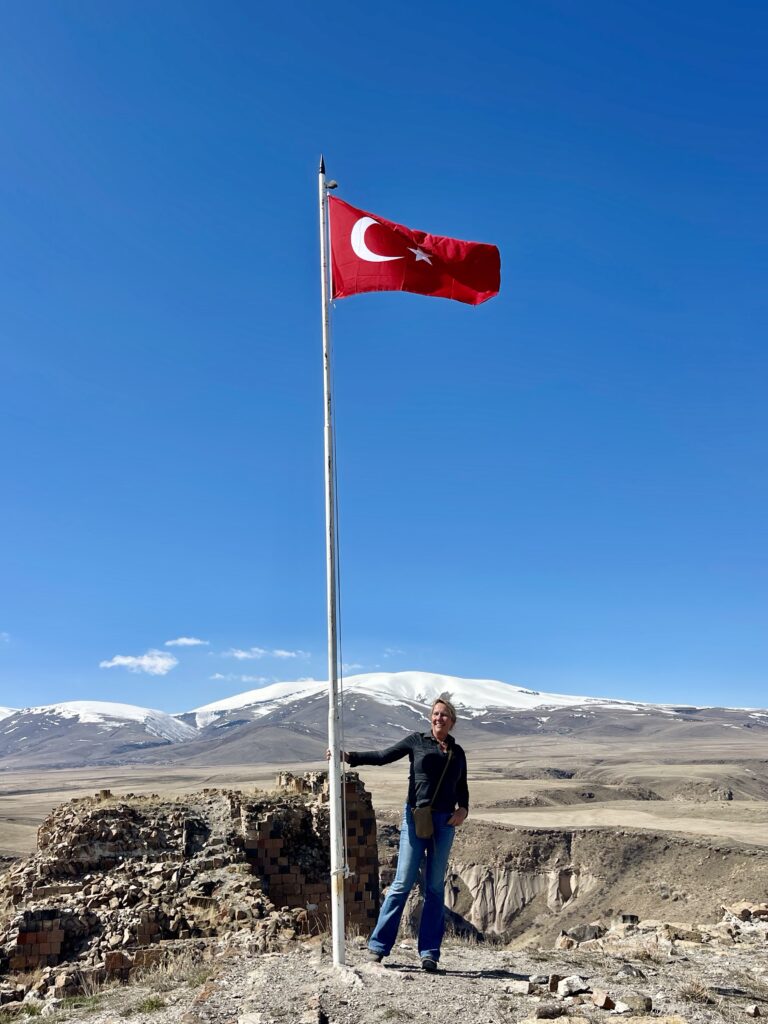
We spent quite some time at Ani (its a big complex) and time was too short to cross the border with Georgie and Armenia at the same day. So we drove to the border and found a nice spot on a frozen mountain lake, not to far from the border. Again an absolutely magical spot, right on a snow covered frozen lake, mountains with snow…….and even an horse pulled sledge, sliding over the lake. So pretty! This part of Turkey, Anatolia, is really a beautiful part of Turkey and far less known than the west part of Turkey where most of the Europeans go for sea, sun and beach.

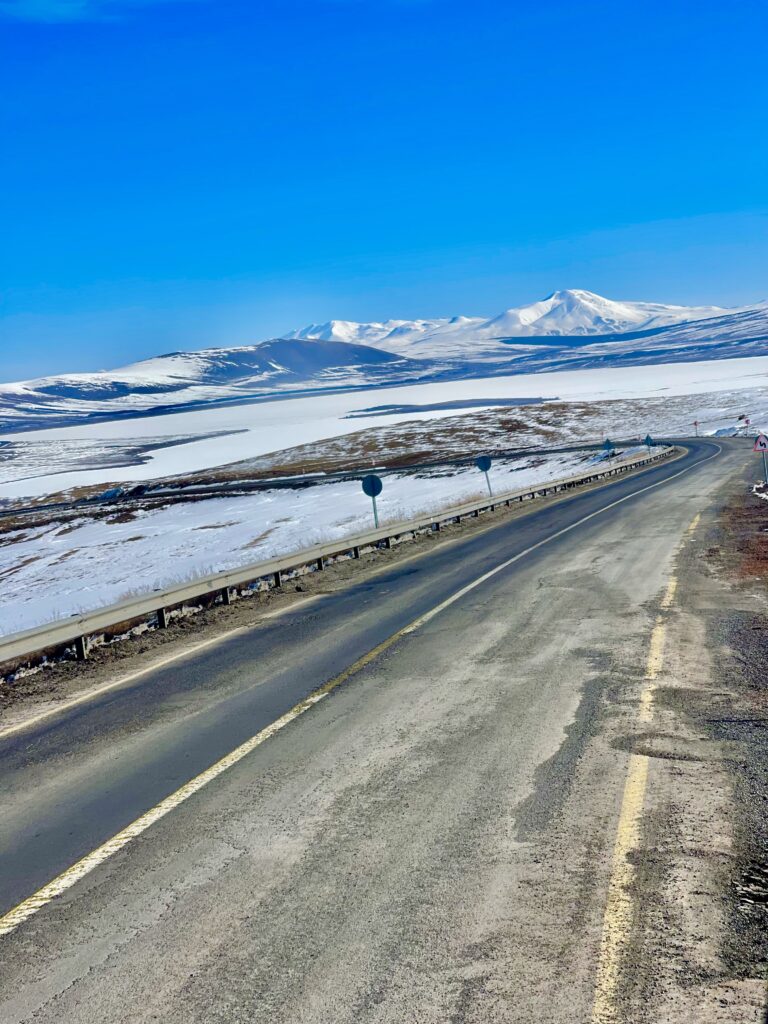
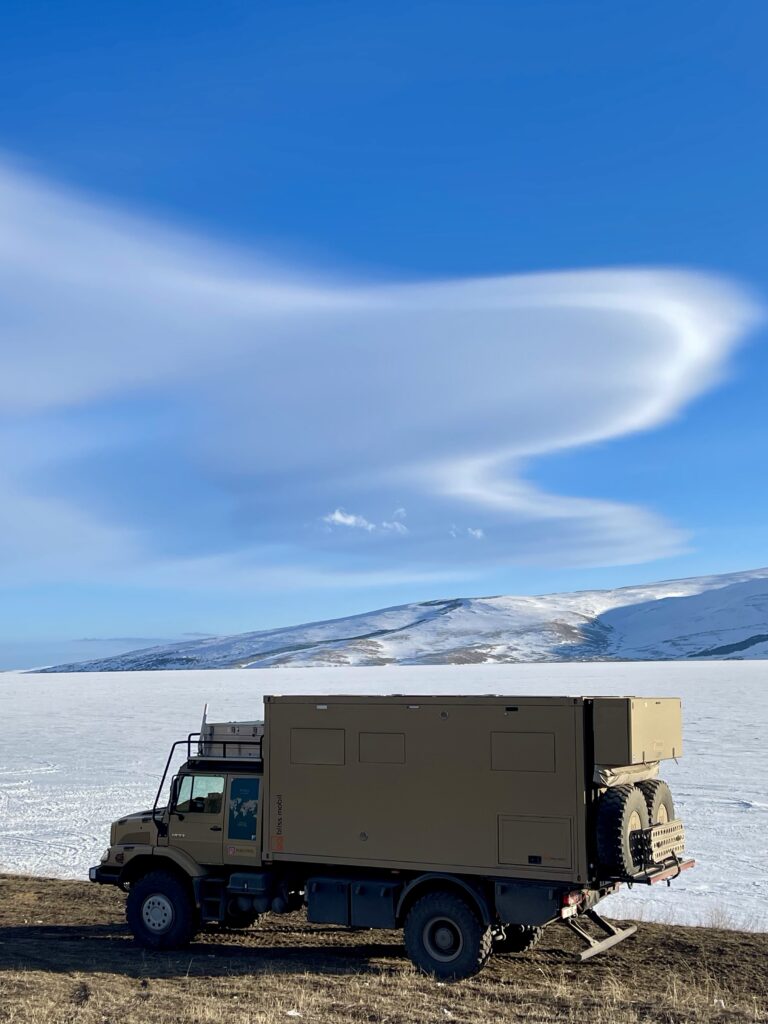
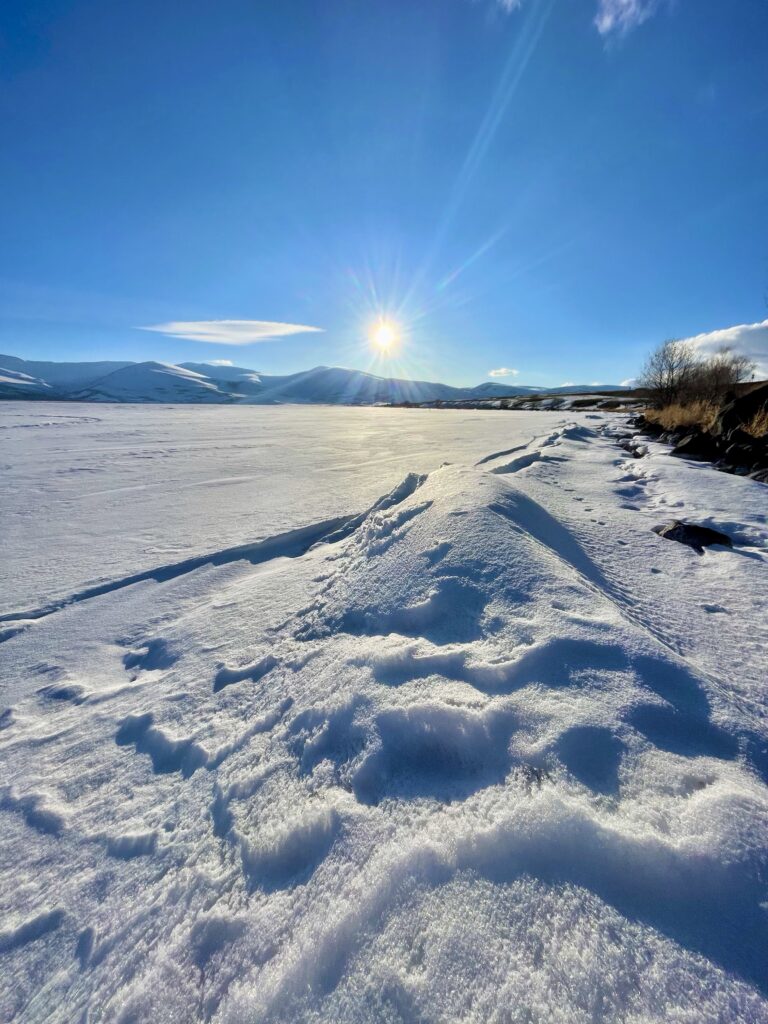

The next day we wanted to get into Armenia, but for that we had to leave Turkey, enter Georgia, leave Georgia and enter Armenia. All together 4 border posts.
At the Turkish border there were already a number of trucks, more than I expected, but we were allowed to follow the regular passenger line (there were not even passenger cars). Stamping our passports out was easy. Then we had to go through customs. They checked the computer and said that we had to pay something with “radar control”. But first they checked the truck inside and then we had to go to the cashier to make this payment.

There is a huge building on this small border post (although a 4 line high way from Turkey goes to this border post). It has a restaurant, shops, offices you name it. It took as a while before we found out that the cashier was on the side of getting into Turkey. The cashier checked in his computer, but didn’t see anything for us to pay. So he waved us through and we left the building. We drove further towards the exit point of the Turkish border. Now there were a lot of trucks waiting to get through this gate, but there was no movement. So we waited for almost an hour before we reached the final exit point. They also checked the computer and according to them there was something to pay on our number plate. We couldn’t leave Turkey. So we had to park the truck just outside the exit point and walk back to the building and the cashier, who in the meantime got a phone call from the exit booth that he had to look better in his computer.

This time, indeed we paid what he asked. Its was less then 3 Euro, and had to do with toll for tunnel passages. For 3 Euro’s!!!!!! Anyway, when we got back, we were free to leave Turkey and enter Georgian territory.
A bulky, red faced, Russian looking, Georgian police man, stopped us, asked where we were from and told us he wanted look inside the unit to make sure we were not smuggling somebody. All good, up to the next station. Marja had to get out and walked through the immigration office and was done and out in a minute (Dutch Nationals do not need a Visa to enter Turkey). For me, or actually for the truck, it was different. Like when I entered Turkey, they wanted to see a vehicle passport, which besides my road tax receipt and inspection card I don’t have. To explain the same thing as when I went into Turkey took a lot of time. Many phone calls, Googling, showing maps etc. At the end I managed again, but it took some time. At the end a very friendly English speaking officer got involved. He fell in love with truck, talked about hunting and that the truck would be great for his hunting expeditions. I had another friend! Next thing was to buy a Georgian vehicle insurance, which went pretty fast.


We were in Georgia now. The officer had some more advice for us, though. He said “welcome, you are now in Georgia. This means you have to drink our wines, we have white wine and we have red wine, then we have als Vodka, and do not forget our cognac!” And all this with his beautiful Russian accent. It made us smiling, because where in the world do you get such advice from a police officer?
Well, the sun was shinning, time for a coffee break after all the aggravation.
From this border post to the next one was about an hour and half drive, so we continued. Driving to old villages, like times have stood still. You would expect that getting out of Georgia would be easy if you just entered. No, the guys here (same Russian looking grumpy guys, with huge red alcohol noses), didn’t understand our vehicles papers and Sint Maarten’s connection with the Netherlands. From the side, I see how many times they take a look at the two documents I have and also at the insurance papers. But also here after a good hour, we were allowed to leave Georgia.
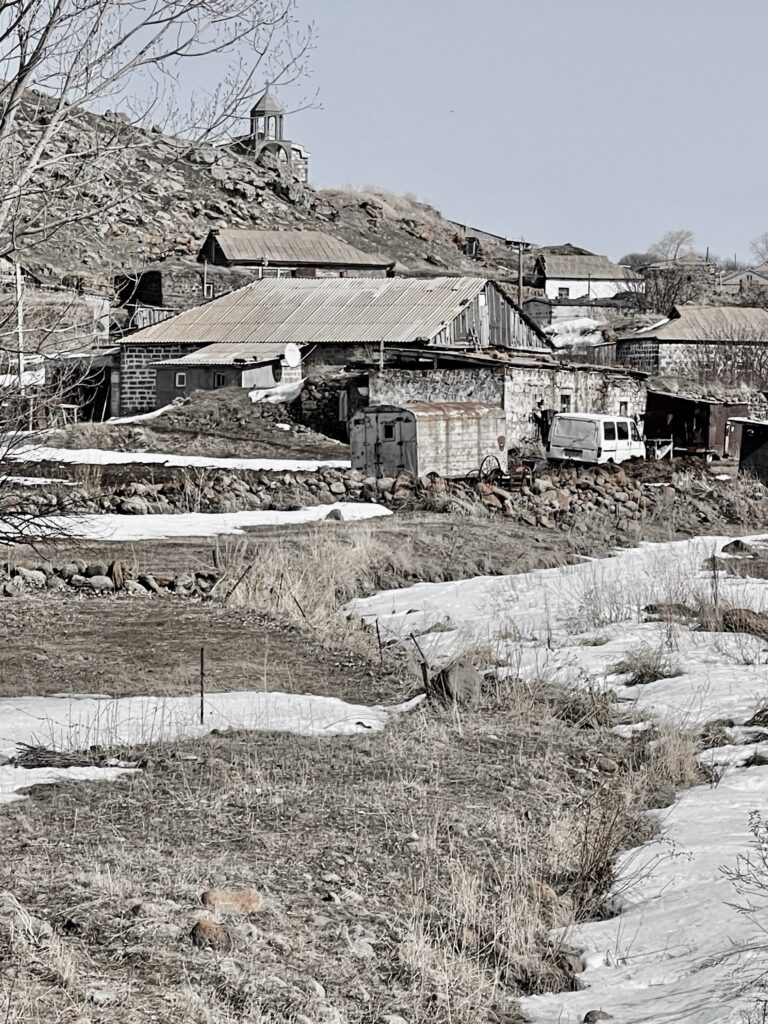

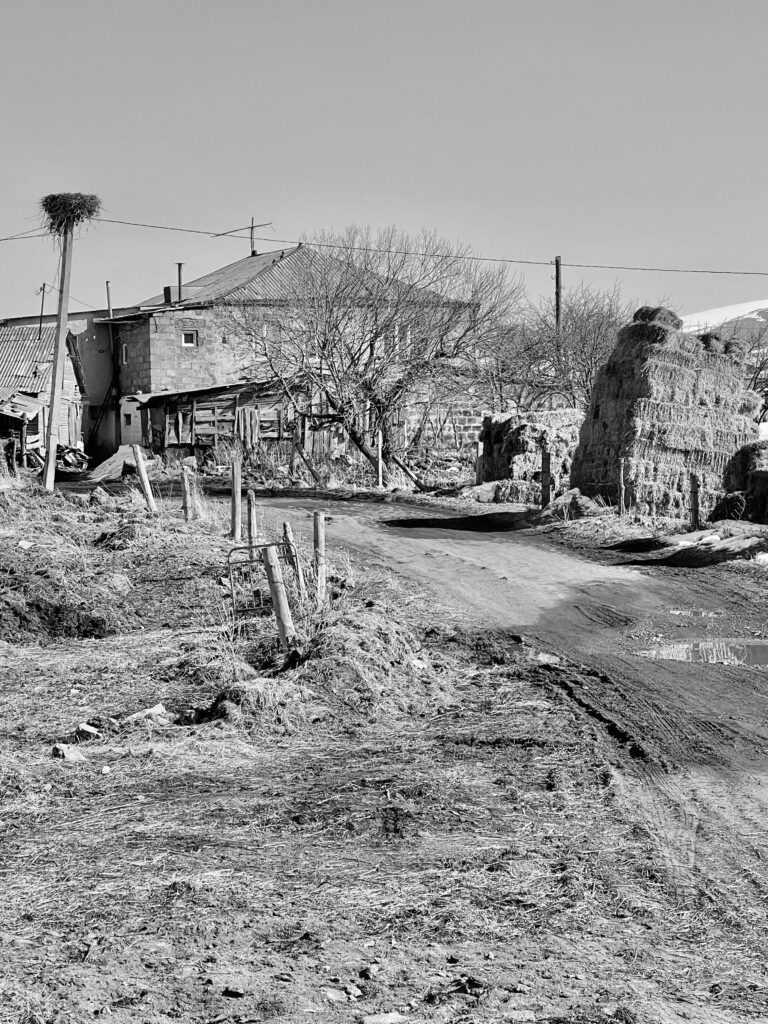


If you think Georgia is like an old former Soviet country (which it actually is), Armenia is even more. Approaching the border post is like going back in time. Where the Georgian side has modern well equipped facilities, Armenia has not. The officers walk around in old Russian style uniforms and there are many old Russian cars driving around.
Also here the car papers were a problem. They were most interested in the inspection card, which looked the most official one. They kept looking at it from all angles, then a higher officer was called in, he also looked at it and noticed that mid april it would expire and asked how fast I will get back to Sint Maarten to renew it. But also he couldn’t make a decision. Then the biggest boss of the station showed up (judging on all his decorations) and after me explaining again all about Sint Maarten and the way we register cars, he finally said it was okay. However, somehow their computer system most probably couldn’t register the vehicle as is from Sint Maarten, so also that took a while.

Now we still had to do the truck search, which was a bit more extensive than at the Georgian border, but at the end all good as well. Now we thought we were done. No, now we had to fill out a customs declaration form for the truck. For that we had to fill out a form at the only customs officer’s desk (an even more grumpy guy). He took the form after I filled it out and said I had to pay. So there was a little bank corner (which I thought was just to exchange money), where I showed our car papers (the guy was first hesitant, but he didn’t really care actually). So I paid for I don’t know what and went back to the customs guy. After a while he gave me the registered import declaration form, which I have to give back when I leave the country. It states the truck can stay in the country for 12 months.


Then finally we had to go for the Armenian vehicle insurance. A small office, where the furniture (a coach and desk with chair) took almost all the space and where there was space for only one customer. Marja went there first when I was busy with the custom guy, and despite the fact there were several truck drivers waiting outside, the big fat insurance guy squeezed behind his desk, calling her to get inside first (you don’t leave women outside in the cold in Armenia). Unfortunately since I had to show him my passport myself he couldn’t help her right away. With many excuses for that, he offered her tea or coffee and let her wait in the comfort of his small office…..
So when I was ready with the customs guy, I could fix the insurance. Since here we were not able to pay with card, we had to pay in local currency. However, the guy was happy to receive US-dollars instead. And since he didn’t want singles, he even gave a discount! All good again.
All together, it took us 7 hours to cross the 4 border posts, but we were now in Armenia. It was getting dark, time to look for a campspot.
