
Leaving Mosul meant we had to pass checkpoints again. We left the city via another highway, which was a lot busier. This time the militia checkpoint was less complicated. I had to park the truck and the militia men instructed me to go to the office on the other side (the entrance towards the city direction). There were a lot of militia men and I saw they really let people completely unpack their cars, boxes and suitcases. I was told that they were also looking for “illegal” medicine.


A man wearing a plain outfit came to me, asked for my passports and walked into an office. A few minutes later he came back with the passports and a small piece of paper with Arabic text and his signature. We were good to go. I gave the paper to the militia men and they waved goodbye.
At the next two check points we were good as well, this included the Kurdistan one (even now we came from Mosul). While driving north east, we encountered a large convey of military vehicles of the US Army. The US is still present in Iraq (including Kurdistan), officially to fight the remnants of ISIS, but also to protect their own interests in the region. They also try to keep Iran (who is present with the Shia militia) at bay.


We aimed at going to Lalesh, a small village of the Yazedi people, who also have their most sacred temple in the village. Once you get closer to the village, you notice several small temples in the country side, with odd looking sharp pointed domes. Not too far from the village we saw a small hill with one of these temples. We decided to have a coffee break there.
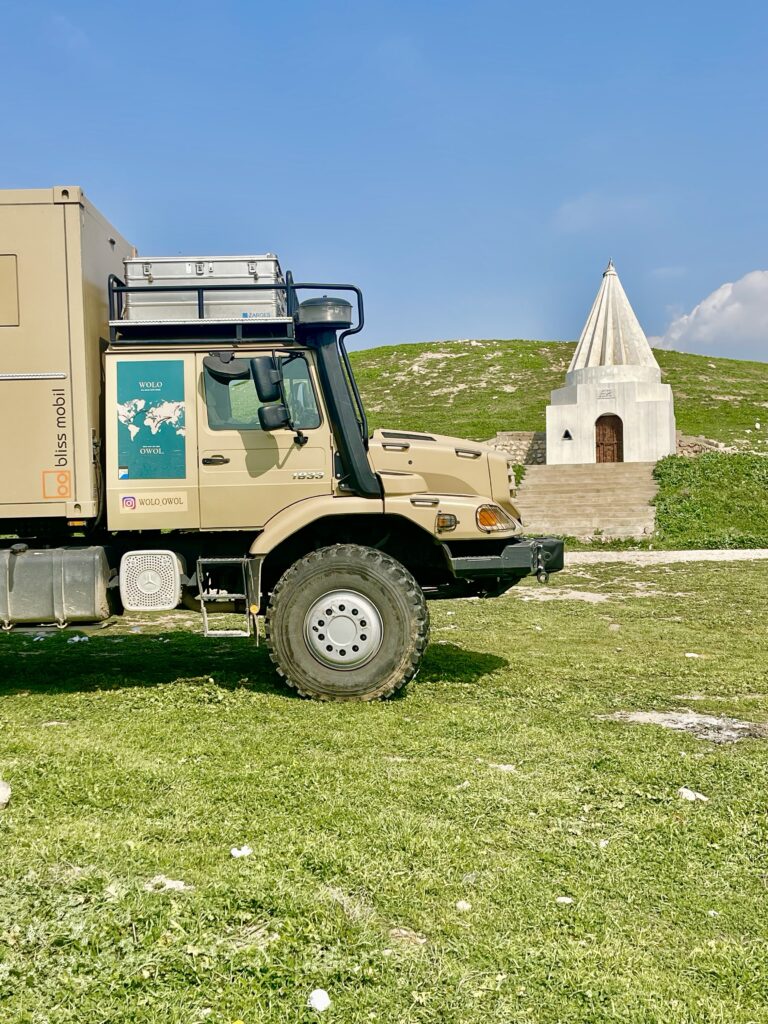
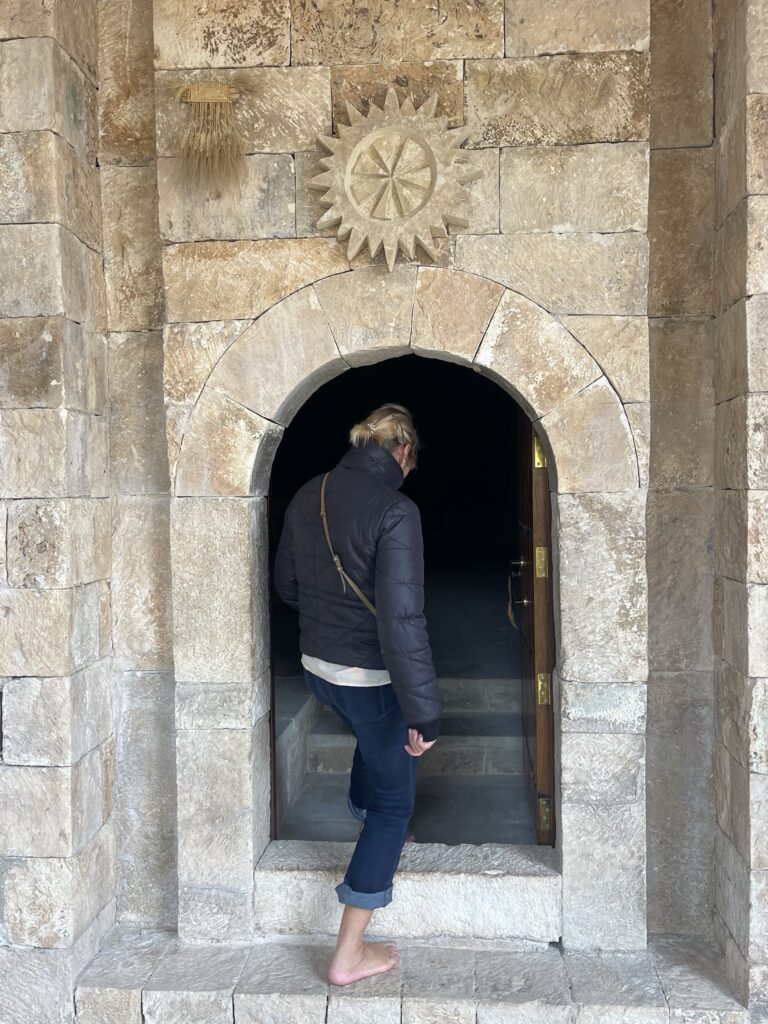
After the coffee break somebody knocked on the door. It was a young man, who introduced himself as a Yazedi. The Yazedi’s are a minority group who have their base in Iraq, but you will find them also in Syria. The diaspora of 400.000 are spread all over the world. The Yazedi believe in a creator, but not in Jezus, Prophetess or any other messenger. They have a strong connection with nature, but also they have some interesting rituals. In their temples you will find colored cloths hanging on walls or columns, with knots in it. These knots represent a wish from the one who made the knot. If somebody unties the knot, there is a bigger change that the wish comes true. They also don’t allow you to stand on the door step or to walk into the temples or holy parts of the village with footwear. They also don’t eat lettuce. This was all explained to us by the Yazedi man. He explained that the sharp dome represents the sun rays and the bottom of the dome represents the layers of the earth.
He also told us about the recent atrocities committed by Isis against his people. Isis wanted to eliminate all those who are non-believers. Thousands of Yazedi’s were killed and thousands of Yazedi women and girls were sold by Isis as sex-slaves. Even today the Yazedi’s are a marginalized group in Iraq, lacking opportunities on the labor market (especially in Government positions).
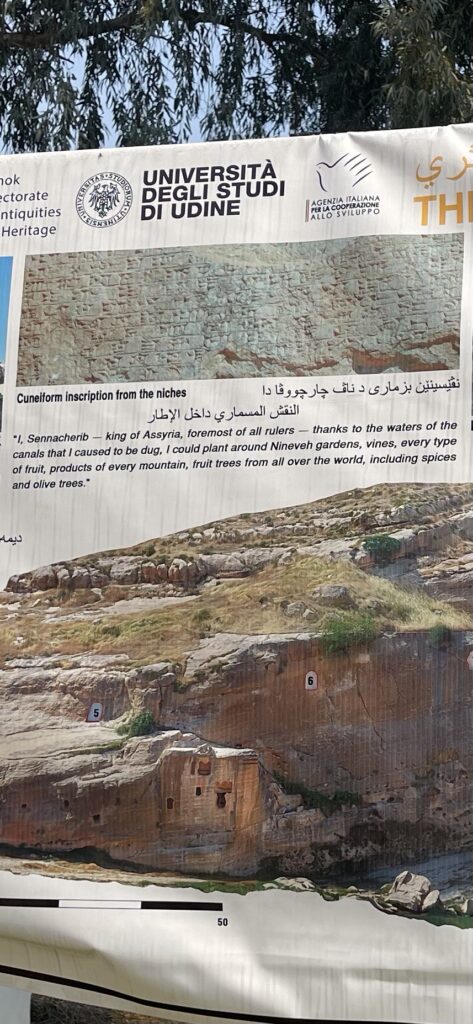
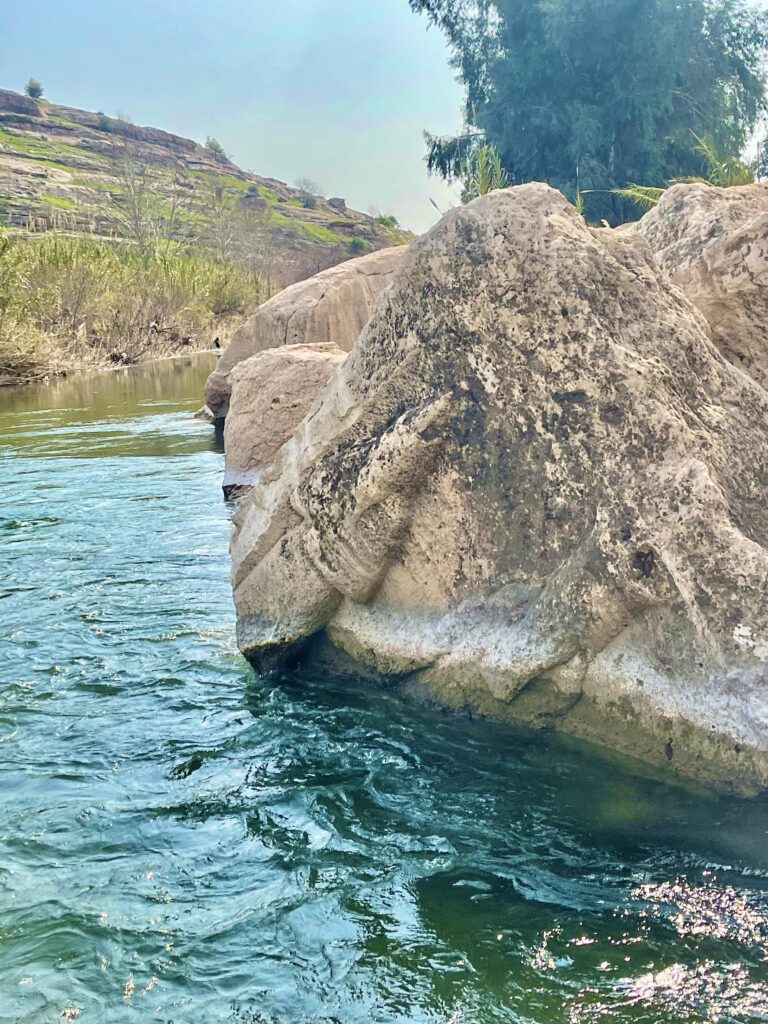
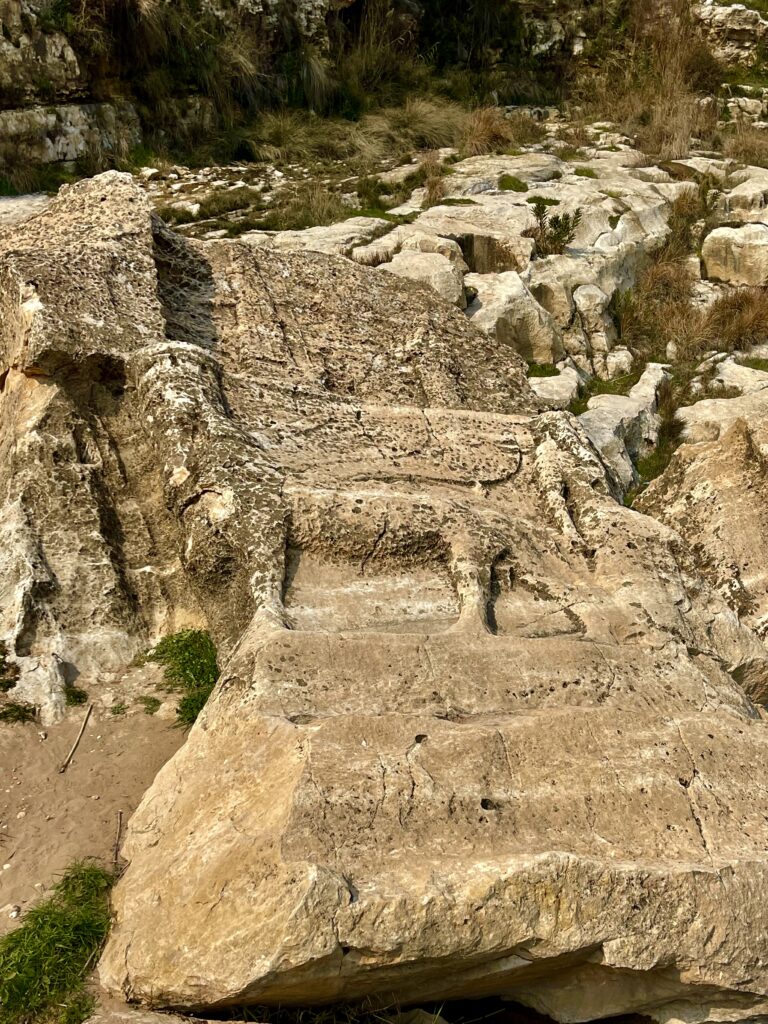
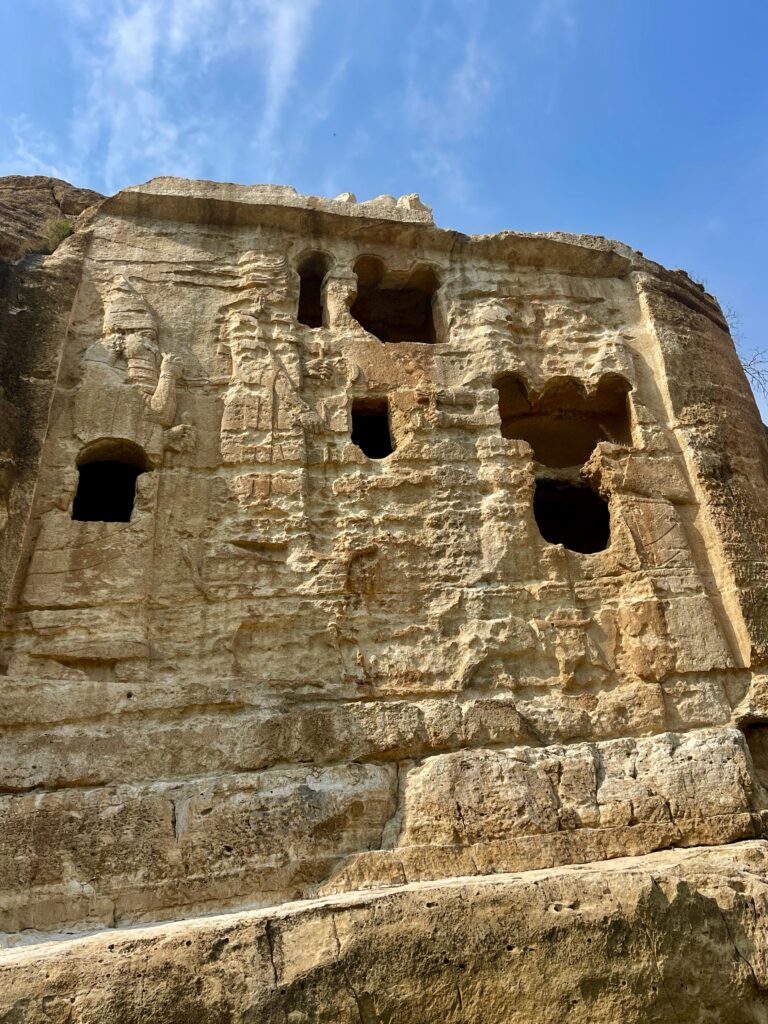
We thanked him for sharing all this with us, and said goodbye. We now continued towards Lalesh. Before reaching Lalesh, we passed a sign “Archeological site of Khinis”. Ofcourse, we turned into this side road and drove towards the site. We passed some military sites and then, deep in a valley at the end, the road stopped at big gate. A few men were sitting outside drinking tea. We were welcomed by the manager of the site and were invited to first drink tea with him. The police man guarding the site, sold us the two entrance tickets and after the tea was finished, the manager showed us around. The site is unique in the sense that it comprehends a – for its time – unique man made water channel (carved out of the rocks), built by an Assyrian King (Sennacherib), which brought water from the mountain river, over a distance of 80 km to the Nineveh plains. At the entrance of the channel, where the water is diverted from the Gomel river, two huge Lamassu were placed at the entrance (now partly covered by water, and eroding). Along the cliffs you find reliefs very specific in size and description for the Assyrian Empire. It’s a propagandistic showcase of the unique engineering skills of the King, who was able to manipulate the flows of water for the purpose of irrigation and water for the cities of Nineveh and Nimrud. A really amazing historical site, which shows again that the importance of water is recognized throughout centuries. The manager was a very enthusiastic person. He really could explain a lot and since the reliefs were so battered by the elements, a layman would not have recognized and see them. We found out, actually, that taking pictures will show them more clearly.


A brand new road with landscaping and fancy light posts leads to the village. Due to the security risks for the Yazedi people, the Kurdish Regional Government has committed itself to protect them. Therefore the Peshmerga are at the checkpoint at the entrance of the new road.
The village is perched in a valley higher up in the mountains. Just before we entered the village, there were more Peshmerga and they told us where to park after that, also that we had to take off our shoes. Indeed, we saw (almost) everybody walking bare-foot (except for some construction workers). The streets felt frozen, so we kept on walking! Left and right you see temples and praying buildings. There were not that many homes.


The main temple is like a big cave. It’s made of rocks and constructed in a rough way. There are no windows (except for the door entrance) and there are no lights or candles. You can’t find any kind of decoration or ornaments. No figures of people, there is nothing except for a big number of cloths with the knots. It feels very medieval being in a place like this. The Yazedis don’t allow their members marriage with others than Yazedis, otherwise you will be expelled from the group.

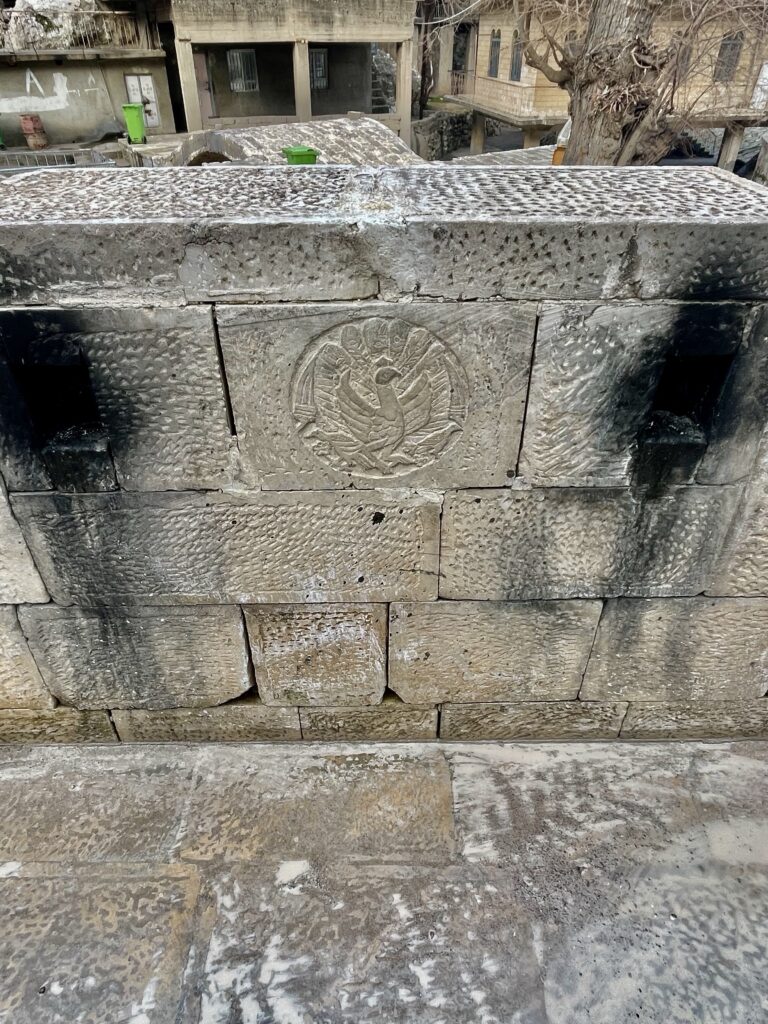
The Yazedis believe in one God and he created Seven Divine beings (7 angels). One is the leader of the 7 angels (Lord of this World, who is responsible for both good and bad. He is depicted outside the Yazedi buildings and temples as a Peacock. Often other religions (like Islam) considered the Peacock Angel as the evil spirited Devil. Hence, the Yazedis were often accused as devil worshippers and therefore were victims of violent religious persecution.
A lot of new buildings, temples and praying areas have been constructed or are under construction in Lalesh. Due to centuries of persecution, there is a substantial number of Yazedis living abroad and they contribute to the restoration and renovation of Lalesh, their main religious center.

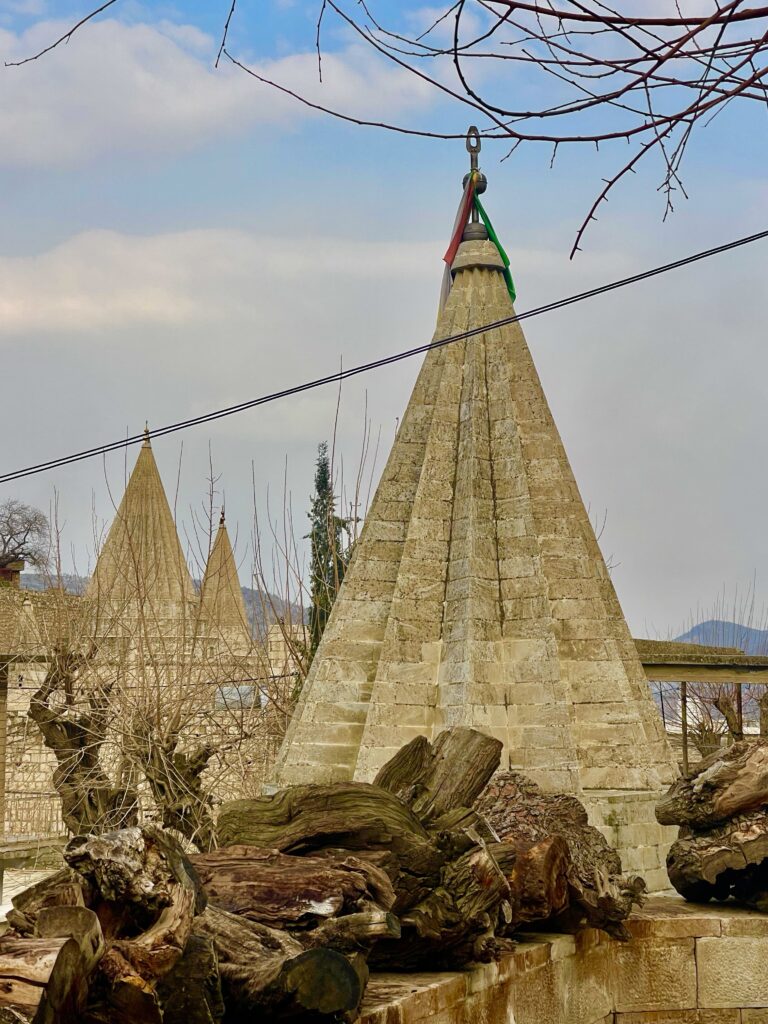
Lalesh made a big impression on us, not just the temples, but also the mysteries which surround the Yazedi people and their beliefs. Knowing that at any time a peaceful time can turn violent again, ending their lives, they hold on to it strongly. It’s that determination, with the risk of being killed because of it, that intrigues me.
Not far from Lalesh we made camp for the night, overlooking the mountains of Yazedi country.
The area of the Yazedis is a beautiful mountain area. One of the more remote areas we wanted to visit was the Bilkeef Valley. A forest valley with waterfalls. A small road leads us through the mountains. What we noticed before, were the many chimneys in the valleys and on the mountains with big flames. This is the burning of gas, what is a side product of the oil they pump up here. It’s pretty sad, because most of the smoke it generates, hangs around the valley and smells bad. It’s an environmental disaster for this area and causes health problems for the inhabitants of the mountains.

We then reached a Peshmerga check point which was near a road crossing. Many oil tanker trucks were driving up and down near the checkpoint. The road we wanted to take was blocked. I asked the officers whether we could continue our way towards the Bilkeef valley, however after many phone calls and the arrival of a higher officer, we were not allowed to continue. It is now a military zone (maybe it has the do with the sensitivity of the oil installations).

There was only one road left, so we had to take that one, which was actually also a beautiful route to drive, only we had to share the road with the oil tanker trucks. These trucks drive fast through small, peaceful villages and I can imagine the dislike the village people have against the oil production in their area.
Suddenly we saw a road sign, indicating a building with a cross on top. It was the indication that we were entering a Christian village! Very weird to indicate the religion of a village on a traffic sign! Maybe to make it easier for future terrorists to kill the people of such a village. For me it didn’t make any sense. We noticed indeed a church with a cross on the roof and some houses also had crosses. It’s just strange after driving through moslim countries for so long and see mosque after mosque, to see a Christian church. It was almost like a tourist attraction, showing a “rare species” of human beings.

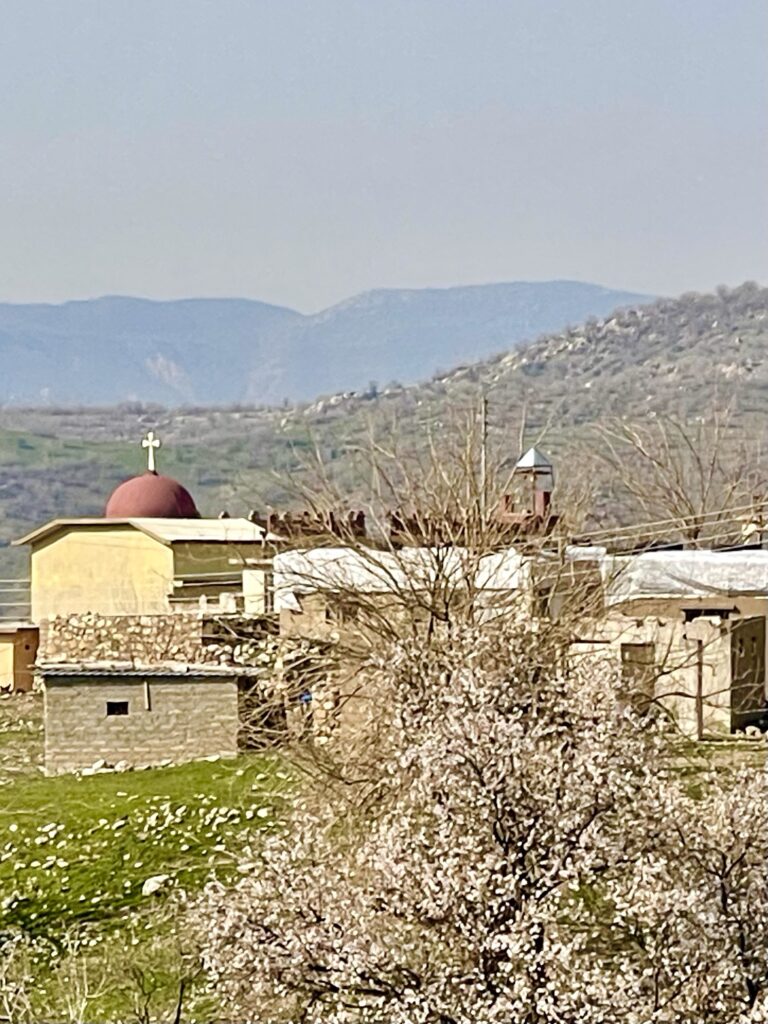
The sight of the Christian village, was an indication that we now entered another area in Kurdistan, with lots of natural beauty as well. Soon after we encountered yet another Christian village. We saw we were getting closer to the small town of Alqosh. A town which is 100% inhabited by Christian Assyrian people. It’s unique in Iraq, since there are no other cities like that. The Assyrians are a minority group, like the Yazedis, and the Turkmen (among others). Like the Yazedis, they also have been fiercely persecuted throughout the ages. Assyrians are an ancient “tribe” or population group, going back to Babylonian times and Assyrian Empires. With the islamisation of the Middle East, Christians lost ground and were either killed or forced to become Muslim. A number of strong Christian believers held ground and moved into the mountain areas of Kurdistan, where they were able to defend themselves. Like other minority groups in Iraq, the Assyrians strive to have an autonomous region, but changes are slim due to their numbers.

Alqosh is one of those places which remained Christian throughout the ages. Like Lalesh of the Yazedis, the Kurdish Regional Government took the responsibility to protect the Assyrians. Also here we had to stop at a checkpoint and even had to give our passports as collateral, to be sure that we would leave Alqosh again before sunset. A brand new road with beautiful streets lights, leads to the city. The city is not enormous, but still much bigger then Lalesh. We parked at center of the old town and walked around. There is a big church and everywhere you see crosses. A lot of abandoned and destroyed old houses are at the heart of the old town, but around the old town a lot of big, nice looking houses have been built or are under construction. You could see that the Asyrians are a different type of Iraqis. The town is very clean, compared with the muslim cities and also much better maintained. It almost felt a bit European (especially at the community center, where there was still a Christmas tree and a Christmas stall).
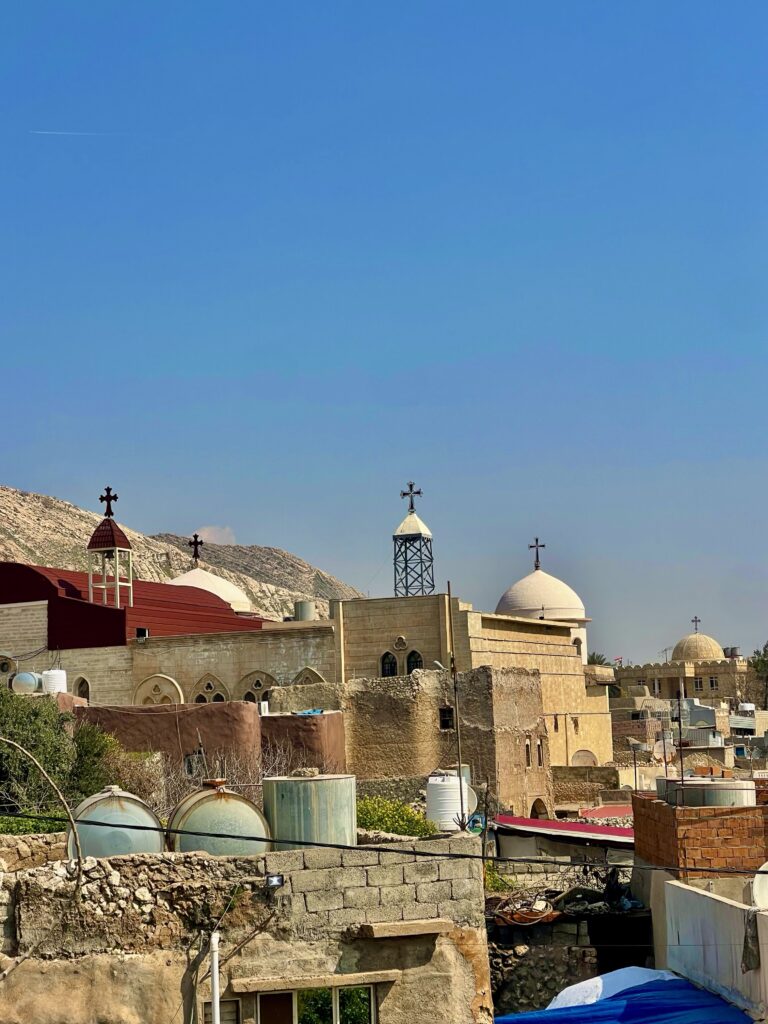

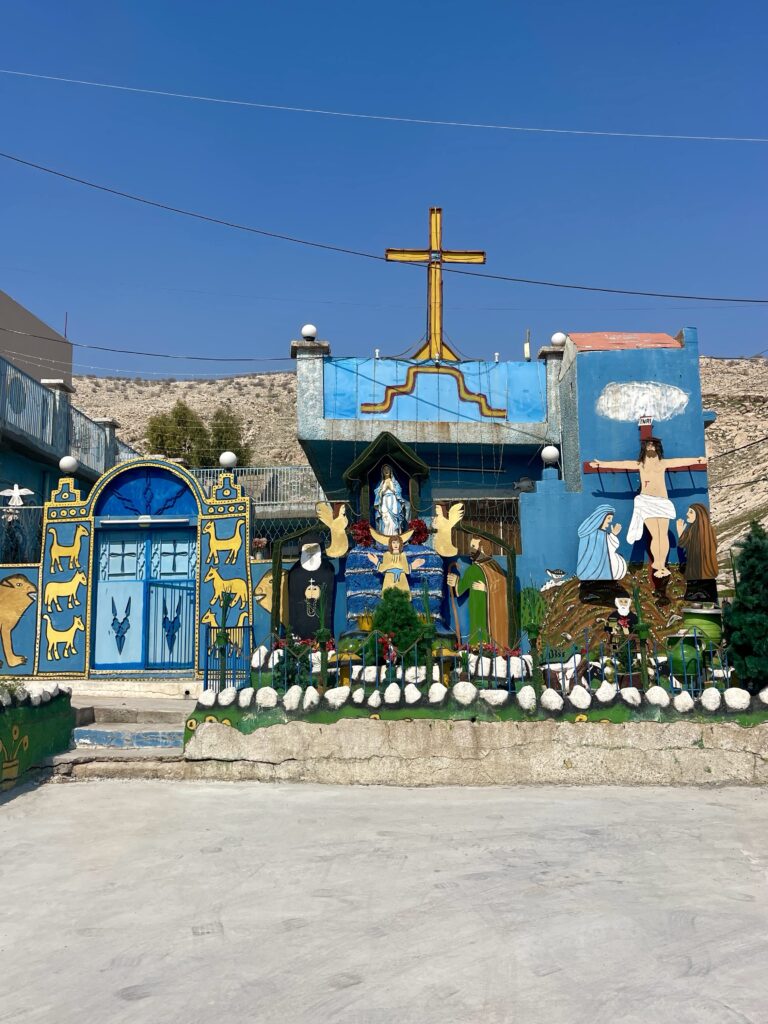
On top of the mountain where Alqosh is located, stands a huge cross, which you can see from far. Below it shows a replica of the old town (Middle Ages), which is to show tourists how Alqosh was in its early years. From here you can also see the Assyrian graveyard at the center of town on a small hill.


Nearby the town is the famous Sant Hormizo Monastry located, which originally was carved out in the mountain. The monastery is surrounded by hewn out caves, which were used by the monks who built the monastery as their living quarters. There were no windows or doors to protect the monks from cold and rain. They only drunk rain water and ate lentils, boiled wheat and heavy bread cakes. The monks lived a Spartanian life. The monastery is named after Rabban Hormizd who founded the monastery in the 7th century and who is buried in a tomb in the old rock carved part of the monastery. The monastery was attacked and destroyed by the Kurds and Turks many times, but it was always re-built. However, due to all the attacks and other issues it was decided to build a new monastery in the plains near the new city part of Alqosh. The old monastery remains partly operational and is a tourist site as well.


To get there was another story. There is a very steep road leading up to a small parking lot just under the monastery with very tide hairpin bends. The last three bends were so tight, that I could not make them in one time. I had to go back and forth between the wall of the next part of the road up and the little barrier, preventing cars from falling down. I even damaged a part of the inner wall in one of the bends. In the meantime I had a line of cars behind me and in front of me, waiting patiently for me making the bend every time. I stopped at the last bend, where there was space to park the truck. The remaining part we walked. Going down was a bit easier, but still three of the bends I couldn’t make in one time on the way down either. Once again I realized the importance of my wonderful co-pilot.

We headed to Duhok, the last big town we wanted to visit in Iraq, in order to stock up for provisioning. On the outskirts of the town was a big new shopping mall with a large outdoor entertainment area. Quite unique for Iraq (except for what we saw in Baghdad). We were allowed to park at the back where buses park (there are organized shopping tours to this mall). There was a Carrefour supermarket in the mall, however, it turned out to be one of the worst Carrefour supermarket we ever visited. Badly stocked, low quality fruit and vegetables and still very expensive. We got what we needed and got the truck organized. Staying for the night on the parking was not allowed, so we had to find a place elsewhere, while it was already dark. First try was a dirt road nearby the shopping mall, but the moment we drove in, we noticed that it lead to a concrete plant and cement trucks where driving up and down (even at night) that road, so not so quiet and private, but very dusty. No good for a camp.
The security guard at the shopping mall had mentioned a big bus terminal not far from the mall, so we headed that way. The terminal had a huge parking, almost empty, but with a boom and a security guard. We were able to explain him what we wanted and he was a nice guy. A student civil engineering, doing a side job to make some extra money. Had a very pleasant conversation with him and he pointed out the most quiet place on the parking.
Next morning we drove all the way to the north of Kurdistan, near the Turkish border, to a popular holiday area for the Iraqis. A nice ride through the mountains brought us to the city of Amedi. Amedi is located on a mountain plateau, surrounded by ravines and mountains. It’s completely built up and not really suitable to drive around with a big truck, so we drove up the only entrance road and just before the entrance to the city, parked the truck along the side of the road.


Despite the fact that the city is well known and attracts a lot of visitors, there is hardly any tourist infrastructure (eg hotels, restaurants or souvenir shops). It’s mostly residential. The city goes back to ancient times, but the only physical proof left is one of the old city gates, the so called “Mosul Gate” and 2 tomb chambers. At a small coffee/tea and shisha lounge at the beginning of town, we made a stop for a coffee and had a chat with a guy from the city, who is actually working as a body guard for the Iraqi president. He had some interesting tips for us for what to see in the area.


Just below the city is an area called Sulav. It’s actually a village, but completely turned into a tourist facility, with many restaurants, shops and hotels. So what we missed in Amedi, we found a little more down the road. Since it’s still winter, it was quiet and most of the places were closed. We strolled around and I was amazed (again) by the quality of construction and city planning. Actually there is no real city planning or approval of construction plans. You just build, see if it fits the piece of land, don’t really care about your neighbors and a design, well not that important.

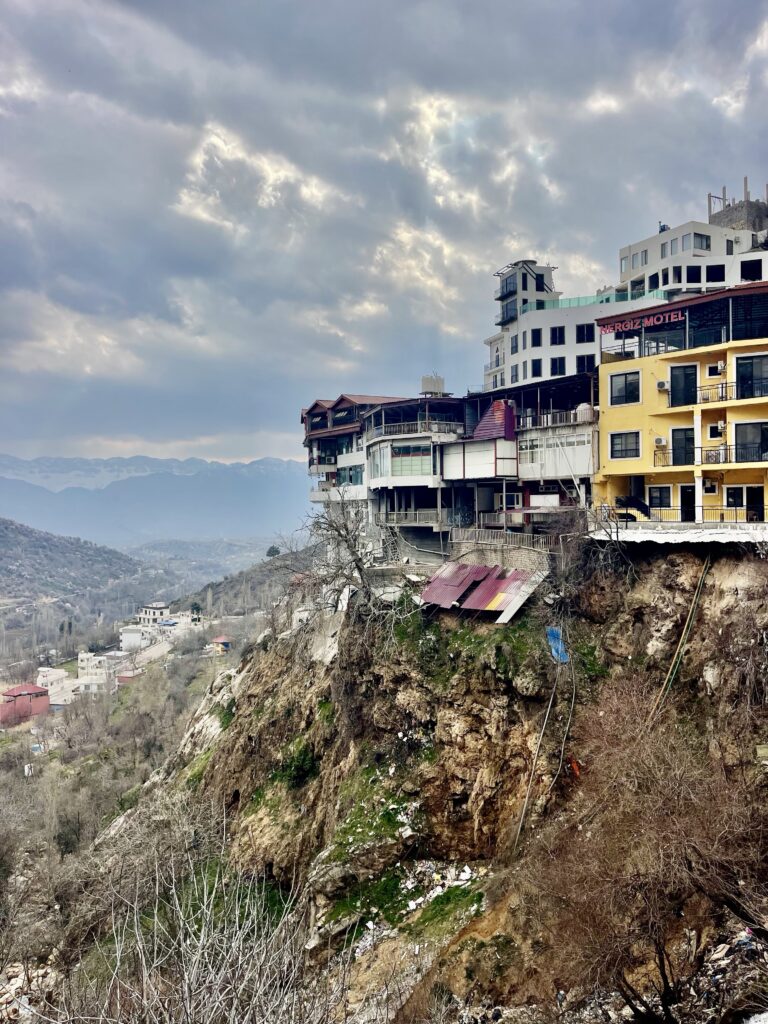

During summer its one of the hangouts of the Iraqis from the south. It’s cool in the mountains, there are restaurants and nearby there are small rivers and waterfalls.
Not far from Sulav there was supposed to be another one of Saddam Hussain’s palaces. It was not on any of our maps, but we read about it somewhere and the guy in the coffee lounge told us about it. We found a long high concrete wall with nice paint work on it (showing soldiers in action, flags and in big letters the word Peshmerga).

There was an opening which brought us to a driveway, which winded through a large area, which used to be a large garden or lawn. On a hill we saw a damaged structure, surrounded by a damaged wall. It had the Kurdistan flag on top and some antennas. We followed the driveway up the hill. The walls along the driveway, used to have nice carved decorated natural stones, but most of them have been removed (looted). When we reached the parking area on the top, there was a barrier guarded by a soldier. I thought that the palace (actually, there was not that much left of it, it was really badly looted and partly destroyed), was either not accessible or just guarded and after reporting, could be visited.
The soldier was surprised to see us and was confused as well. We tried to explain him that we were looking for Saddam’s summer palace. He then pointed to a very high mountain peak a few kilometers away (all the way in the snow), where on the top was a structure. That was the palace, he said! I could hardly believe it and wondered if it was even possible to get there by truck. I said thank you, and drove back on the driveway.
When I reached the end, I stopped and took my binoculars to look at the mountain top. I indeed saw a building, but with a lot of antennas. For me it looked more look a weather station. We decided not to go there, and instead look for a spot to camp. The moment I wanted to drive away, a military jeep full of army men stopped next to the truck. The officer asked me to follow him back on the driveway to the “palace”.
When we arrived and stepped out of the truck, a whole group of soldiers, officers and a high officer (he was the commander), came from the palace towards us. (It turned out that the palace remains, are in use as an army base). The Commander (through a translator) asked us why we were here and I tried to explain that we were here to visit the palace (like we did at Babylon). He didn’t get it and kept on asking questions (in the meantime we were served coffee and tea, which made me believe that there was first the assumption that we were from a foreign military, visiting the base) . At the end he was convinced of our good intentions and we could leave. Before we were back in the truck he started shouting against his men. I believe that there was a security issue. How can a tourist just show up at an army base, or why did they wake him up, saying there is a foreign military truck at the base for whatever reason.
We left the palace for the second time and drove away to find a good camp spot. We were told by the Commander to stay on the main road, no more adventures on the way. We were now far north in Kurdistan, near the Turkish border, which is sparsely populated and very mountainous. It’s the base area for the PKK, the Turkish Kurdish rebels fighting for an independent Kurdistan in Turkey. There is a fragile relationship between them and the Kurdistan Regional Government (in Iraq). However, its a no go zone for Iraqis and Iraqi Kurds who do not live there, and in fact, for foreigners as well.
The area is so remote, that when we (still took the chance and) camped on a small field between the mountains that night. We were visited by a pack of wolves, who roam these mountains. It’s a bit scary to hear the howling of wolves so close around you, but from the other hand it’s satisfying to know they are still there.


Now the time had come to leave Kurdistan Iraq. We continued driving the most northern road in Kurdistan enjoying the mountains. We stopped one last time for a coffee break to enjoy the view, when an old Kurdish man came walking to us over the hills. He was on crutches and had a bend leg. He was a nice old Kurd, who tried to explain to us to be careful. He had been shot in his knee many years ago in the area, by either the army or rebels. And looking at his knee, he never got proper medical care for it. He said goodbye and continued his journey through the hills. A real die hard that man. The checkpoints we encountered were all on a split of roads (going north to the actual border where there are some villages, which were of limit for us, or going west or southwest, which was the only option left). The checking became easier, since we were actually on our way out. Just before the last city, we made a final fuel stop (fuel is a lot cheaper than in Turkey) at one of those simple little pump stations. (It’s amazing that it all works and that there are zero preventive measures taken in case of fire).


Just before we reach the last city in Kurdistan, we passed several refugee camps. There are about 300.000 refugees in northern Iraq, mostly Kurdish Syrians, who fled Syria during the war with Isis. It’s hard to imagine the circumstances these people live in. We saw that already in Jordan as well. For Iraq its a huge burden, since Iraq itself has over million displaced citizens, who they can hardly provide basic services for. As long as Isis activity is ongoing in Syria, these people can not return to their homes (or what is left of it).

We made a last stop in the last city (Zakho) before the border crossing and parked the truck in the city center to get the laundry done. (Three weeks of laundry, that’s a lot and it started to smell). While waiting we walked a bit though town, to find out it is not the most interesting city. What was interesting were a group of ladies, who were picking wild plants or weeds next to our truck on an abandoned piece of construction land. Marja was curious and checked out what it was. It turned out to wild celery. (And a taste one). After a couple of hours we picked up the laundry and drove towards the border crossing, where on a big parking we could stay for the night. It’s the only border crossing between Turkey and Iraq, so it’s a busy one.

Since all the laundry was still a little humd and it was cold outside, we had to hang it all inside the truck to dry over night and we increased the temperature in the camper. And yes, all was dry the next morning. Re-pack everything, breakfast and get ready to go. I didn’t look forward to this border crossing. Turkey is much more sophisticated (I expected them to, for sure, going to ask about the vehicle registration eg) and I was wondering if we would get a full inspection of the truck, which could take a long time. But we had no choice, we have to cross Turkey.
