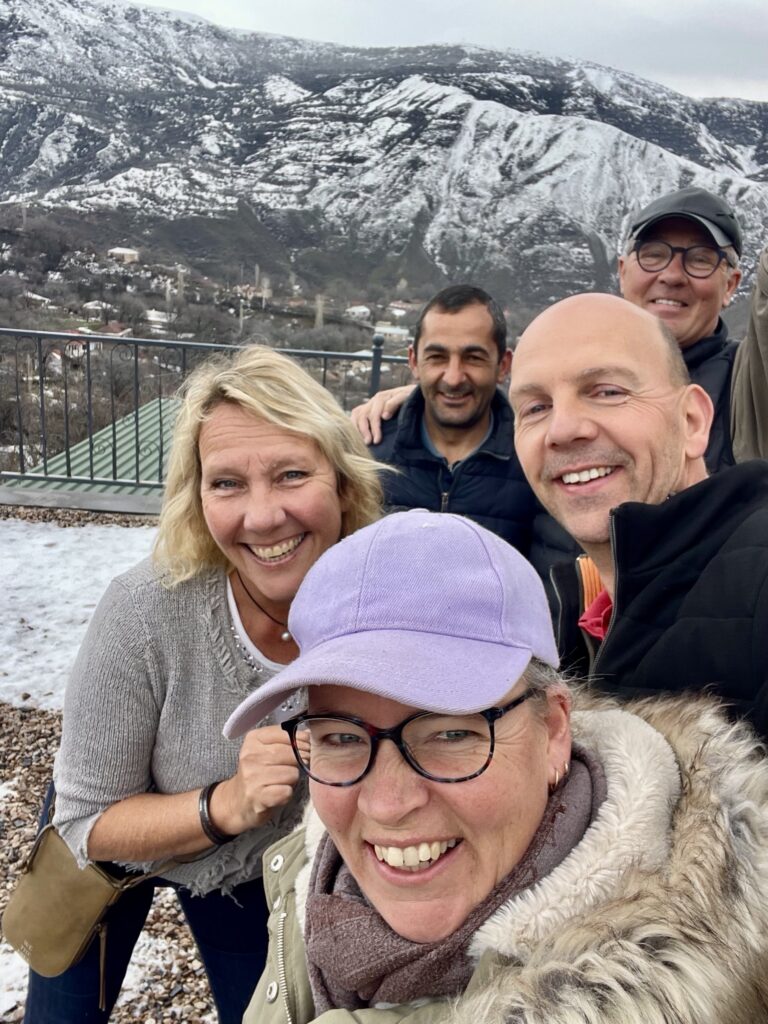
Much later than expected, we crossed the border to Armenia. It was already getting dark, so time to look for a camp spot. A narrow 2 lane road winds over the ridges of the mountain, with left and right high piles of snow. There was a lot of snow and even large areas of flat land where now tricky to drive into. I couldn’t see what was under the snow. Here and there were some farm houses, but no place to park.
We passed a hospital and a fire station on a side road. There was a kind of construction material storage area with no snow and an old Russian tanker truck. Being out of options, I parked there. The moment I switched off the engine and got out of the truck, a big man in a long winter coat came out of an office container. It looked like he was the night guard.
I tried to ask him whether we were allowed to park the truck for one night at this spot. He seemed to understand and tried to make a phone call (probably asking his boss or owner if that was ok). He couldn’t reach him, but the guard said it was no problem. He then asked us if wanted some coffee or tea. We couldn’t refuse (though we were tired and hungry), he was too friendly.
Inside the old office container, there was a couch, which also served as his bed, a small electric heater and a desk with all kind of stuff on it. He was such a gentle and kind man (despite his rough looking face and big posture). He really did his best to make us comfortable. He made the tea from dried herbs which he took out a plastic bag. He got some flat bread and home made goat cheese. He got some napkins, even plastic plates and knives. He seemed a humble man and unfortunately we couldn’t communicate with him.
When we left his office to go to the truck he even gave us what was left of the bread and cheese. He gave all he had.
The next morning when after breakfast we were ready to leave, he asked us again to come in his “office” to have coffee. Again we took the invitation and drunk coffee with him. The man who would take over the next shift walked in as well. He was good with the translation via his phone so we had some conversation going. Our new friend was packing up to go home, and asked us if we wanted to see his house and family. His daughter even speaks English, he said. Again we said yes. Only thing was, we found out, that he had no transportation himself, so he had to get in the cabin as well (and he was big). It was the second time Marja had to share her seat with another man. This time she was okay with it. We were looking forward to meet his family. However, he lived about 20km away from his work, about 20 minutes drive.


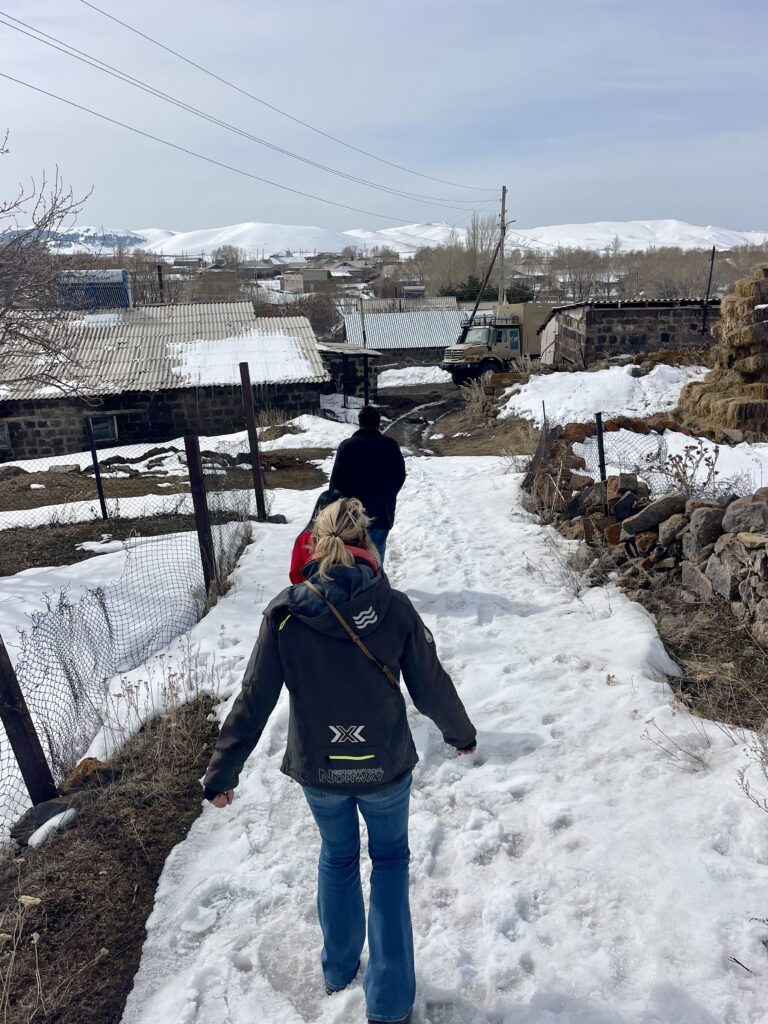
We left the main road and entered the village where he lives. Most roads in these villages are unpaved and very muddy when it rains and snows. Houses look not maintained and old from the outside. There are hardly colors to find in these villages in winter time. (When spring comes, everything turns green with thousands of flowers).
Almost at the end of the village there was his house. In front there was an old Russian car, under a thick layer of snow. Probably his car was out of service and the family depended now on public transport or get rides from friends and neighbors. Like most of these houses, there is a little shed or stable where a few animals are kept for the basic provisioning.

The daughter opened the door and welcomed us in English. Inside the house it was cozy, warm, neat and clean. I would compare it to an oyster, not so nice on the outside, but very nice on the inside. His wife was there as well and she had prepared a light breakfast, with home made bread, home made cheese, tea, coffee and dried fruit. In the mean time the daughter had a nice conversation with us and could translate for her parents.

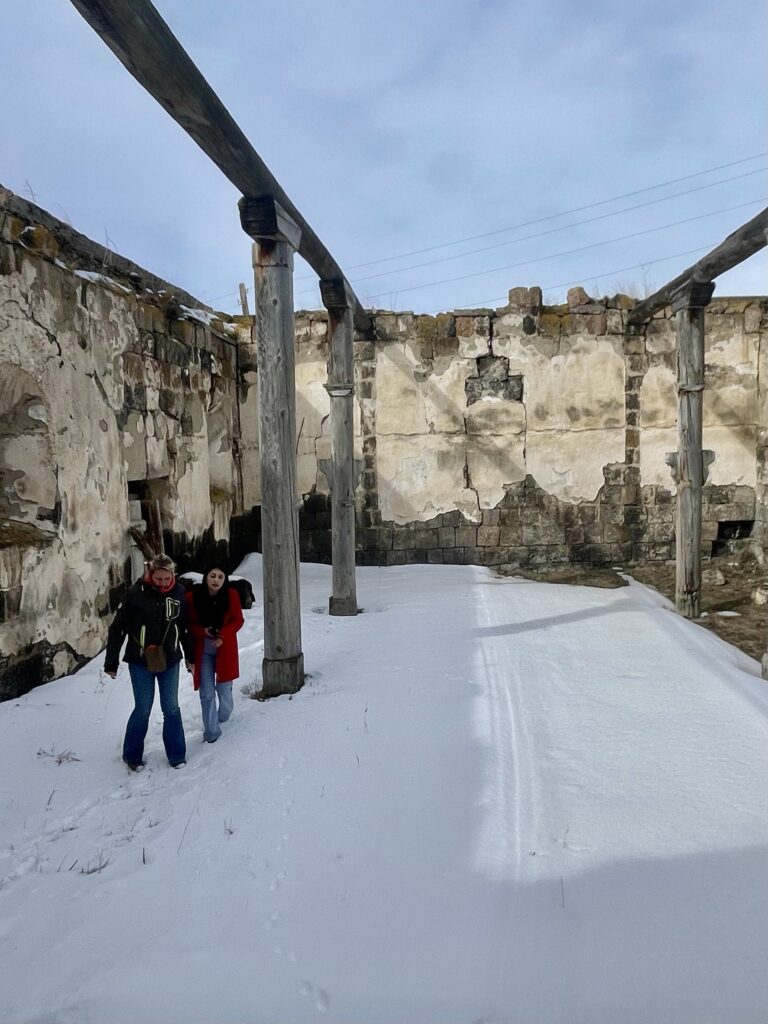
She also told us that they have a little church (more like a chapel) and asked if wanted to see that. Of course we wanted that. A short stroll through the snow, up a little hill, was a small building with a cross on top. The father opened the lock and we entered the small chapel. The chapel was built over 4 graves (we couldn’t figure out who were buried there). The chapel was full of little pictures and statutes of holy figures. We all lighted a small candle. There was a big flat stone, where you had to move a coin up and down and leave it and make a wish. We realized that this family was very religious and the father put his faith and his believe in the holy spirit, with the wish all would go well for his family. It was actually a bit of an emotional experience with this Armenian family. On theway back to the house, we passed the former church of the village. This church was burned by the Turksisch army, when it invaded Armenia in 1920. It was never re-built.

When we wanted to continue our journey, the father gave us more wild dried herbs for tea and his home made cheese (which actually is very nice. It has a bit of a roquefort cheese taste). He asked if we could give his daughter a ride to the next big town, were she is studying at the university. After so much hospitality (and she was at least halve the size of her father), we couldn’t refuse that, we gave her a ride with pleasure.


The next town (Gyumri) was not that far away and we had a nice chat with her while we were playing Armenian music on the radio. We noticed that at every little chapel we passed, she made a cross. Later on we noticed that many motorists honk their horns, when they pass certain chapels. Christianity is deeply rooted in Armenia. It’s something that holds the people and the country strongly united.
We dropped her off at her University and drove to the famous battle site of Sardarapat. It’s here where, many years ago, a small Army of mostly volunteers defeated a much larger Ottoman army, which was on its way to conquer Armenia and slaughter all the Armenians. The defeat of the Ottomans was the start of the First Republic of Armenia. Though it only lasted for two and a half year before the Turks took back a part and the rest became a Soviet Republic.
Before we reached the site, we stopped near a lake for a coffee break. The lake (Arpacay Baraji) is divided by Turkey and Armenia. We had a nice view over the lake and near the lake were some old abandoned Russian era factory buildings. We just had our first cup of coffee finished, when an old Mercedes come speeding to us. When it stopped near the truck, a grumpy, angry looking man in army uniform came to us and he identified himself as being a border guard. We showed him our passports (of which of course he made pictures). We offered him a coffee and that made him more friendly. He explained via his Google translate about him, the lake, and the border with Turkey. Most of these border guards, like in other countries, are village people, who know the area and the people who live there. It’s there task to observe anything or anybody strange in their territory ands report it to their bosses. Often these guys are active, or former farmers as well. Nearby was also one of the many Soviet era war monuments. Usually massif granite ore concrete structures, symbolizing heroism, strength of the fallen soldiers during WOII.

We drove away and reached the site were a huge monument has been erected to honor the heroes who had fallen during the battle of Sardapat. Nowadays, also all the men and women who have fallen during the recent wars with Azerbaijan are remembered at this impressive monument, high on a hill. The monument is placed on the main battlefield and a long park stretches over the hill towards a large museum building on the other end of the park. A very nice and interesting museum concerning the history and culture of Armenia.


Next location was the archeological site of Metsamor, where we also could stay for the night. Finding a camp spot in Armenia was up till now not so easy. It’s either the snow or no hidden spots in forests or mountains.
When we arrived at the site, the museum was already closed, but we parked the truck on the parking lot. Of course within a couple of minutes an old Lada with an elderly guy in uniform showed up. He kept on talking Armenian and I understood he was the guard for the museum and wanted to know what we were doing on the parking lot. He couldn’t understand me and kept talking. Luckily another, younger guy showed up and he understood. He told his colleague it was ok and that he could leave us alone. So our night camp was secured.
Next morning we climbed up the hill (which is the archeological site where also the museum is located). The museum was still closed, but the new guard told us to walk through the excavated site in the mean time. At the site itself is not so much to see. Interesting is a big “construction drawing” carved out on a flat rock, showing an extensive irrigation system of an entire valley, which is quiet an engineering feat (but somebody or a sign has to indicate it, because you would not recognize it as such by yourself). Another interesting part is a group of large rocks, which (according to archeologists) is proof of the astronomical skills of people living over thousands of years ago, by carving marks in the rocks, indicating the north, south and east, west directions. (Again, you wouldn’t recognize it with your own eyes, unless there is a good explanation nearby.)


We got back to the museum. We were the only visitors. An elderly lady, with old fashioned style Russian clothing, opened the door. She was actually the cleaning lady, but looked like a prison warden. The director of the museum came out of her office, dressed up like she was going to a ball (probably she was informed by the night guard that she would have visitors today). She sold us the tickers and we were good to go to explore the museum. But at every step we took, the “cleaning lady” was behind us, with a suspicious look (like we were identified as “museum robbers”). After we did the first floor, the “cleaning lady” was replaced by another lady, who could be straight from the head office of the KGB. Very tide black hair to the back, ultra red lips and glasses, like those from a James Bond spy girl. She was in charge of the “vault”. Small steps leading down the cellar of the building, where the walls were shiny black and the corridor and rooms we walked through, were dimly lit.
But then we saw it! What we would not have expected after visiting the site outside the museum, was a huge treasure of gold jewelry of all kinds. And really a lot! The old citadel city of Metsamor had many tombs and graves of important citizens, untouched by looters. People were buried with extensive treasuries of gold and silver jewelry. Now I understood the security concerns of the people at the museum. It was really beautiful to see how crafty people were thousands of years ago. Such real treasures!
We continued driving in the low lands of Armenia (around 700/800 mts above sea level). The climate is al lot different from the Armenian highlands (up to 3000 mts). The land is flat and fertile. It’s here where you find the many wineries of Armenia. But also lots of fruit is grown here. After Jordan (which is a mostly Islam country), Armenia is the second country where grapes are grown for the wine production, we visited.
Wine goes hand in hand with religion in Armenia. Before Turkey conquered west Armenia (now part of Anatolia), the highest mountain of Armenia was Mount Ararat. According to the Bible, this was this mountain where Noah’s Arc hit the ground after the flood. When it did, Noah walked down the mountain and planted a grape plant. So, it is Noah who made the first (red) wine. Red wine in its purest form is also seen as Jezus‘ metaphorical blood and is used in the the Armenian Orthodox church undiluted (the Catholics ad water to the wine).
With all that said, it shows the importance of wine in Armenian culture. And of course we had to convince ourself if indeed, the wine of Armenia must have come from the hands of Noah. A sign along the road led us to a beautiful winery. The winery was closed (its not the season for harvesting yet), but a nice lady attending the surroundings, made some phone calls and informed me that the manager was on his way.

A young guy showed up and was very happy to explain us all about the winery, the Armenian wine culture and a bit about Armenia itself. This winey was brand new and had its first harvest last year. We were served with some wine straight from the barrel! And yes, Noah started on the right spot with the right grapes, a delicious dry-red wine, this Armenian wine.

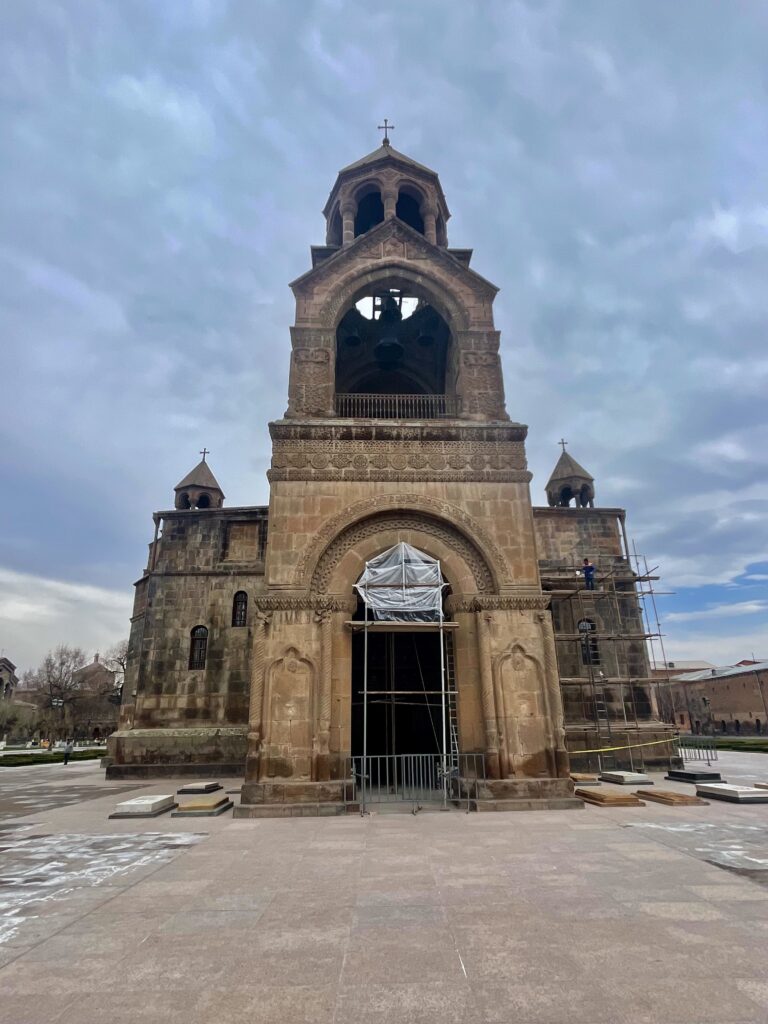
Nearby the winery is the city of Etsjmiadzin where the Etsjmiadzin cathedral is located. This is the mother church of the Armenian Apostolic Church and is often regarded as the oldest cathedral (built in 301 tot 303). It followed the adoption of Christianity as a state religion by the King of Armenia. We parked the truck a bit away the church complex, since trucks were not allowed in that area.

The Cathedral has been under renovation for the last 5 years and was unfortunately not open for visitors yet. However some of the Holiest attributes of the Cathedral were moved to another part of the complex where the Cathedral is located, for a temporary exhibition. A very nice Armenian lady guided us through the exhibition and explained us extensively about the Cathedral, the Armenian Church and the exhibited items.
Some very unique pieces are kept here (normally in the Cathedral). One is a relic which contains the only known piece of Noah’s Arc. It was found 400 years AD at the foot of Mount Ararat by St. Jacob. Further more there are relics containing wooden pieces of the True Cross of Jesus a relic in the form of a silver underarm with hand, which contains the hand of Saint and the spear, used by a Roman soldier to pierce the body of Jezus. Some of these relics are actively used during certain masses.


Visiting the Cathedral, seeing the relics, getting informed about Armenian religion, helps to understand the country of Armenia. Like the Assyrians and the Yazedis in Iraq, the Armenians have been persecuted during the ages. Accept for Georgia, the country is surrounded by Islam countries who have tried to conquer its territory and kill its people. During past times, several empires have tried to convert Armenians into muslims. But their faith remained strong over all this years.

Yerevan, the capital was our next destination and place to camp. On the way out there was a police control for trucks. I passed all the trucks, but was still pulled over by the police. They didn’t really realize our truck is a camper (again because we have our windows covered). I handed them the vehicle papers, but they didn’t know what to do with it. Then I showed them the inside of the camper and now they understood. They were all impressed and wished us a good journey.

Yerevan is one of the older cities, partly designed when Armenia was still a Soviet state. The roads were not so wide, the city is full of statutes and monuments, and many tasteless apartments blocks. It’s built in a valley and the newer suburbs are crawling up the surrounding hills. Driving through town with a big truck was not that easy and traffic is hectic. Again thumbs up for my navigator!

A park on a hill, with a view over the city center and the sprawling suburbs, was our destination. It’s called Victory park and has a huge statute at its centre, which is surrounded by old army vehicles, a fighter jet and a rocket. The park was built during Soviet times to commemorate the Soviet victory over Nazi Germany. The statute itself is called “Mother Armenia”, a female personification of Armenia. Before this statute, there was another statute in this place, that was a statute of Stalin, part of the Victory’s Park commemorated victory on Nazi Germany. But of course, Stalin being a dictator, was removed as soon as times changed, and replaced by a young lady, who depicts the strong women of Armenia and as such she is the “Mother” who looks after her land, her people and the city of Yerevan (she looks right over it).


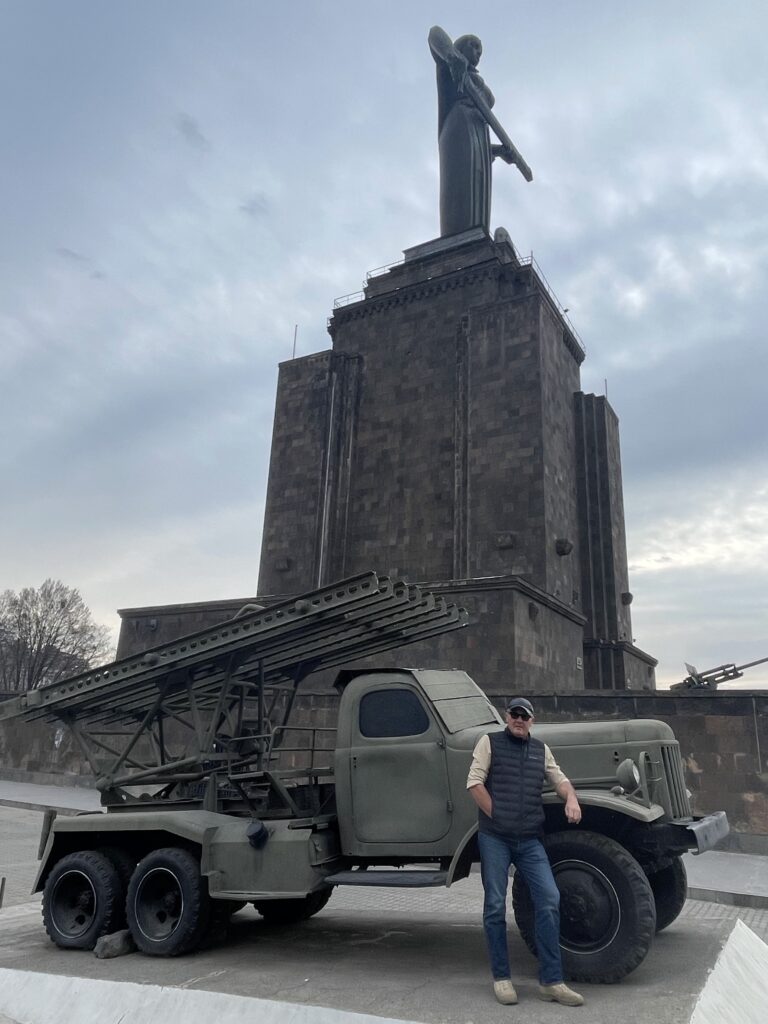
The park also contains a large play ground with Soviet era carrousels and…… a big parking, which was suitable for big trucks. From here there is a very interesting walk towards downtown Yerevan. We walked along the promenade overlooking the town and since it was a bit late, we called it a day, but not before moving the truck a bit. The far corners of the parking were used by young city people for things which could be a bit noisy! When we returned to the truck we received a message from another overlander, who we met on Instagram. He was also heading to Yerevan the next day, so we decided that we would spent an additional night on this parking.

Next morning we set off to explore Yerevan. Yerevan is a city of about 1,5 million people, which is half of Armenia’s population. Yerevan is growing especially since the arrival of thousands of displaced people from the former autonomous region of Nagorno Karabach, which was completely lost to Azerbeidzjan in 2023. It’s also the only place where you see substantial new construction happening in Armenia.
From the promenade of Victory park, you cross a pedestrians tunnel towards the Cascade. You pass an enormous free hanging concrete “balcony”, from where you have an even better view over the city. Behind the “balcony” is another huge monument

Via some old shaky metal stairs, you reach the Charles Aznavour House, which houses the name sake Foundation. Charles Aznavour is one of the most well known French chansoniers, and of Armenian descent. By now we reached the Cascade. The Cascade is a huge set of steps, with platforms, art decorations and fountains (from afar it looks like a real water cascade). There is also an internal part with has multiple escalators and a couple of art exhibition rooms. When you walk down, you walk straight into the heart of the city.


When you reach the bottom, we felt a little bit like Paris. Restaurants, cafes and terraces. It’s a big difference when you come from moslim countries. It has an atmosphere we are used to. Walking through the city, we noticed lots of art works, monuments and galleries. A visit to the Vernissage market is said to be a tourist must, but it was disappointing, since there was a lot of tourist souvenirs and a lot of the same.


Having a real good Armenian lunch with a good Armenian wine is what you can’t skip in the capital. It really makes you feel you are in a European country. Geographical Armenia is in Asia, but cultural and religion wise Armenia is European. (Armenia is even more European then Turkey).

A worthwhile visit, was to the National Museum of Armenia in Yerevan. Armenia has an interesting medieval history and some amazing archeological finds have been done. Grave tombs have been found, whereby eg a king was buried with an ox-cart (including two oxen), including all kinds of items and jewelry for in the afterlife. Another interesting find is the oldest shoe in the world. A pretty much well preserved leather shoe of over five and half thousand years old. (The oldest shoe ever found in the world).


We strolled a little more through the city, passed the Revolution Square with its circular buildings (where the Government of Armenia is located). And passed along busy streets. Here in Yerevan you also see the divide of the rich and poor in the country. Many expensive cars and well dressed people (often Russians who fled Russia).


Weekend started and the sun was shining. A lot of young people were out and terrases were full. Of course we did the same and while I had my first beer since a while, I got a message from the other overlander, that he arrived in town and asked where we were, so we could meet up and have a drink together.

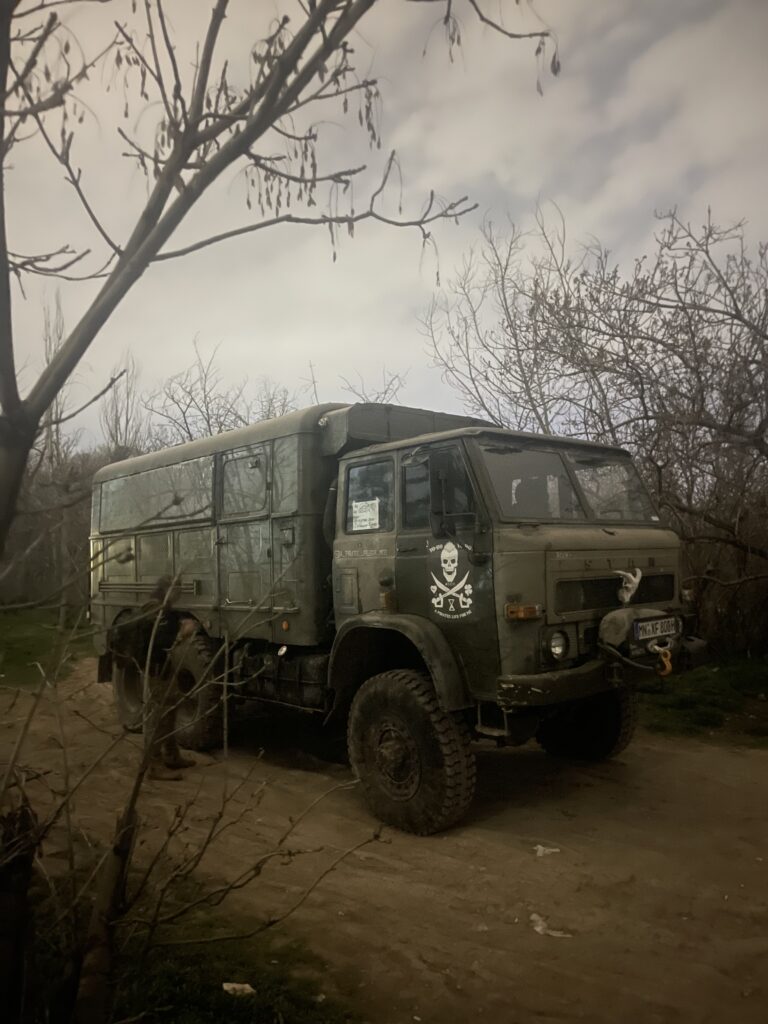
After a while Florian showed up. Florian travels mostly by himself, in his camper truck, but sometimes has people (girls/women) joining him. Florian is a tanker captain and when he is not on his ship, he is traveling with his truck. This is an old Polish army truck (brand called Star). I follow him on Insta and find him quite a character, and a great fun guy. He himself converted the truck (it was used as a mobil workshop for the Polish Army), into a wonderful camper truck. Very well designed, very sturdy and I noticed some interesting features. He is an extremely handy guy and can fix almost everything by himself.
We had a great evening together, with some good Armenian beer and wine (for the first time since a while). Florian had travelled already through Georgia and goes to the extreme with his truck. When we walked back via the cascades to the camp, we heard somebody playing a trompet somewhere down below. The acoustics of the area made the trompet sound very magical, and this together with the view over the city in the night from the cascade made us all stop and wonder at this beauty for a while. It was so beautiful!
Back on the parking, we finally saw Florian’s truck. It’s a beast from the outside, but inside he did an amazing job. He even has a mini wood stove with a periscope chimney! We had some tea and a last chat and then said good night. Tomorrow will be another day.

Next morning Florian came over to have coffee at our place and we continued sharing nice stories together. Before noon arrived, we said goodbye, did a last photo shoot and went both on our own ways again. We started looking for a supermarket to stock up a bit. The first two supermarkets we found, although big, were located in such away, that we couldn’t find a parking spot. And driving around in Yerevan is no real fun. On our way to the third one, Marja at the last moment, saw a height sign for a railway bridge passage, with a maximum height of 3.5mtr. If I had missed that one, the unit would have hit the railway bridge and had either been thrown of the truck or had a different shape now.

I made an emergency stop, put on my alarm lights and thought quickly what to do next. It was a major, not so wide, 2 lane road, so all traffic had to stop, to allow me to make a turn. Marja jumped out off the truck to stop the traffic. Luckily people saw that we had a problem and cooperated easily. I made the turn and we were on our way again, to find another route to the third supermarket.
Just outside town, there was a small supermarket, offering all we needed. With the supplies good for the coming days, we drove towards Khor Virap Monastery. The Monastery is well known, not only for its location, which is considered the best spot to have to best view on Mount Ararat. Mount Ararat is the highest mountain in Turkey, but was once part of West Armenia. For Armenians the mountain is part of their heritage. It has actually a greater value for Armenia than for Turkey, historically (culture and religion wise). We were not so lucky, since the top of the mountain was covered in clouds.

Since it was weekend when we arrived, it was pretty busy at the Monastery (which is also considered the most beautiful of Armenia). The Monastery is located on/near the ruines of an ancient town called Artashat. In the church of the monastery is a well, in which Gregory The Illuminator was held imprisoned for 13 years by an Armenian King, who was sick, but then healed by Gregory. Out of gratitude the Kind then converted to Christianity and made Christianity the official state religion. The first one in the world. Gregory the Illuminator is therefor the most important historical figure in Armenian culture and religion.
The Monastery is indeed beautiful, well preserved and still in use. A mass was held when we arrived. Walking up to the top of the hill of the Monastery, you indeed have an amazing view on Mount Ararat (and in front the high barb wired fence near the border between Turkey and Armenia).

Nearby the Monastery are a few hills, part of the ruined city of Artashat. On one of them is a big statute of a former Armenian Partisan. Before we jumped in the truck to go there, we bought some fresh Pomegranate juice from a young boy near the Monastery. Fresh Pomegranate juice is hard to get by in our country and if you get it, its not cheap!
We almost had a similar view on Mount Ararat from the spot we parked the truck now. When we got ready for diner, somebody knocked on the door. I checked, an old guy in an army uniform. I went outside and saw the old black Lada the man was driving. He showed a “police-ID” (first time during our entire voyage, that an officer identifies himself with an ID). He was a border guard (locally recruited farmer), checking on us like the previous guard when we had just entered Armenia. Of course, we were not too far away from the Turkish border. But after he made photos of our passports, he left and all was good.

Later that night I heard a truck passing by, but didn’t check it. Later on I was messaging Florian about where he was (he was planning to go high in the mountains, to get stuck in the snow and stay there for a couple of days). Then he wrote me back with the message “check who just arrived”! I opened the door, looked in the dark and I saw a familiar silhouette. Florian had arrived….he was the truck I heard. We didn’t tell him that we went to the Monastery, let alone, that would camp here for the night. This was just a huge coincidence! I went to him for a chat and a drink and stayed for a while. We had some good laughs.
Next morning I went out early for a walk on one of the hills near the truck. From above I saw that now Florian was visited by the “black Lada”. When the border guard left, I saw Florian walking to our truck with a big coffee thermoscan. Time for me to come down the hill. It was Sunday morning, so nice to have visitors coming over to drink coffee.

After the coffee we said goodbye again. I am sure our paths will cross again!
We left to make a brief visit to the archeological site of Dvin. A site of ruins of an ancient town part of the Silk road. It’s partly preserved and restored during the Soviet times and recently. However, its done very amateurishly and its hard to find information about the old town on location. In the foundation of what was once a church, we found picture frames with Maria and Jezus, used candles and other religious items, which we normally see in the churches and small chapels. People seemingly are using this part of the historical site as a place of worship.


Florian had told us about a camping not far from another famous monastery. A camping (called 3G), owned and operated by a Dutch couple. Since it was in our direction, we thought it would be interesting to camp there for the night and have a little chit chat with the Dutch couple.
The area where the camping is located is a popular tourist area looking at the number of restaurants. One of the main attractions in the area is the Temple of Garni. A beautifully restored Roman (style) temple with columns around the temple hall. The temple is the main feature of an archeological site, which was once a fortified city citadel. The parking situation was a bit complicated that day, since the President of Kazakstan was visiting the place as well. A big number of security personal with sunglasses and ear phones was walking around, keeping an eye on us (as the only westerners walking around). We had to park the truck far away, so that gave us a nice walk through the village towards the temple.

For the first time since Saudi Arabia, we were now going to an official camping. The road towards the camping was covered with low hanging trees, which we “trimmed” with our truck. On arrival, we saw that the camping was closed until 1st April. We still rang the bell and waited. The moment we wanted to leave, the door opened and a lady came out. It was Sandra, the owner of the camping.
She looked surprised, but also happy to see us (Dutch). We apologized for knocking on her door, but she said it was no problem. We were even allowed to enter the camping, although she said, works were ongoing to prepare for the upcoming season.
The camping is part of a complex with bed and breakfast rooms, pre-erected tents, lawns to camp with your own tent, gravel parkings for camper trucks and a large storage facility for campertrucks, cars and motorbikes. There are a great number of overland travelers who take a break from their traveling and park their vehicles at the camping’s storage place.


The Dutch couple origin from the flower farming in Holland, but took on a rose farm project in Armenia, near where they live (which is the same place as the camping). They bought the property a good 15 years ago and slowly converted the old farm house in a marvelous tourist project. The quality and amenities of the camping are unique for Armenian standards. For a lot of travelers like us, its an oasis in a country with not much luxury. (If only it was for the big swimming pool).
The idea was to spend one night, but the next morning we decided to stay another day/night, since the weather was not so good. Because of that we were invited to have lunch with the couple and their three maintenance/construction workers. And lunch in Armenia is pretty big (people work hard and in the cold, so a solid meal is important) and an Armenian meal is not complete without a couple of vodka shots!!

We used the extra day to do some interior maintenance, cleaning and laundry as well as some paperwork. Next day we woke up and the entire area was covered with 20 cm of snow, so again, we couldn’t leave and spent most of the time in the cabin. At night we were invited for dinner by our hosts and had a great time, exchanging stories and learn much more about Armenia and about their personal experience with Armenia.


Next day there was still a lot of snow on the roads, so we added another day. In the afternoon we walked down towards the village. Like almost all villages and towns in Armenia, it’s like time stood still since the collapse of the Soviet Union. Everything is old. The houses, most of the cars, infrastructure etc. It’s like people froze when they became an independent nation after the collapse of the Soviet Union. There is so little in these villages and towns, which indicate a fresh start, new life and progress. It’s therefore so encouraging to see a young Dutch couple, building such a beautiful camp ground and B&B with outstanding facilities. Nice thing is that they employ local people, who in turn also make nice homes and spread the knowledge and experience they get from “outsiders”.


In return of their invites for lunch and dinner, we invited our hosts for dinner in our camper. Marja had prepared a great meal and it was the first time since our traveling that we had guests for dinner inside. (It’s not that big inside for four people, but it worked out great).
Next day the roads were clear and we could finally hit the road again. Despite the delay, we had great time at camping 3G. Our host were amazingly kind, helpful and generous. We learned a lot and we had fun!