We visited Qatar last year during the Soccer World Cup. However, at that time going with the truck was not an option and we actually only spent a few days in Doha. We didn’t see much of the rest of Qatar. But going to Qatar (again) was not really on our agenda this time. Qatar and Saudi Arabia have a kind of love and hate relationship. Not long ago, Saudi Arabia closed the only land border of Qatar, meaning that no overland traffic was possible going in and out of Qatar. We hated the idea of that happening again and that we would be stuck in Qatar for an unknown period of time.
But first we had to leave the UAE and drive into Saudi Arabia. The previous border posts with Oman and the UAE where easy and reasonably fast. There was not much of border crossing in those areas. We expected that again, when leaving the UAE. Instead we found hundreds of trucks, parked a long way before the actual border post. We reached the border area and took the truck exit. (There is always the doubt if we belong to the truck lanes or the regular car and bus lanes, since we are a camper). Normally it is not a big problem, since most borders we crossed, the truck lanes were not busy. Now, it was a huge number of trucks, parked all over the place in the most dusty parking area we have ever encountered. You couldn’t even see 10 meters in front of you, so much dust of all the trucks driving in all directions. I also was very low on fuel and the fuel station was next to the parking, only problem was, that there was no entrance to the fuel station from the truck parking area. I had to drive back on the one lane ramp in the opposite direction, to get back on the high way. In Saudi people drive often against traffic, so there where no angry faces from upcoming trucks. (It also helps that we look like a truck from the Saudi army).
Now we could reach the fuel station and get some diesel which would bring us to the next fuel station, but in Saudi Arabia. We fueled up (fuel is 75% cheaper in Saudi compared to the UAE). Now we were in the bus and car lane and drove to the Customs check point. Again lots of trucks and no signs at all telling what to do and where to go. An officer in a small shed indicated that we had to go back, which meant, going against traffic again, passing a check point. When we did that, a police officier jumped out of the booth and was confused by what we were doing. He started calling on his phone and another officer arrived in a jeep. We were told to go back in again to have our passports stamped out. There was another small building which we had to enter. We went in the small waiting room, crowded with Pakistani truck drivers (all men of course), the smell of sweating men was quite unbearable. There was one officer behind a window, behind his computer, processing the paperwork of the drivers. We didn’t want to be unpolite or feel privileged, but we didn’t belong here. We were not cargo trucks, just tourists with an oversized camper. Marja (who was analyzed from top to bottom, by every Pakistani in the small room), walked to the front to get the attention of the officer. It worked, he stood up indicated that we should come inside his office. We got a chair and he immediately started working on our papers. A very friendly man, who then directed us to the Customs Office. We had to wait there about half an hour (it was lunch time). Then a security guard came to the truck to ask for the papers, which he took into the office. After a while, he came back, I had to come with him. When I entered the office I saw on the floor a big piece of plastic with food plates on it. A typical sight I had seen several times before. Again I had to explain that the truck was a camper (“caravan” is the word they use in the Arab world). It is usually the guy with the most stars and stripes who gets it but he usually is only showing up at the end……

At least all paper work was done and we now had to drive back to the lanes with the regular cars and buses. A police man with a big machine gun walked in front of us to move all trucks away (since we were driving again in the opposite direction). We had to show our gate pass (the paper which is stamped by immigration and customs, to show that you did all your formalities, and we were allowed out of the UAE. Next stop the Saudi border. We drove straight into the passenger car lane (nobody in front of us) and to our surprise, no confused officers. They smiled, checked the passports and asked if they could see this amazing house on wheels on the inside. Of course I couldn’t refuse that. Next stop was the Customs. Here was a more serious guy at work. We had to park the truck in a slot for inspection. The officer went inside checked the lockers and then wanted to see the storage area in the back. Usually, the Saudi Customs officers don’t do the handling of goods themselves. There are several Asian guys working with them (Pakistani, Afghani, Bangledeshi), for me not the typical people you would expect do the search work. But they started digging with their hands in our food boxes. That moment one of them took out an “ontbijtkoek” and asked if he could have it, I was done with these shabby looking hustler type of guys. I just told them this was enough and I closed the boxes and told them to bagger off (the Saudi officer was gone at the moment). When the officer came back and I asked him if he wanted to see more, but now all was ok and we could go. Finally, all the border crossing stuff was done. We could continue the journey again.
Now we were back in Saudi Arabia. Our first camp would be the beach, where we parked before, the night before we went into Qatar last year. This beach is sort of next to the Causeway to Qatar, so near the border with Qatar. The beach is also close to a town and since it was still weekend, it was busy on the beach. Right away, people come visit us out of curiosity and to have a chat. Border guards arrived, of course, yes, we were back in Saudi and its all about security. They checked and photographed our passports and we were given permission to spend the night right here on the beach. Very nice.
Next morning when we woke up, we read our newspapers and realized that the F1 race was going on in Qatar this weekend and that today (Sunday) was the last racing day. We looked at each other and said, “why not!”.
Not planned at all, we decided to go (we made that decision during breakfast, so no time to plan). The border post out of Saudi was not far from us and we had some experience with the day before. We took the regular vehicle lane and again a customs officer, who didn’t exactly know what to do with us. A lot of phone calls, other colleagues came to have a look. Then it was decided to refer us back a bit to go through the mobil X-Ray machine. When I wanted to drive through that device, a guy with a big beard and angry face jumped out of the cabin of the truck which carries the X-Ray machine. He was pointing to his watch. He probably had a break or something like that. So no X-ray for us.
I drove back and now another customs guy said I could go to do the Immigration. That went fast and we continued driving on the long causeway, connecting Qatar with Saudi Arabia.
At almost the end of it, you have the Qatari border post, which looks like a small village, but with an awful lot of fences and barbwire. I took the truck-lane this time and just before a weight bridge, a police pick-up was blocking the road. A young police officer (and like most of the Qatar police force, not a Qatari), came out and didn’t know what to do with a big truck with a European couple in it. Nervously he was calling on his radio for advice. Within a few minutes, two police jeeps showed up. In one was a big, very friendly and enthusiastic officer (originally from Africa). He was impressed with the truck and saw that we were in the wrong place. He gave us an escort over the huge truck area, with the other police car behind us. He brought us to the customs and immigration building. This building was full of Pakistani truck drivers as well. And again they all looked surprise to see twi “white” people entering (especially one being a female!). The big police officer (Hammed), guided us through the whole process, together with a very nice customs officer (Nassar). It looked like the entire team in that building was working for us. Qatar really gives a tourist the feeling that you are welcome.
After all paperwork was done, the truck had to go through the X-ray machine (all trucks going into Qatar, have to pass through a huge building, where a massive X-ray tunnel has been installed.) The drivers have to leave the truck and have to wait in the waiting room. We were guided into the directors room and got coffee. What a treatment.
After the truck was cleared, Hammed drove in front of us with his police car to show the way out of the complicated border complex. We entered Qatar and drove over the remaining part of the causeway, over a brand new 10 lane highway. Driving in Qatar is a delight. Almost all roads are brand new, multiple lanes and not much traffic. Besides, in Qatar, people have a more civilized way of driving on the roads.
We reached the huge F1 International Circuit very much on time, but we had one problem. We had no entry tickets (yet).
As I said, we reached the huge F1 International Circuit very much on time, we drove around to find the entrance and where we could park. We passed the security gate, which went wide open for us right away, since the security guard assumed we were either military or part of the race teams. We were now parked as close to the entrance as could be and we were a bit hidden in a corner, so a great spot for us. But now we actually had an issue, we had no entry tickets. So, we went on line, but all websites showed “sold out”. Then we started to call some friends who might have contacts who could get us some tickets, however, it turned out that all tickets were gone. Yes, it was very last moment indeed. But Marja never gives up and we could not imagine that all tickets were really sold, we figured there must be two seats available for us somewhere in the circuit. So Marja started to ask around and after a few attempts, found a guy on the parking lot, who was (re)-selling tickets. And yes, he had two for us (and even for a pretty discounted price). There is always that guy hanging around somewhere at events selling real or fake tickets. But this being Qatar, where you might get arrested and thrown in jail for minor things, we trusted the tickets were real and the guy actually took a the risk of (re-)selling (his) tickets.

So, a total completely unplanned plan, to go to the F1 in Qatar, did work out very well. We dressed up in the truck and went to the circuit area. Of course we recognized the Dutch fans of Max Verstappen in the orange outfits. There were many nice stands and boots to visit. We got a very nice spot to sit and watch the race. It was surprising to see how many people showed up at the very last moment and even during the race. (It was a rather hot and humid day and evening, so it was in fact understandable).

After the race there was a DJ show (DJ Snake),but the kind of noise this guy made, was not our thing (and most others) so we went back to the truck and drove a little bit away from the circuit and parked between some trucks and heavy equipment for the night.
The next morning we drove back to downtown Doha, for Doha Expo 2023. The Expo is a huge undertaking again by the Qatari Government (like the World Cup Soccer), but far less advertised (at least we didn’t know about it, until we saw the bill boards in Qartar). At arrival, it was hard to find a parking spot for the truck, because the parking area was underground and there were no above ground parkings for cars and trucks. Since the event was still (partly) under construction, we tried to park near or on the construction site. However, the guards didn’t allow us. I tried to explain them, that we are visitors for the Expo and that the whole reason for Qatar to organize such events, is to get tourists and guests for these events. At the end, I was able to convince them. (Problem is, they have simple instructions and are not allowed to think outside the box. That also counts for their supervisor, the boss of the supervisor, and the boss of the boss. Only after the last boss, you will get a Qatari, who would understand it right away. But that guy is often hard to reach).

It was midday, bloody hot and there was almost nobody at the expo. The Expo’s theme was “Green Desert”, which meant how to (re)-plant the desert. But it was a theme, which was not really visible (except for a few country pavilions). Qatar invited all countries in the world, to participate and set up pavilions. Some countries did a very nice job and got it right (of course host country Qatar, but also Saudi Arabia with the biggest and most impressive pavilion about sustainability, re-planting and water, but also Oman was very well presented). Other nice pavilions where from Kazakstan, Turkmenistan, Italie, Turky and Rwanda (Rwanda, known for its mountain gorillas in the rainforests. However, their stand was about coffee, and selling coffee. For coffee plantations huge amounts of rainforests are being cut. “Yes, we also have gorilla’s”, when I asked what else is Rwanada….) but were mostly presenting their country as tourist destinations (so they should have been at a tourism exposition instead). A lot of standard booths (container size blocks) where provided by Qatar, with a country name printed on it, but nothing inside. Some where still busy trying to make or organize something (even the Dutch pavilion which looked like a standard market stall with some flowers pots on the ground was a shame to see). The funniest booth was the one from Cuba, which we visited. Inside we thought to meet some Cubans, but the couple we met there (it was a married couple) came from Nigeria and were standing in front of a big map of Western Africa, which they presented., The didn’t even know what of where Cuba was. They were hired by the Expo organization to present “a” country. We saw that in another couple of booths as well. To our opinion, the whole Expo was a flop. Not finished, not according to the advertising and a huge lack of participation. On the way out there was an underground exposition about AI and Bio-enginering, presented by a private hospital in Qatar. The main message was that they are working on extending life. (Some Middle East rulers dream of having their lives extended above the normal life expectancy or having an eternal life. But money can’t buy that yet (I hope).


We left the Expo and tried to find a camp spot. But like Dubai and Abu Dhabi, also Doha has not many options left to camp in or near town. We drove back to the camp spot near the circuit, between the trucks, but not before making a tour over the Cornich and through down town Doha. And with the night setting in, the city started to light up, with all its colorful lights.

Next day was time to explore the rest of Qatar. We had seen enough fancy “resource wasting” cities by now. We wanted to see, what is left of the old Qatar. We drove over the huge brand new multiple-lane empty highways, passing the enormous outlandish football stadiums, of which we visited one last year during the world cup, the Al Bayat stadium (the huge Bedouin style stadium). Where it was the center point of world attention last year and thousands and thousands of people were in and around the stadium, with hundreds of buses and thousands of cars filling the huge parkings, there was nobody now (except for some gardening guys, who try to keep the trees and plants alive on the property). We walked the beautiful passenger bridge over the highway, which connects the parking lots with the stadium. It hasn’t been maintained since the last soccer player and spectator left the stadium. Pigeons are now owning place, elevators were out of service, rusty and full of graffiti (which surprised me in this well controlled country). The stadium is fenced in and guards are patrolling the area. The about 80 entrance gates, where closed, dusty and some parts were falling of the buildings. The 80 or so X-ray machines (used a few times), were all still there (wrapped in plastic).
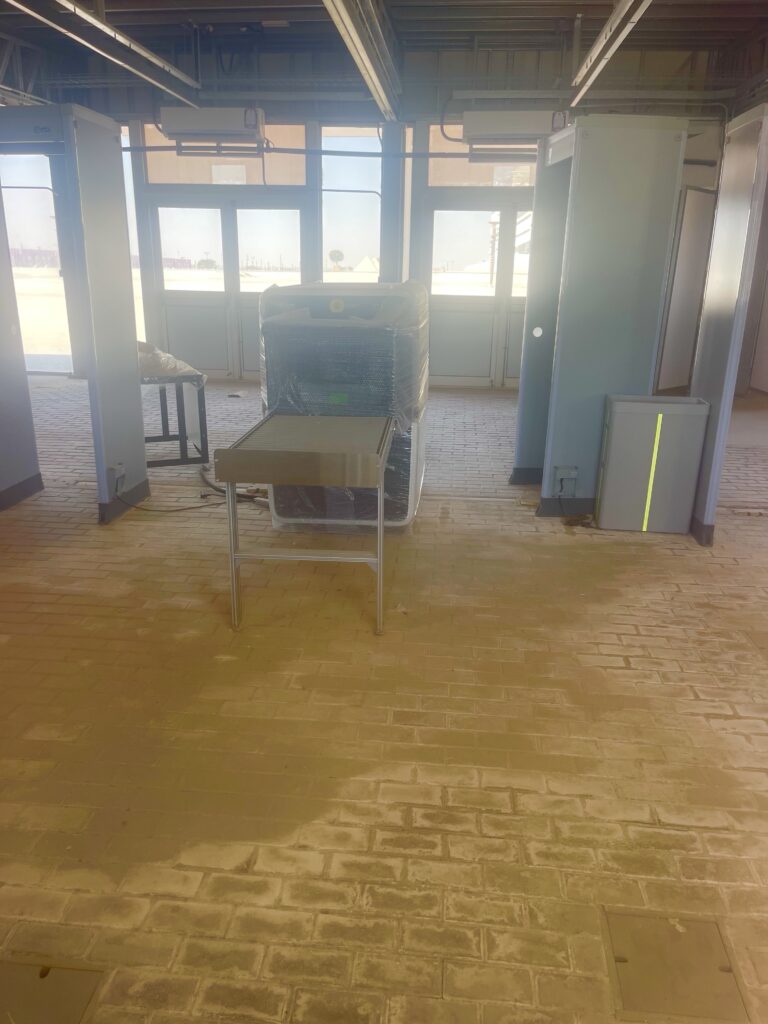


Even though we walked outside the fenced area, the security people wanted us to walk further away from the fence (probably afraid that we would see too much deterioration of the property). We just ignored them, since there were no signs and their authority is debatable.
We heard that the airconditioning (yes, the whole 67000 seat stadium is airconditioned) was running (and in Europe we have to do our utmost to save energy and to go green), and at the same time in the same country, they had an expo out making the desert green again and about sustainability. One of the friendlier guards told us that they keep the place cool and humid free in preparation for the Asian Cup 2024. Six countries will compete in soccer in Qatar in January 2024!!. The participating countries are Sri Lanka, Bangladesh, India, Pakistan and Afganistan (of all places). Wonder if these poor countries will fill all the hotel rooms, built for the World Cup!
Anyway, its an old story, which repeats itself after every Olympic game or other big world tournaments. We have seen it and move on.
We drove away to the more remote and rural parts of Qatar. Qatar is mostly flat desert land, so the Al Bayat stadium remained visible for many kilometers, like the Eifel tower in Paris.

Away from Doha, you find beautiful coast lines, doted with sections of mangroves and beautiful white sandy beaches. Residents of Doha, have their mansion style properties near these beaches (which is unfortunately reducing wild camping options). There are public beaches with well maintained utilities and facilities. As Qatar, is (still) a strict religious country, the public beaches are divided in sections for women and children and families in one section and single men in the other. Besides all the construction, Qatar also has some reserves and parks to protect some of its nature. One is an extensive mangrove area, with a long elevated footpath going through/over it.


All the way towards the north of the country there is a strip of coastline, with hardly any construction and some abandoned fishing villages. A beautiful piece of historic Qatar. We stopped at the “lost” fishing village of Jumail. Although being an official tourist location with the typical brown sign post along the road, it was not well kept. Fences and guard house destroyed, partly overgrown and garbage between the ruines. The location however was amazing. A few Pakistani workers were working on the restoration of the village mosque, but that was all we saw about keeping the place up. We parked on the beach for a coffee and not long after that a police jeep arrived to check on us. In Qatar they are not very familiar with overland trucks. The police thought we were from the Qatari army (again). They asked if we were ok and if we needed anything, again so friendly, that counts for all officials here in Qatar. And you have to keep in mind that a war broke out between Israel and the Palestians, which last one is well supported by Qatar. (Not that there is something wrong about that, but with a polarizing world, where the West is blamed for a lot of misery in the world, we were happy that we didn’t notice any negative feelings against us).


Another vehicle arrived. It was an original Qatari (mind you, 10% of the population of Qatar is Qatari, the rest is immigrant, so to meet a Qatari is a change of 1 on 10). The man started to talk and explained that he was born in this village. He was born when nobody in the world knew about Qatar, Doha was a village, and his village had no electricity. He complained about how everything in Qatar had changed and that now all is about money and wealth. How people disrespected nature, pollute and destroy it. He also spoke about the change of culture because of all the immigrants and the collapsing social cohesion of Qatari family and friend life. I was surprised to hear this. You would expect that with all the wealth of this country, all the benefits the Qatari people receive from their government, they would be happy and satisfied. Okay, this was just one person, but still, not everybody is happy with progress and that is not limited to one country. And seeing that in a lot of Middle East countries people (mostly men), like to spend their leisure time in the out-doors (whether in the desert or fishing along or on the sea), people miss the old days, or times. Times when things were not too complicated or too stressful.
Efforts have been made in the past to save this historical area of the Qatar. A few forts in the interior near the coast have been completely renovated or even completely re-built. But you get the impression that at a certain moment, the authorities lost intrest and stopped the projects from one day to another. Some forts are finished, but all the construction materials are still there (some even with a complete construction camp). Inside the forts it’s empty and there are not even signs to explain what is what. (some do and others don’t). There are no real roads going to these historical places (some bumpy tracks at most). It’s a pity, because these forts where once built near precious water wells in the days when there were no desalination plants. Water was the most valuable commodity in the old times, wars were fought over access or possession of the scarce water wells. It shows such a difference of the old and new Qatar. Where water was once the highest asset, it has been replaced with oil and gas. And with the the revenues the can now make or buy the water they want and literally waste it on washing cars, spraying roads to wash them etc. It should remind visitors also that there are millions of people around the world still struggling for fresh water. In northern Africa, people still kill each other over access to water wells.


Before oil and gas were discovered Qatar was depending on the pearl trade. Most of the fishing villages along the coast, were pearl fishing communities. The Unesco site of Zubarah is a unique site, where once stood a large very rich city, which was the center of pearl trade in Qatar. It was huge and excavations are still ongoing. Next to it is also the completely renovated fort of Zubarah, which was until recently still in use by the Qatari army. The history of Zubarah shows how complicated the Arab world can be or is. The city (located in Qatar), used to be ruled by a tribe, who are now the ruling tribe of Bahrain. Since this tribe had to flee the city in the past, they still consider it their home land. Attacks, sieges, legal claims, all have passed the revue over the years, concerning ownership of this area (the town and surroundings). It also can explain why certain present situations are as they are, since these situations are a result of things which happened in the past.

Near the training camp of the Qatari special forces, we found a super nice, secluded little beach (which was on Zekreet peninsula) where we spent the night. Another Qatari passed by (we were lucky to meet a second one). It turned out it was “his” spot, but his in the sense of he rents this spot from the government each year for a certain permissible period. He comes every few days with a Pakistani, to water the trees he has planted. Every year this spot on the beach is transformed by him into a little village with multiple caravans, trailers and tents, complete with artificial grass. It’s during the wintertime that he hangs out here, mostly with his friends. He placed a table and chairs next to his big pick-up truck and invited me to have a beer (a real beer). Seeing the man, his clothing, his truck, the pictures of his beach camp and now the beer, I realized he was not an ordinary Qatari. But, we don’t ask questions, which could be too sensitive. His Pakistani guy, was in the meantime busy with a net, belly deep in the water, trying to catch some fish. Later, our “land lord” joined him (and it was already pitch dark). After an hour or so, the result was a few small coral fish and some crabs. Too little to take home, so he dumped it on our table, so we could make fish soup. We accepted it, but at this time of the day, and looking at small fish and crabs, the moment our “fisherman” left, I released them all back in the water. They had their lucky day!

Zekreet peninsuala is a special place. It has its own little desert and a large conservation area where wild Gazelles and Oryxes are kept. Unfortunately, we needed a permit to enter and I couldn’t convince the guard to let us in. So we decided to follow the remaining part of that part of the coastline of Qatar. Soon however, we were in the middle of huge oil installations, which continued for kilometers. The nice coast line of that side of Qatar was finished. We stopped at a little town near the installations, which was mostly inhabited by Asian oil workers. The supermarket we went in, was an “elbow” supermarket. You were in “Pakistan or India” fighting your way through the store, by pushing people aside, which otherwise they would do as well. A little coffee shop outside, staffed by 2 nice ladies from Uganda, was the place for us to have a coffee break. On the parking of the mall (of which the supermarket was part), busses full of oil workers arrived dressed in yellow or blue overalls and wearing helmets. They were all dropped off to go to the nearby mosque for their afternoon prayers. After half an hour, they came back, all back to work.


Along the last piece of coast line, you see the neat organized beaches for the oil workers with all necessary facilities, including watersport activities, but we didn’t see anybody using it (most probably it was still too hot and not the weekend).
The last part of Qatar which we wanted to see, was the desert with the dunes, part of the Empty Quarter desert. For this we had to cross Qatar in the middle (which was also pretty much industrialized). Once you have crossed the interior, you reach the big multiple highways towards Doha, from where another brand new big highway, brings you to the popular Sealine area. It’s the coast area, not too far from Doha, where the city people go in the weekends. There are hotels, camp sites, you can rent quad bikes for riding the dunes, you can even rent camels! When you pass this area, there is a 50km dirt road through the desert, which brings you to what we wanted to see. The famous Inland Sea. The dirt road consists mostly of compacted salt dirt with sometimes a little sand dune. It was an easy but nice ride. Left and right sand dunes where we saw SUV’s from Qataris crossing to the tops and going down again (dune bashing). Then after little less than an hour, you reach a spectacular vista. Surrounded by sand dunes is this large body of inland water, with a small opening to the sea (Arabic Gulf). The colors of the water are spectacular and it’s very peaceful with thousands of birds roaming the shorelines of the lagoon (which it actually is), for food. Occasionally, some guys come to do some fishing. There is a lot of fish in this lagoon, which is rich in food for the fish. When the tide starts to rise, the lagoon gets a lot bigger when it goes down, you see a lot of sandbanks. The water is not very deep. You can almost walk everywhere.

We parked the truck on lenghty sandbank which remained dry during high tide. It was like a paradise. At night the stars were so bright, the water so calm and except for some birds, you heard nothing.
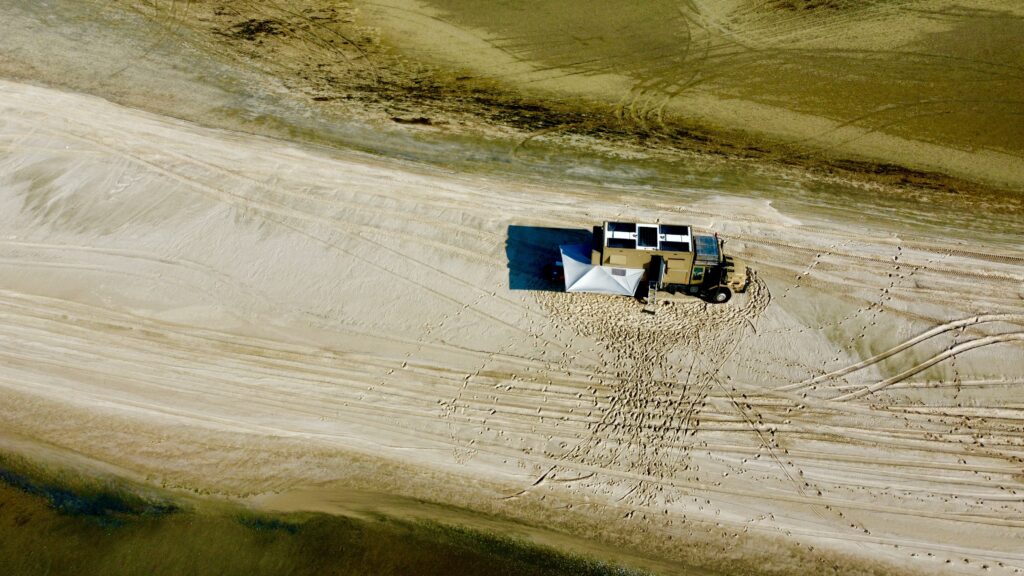

Next day, early morning, before breakfast, we took out the bicycles (for the first time since we were back). The fat bikes proved again to be perfect for the soft beach sand and we made a nice tour along a stretch of the lagoon shoreline. There where now a few people (families, groups of guys or lonely fishermen), along the shore line, and they were very surprised to see two European tourists biking along the Inland Sea. I bet that nobody ever did that and can imagine why indeed these people were a bit surprised (besides, Marja was dressed in her sporting outfit and all the women we past along the shore line, were wearing their black habayas and had their faces covered).

A nice dip in the Sea, was our reward after the biking trip, followed by a healthy breakfast. Since we enjoyed being at this spot so much we decided to stay two more days. The next day, we had a lazy day (there are hardly any days that we do nothing). We did some walking through the water and hopped from sandbank to sandbank and walked and climbed the dunes around the Inland Sea. Lots of fish were jumping away. There are this big flat fish, with the color of the sandy bottom, which you hardly see. Most of the time they just race away when you approach and leave a big cloud of sand dust in the water behind them. But sometimes they notice you todo late and you step on them. You then feel a lot of movement under you foot, so you quickly raise your foot. They are harmless to humans, but the let you jump, when you step on them.

The day after, we took our other toy out, the inflatable kayak. It was so appealing to go out boating, that we couldnt resist. There was also a rocky island in the Sea, where we wanted to go. So we went out for a small expedition. Some parts were so undeep, that we got stuck and had to walk, but mostly it was ok. Because it is not so deep, we could see so much fish through the clear water. We even met a group of flamingos. On approaching the island, we were welcomed by “attacking” fish eagles. Since this island is so remote, it is the place where the Sea Eagles breed. We stayed away from where the Eagles didn’t like us to be. On the other side was a small cove, where we parked the kayak and went snorkeling. What we encountered, was not what we expected. Behind the island the depths changed from less then half a meter to 50 meters (due to the currents of the tides). And in these depths, we saw huge shoals of all kind of fish. It was amazing to see so much life under the surface of such calm waters.

Going further with the kayaks, we stopped at a few sand banks and another island, where in the middle was a large abandoned Sea Eagle nest. These nests are huge and its hard to believe that with no “hands” just the beak, birds are capable to carry so much material from everywhere, to build up such a high tower (almost 1,5mtr).
The high tide started to set in and the current increased. We had anticipated that, so the way back, we just drifted along with the current. All the time we were the only ones floating on the water. There was nobody else on the water, like the previous two days. When we got closer to the truck, we noticed two cars parked close behind the truck, in such a way, that we couldn’t leave (if we wanted). We took it easy, stopped, turned around to make pictures with sun going down, when one of the cars started honking. I assumed, these were annoying SnapChat guys or other people just curious and wanted to talk. When we got closer, however, two big guys stepped out of a LandCruiser Jeep and walked to the shore line and waited there. It was a bit of an intimidating situation. They were not wearing uniforms but regular clothing and were clearly waiting for us. When we reached an Arab with traditional white robe and head cover, stepped out his jeep. He was on the phone while we stepped out of the kayak and moved it to the truck, the other two guys didnt say anything, even when I started talking and askedsome questions. They just looked at the guy on the phone. When he hang up, he started talking to us in Arabic and was clearly irritated or angry and was pointing to the kayak and made a hand gesture that we had to remove the kayak out of sight. Now one of the other guys (a Pakistani) started to translate, that the man on the phone was a police officer of the environmental department and boating was not allowed on the Inland Sea (not even in an inflatable kayak). I apologized a thousand times and promised to store the kayak away asap. The officer was satisfied and even showed a smile on his face. No wonder that we didn’t see anybody else boating on the Sea here. Om the way back we did see multiple signs indeed of what was not allowed on or near the inland sea and boating was clearly mentioned. We just didn’t observe it when we drove towards the Inland Sea. Still we felt good, that we did something unique again, which for sure not many people have done. Kayaking on the Inland Sea.


With pain in our hearts we had to leave this area. The Inland Sea, officially a nature reserve (with the surrounding sand dunes), but also used to cross with 4×4’s through and over the dunes, by doing so damaging a fragile eco-system and where peaceful kayaking on the water is strictly forbidden. Qatar works hard to be green, but at the same time has great disregard for its own nature. While Qatar is overflowing with oil and gas dollars, it’s on an spending spree, to host enormous events, with zero return on investment. Its own population depends completely on foreign labor for almost all kinds of jobs (even most police officers and soldiers are imported). While adding to the greenhouse gasses of the planet on an unprecedented level, the country itself gets hotter by the year. During summer time outside work and living, becomes impossilbe. But with the funds still coming in, even a huge open air stadium can be kept cool for almost a year, without anybody using it. But what will happen if the pumps pump up the last drip of oil or gas?
It is not up to us to judge or even give an opinion. We are visitors, we are there to observe and to learn. We want to see the world with our own eyes and try to make sense of all that is happening. But the more we see, the more difficult it becomes…….
We left this beautiful part of Qatar. Overall we had a wonderful experience in Qatar and are happy that we made the decision to go. Now it was time to go back to Saudi Arabia.
