I should actually use Kurdistan instead of Iraq part 3. Although Kurdistan is an autonomous region within the the Republic of Iraq, it is a different country. If not for the enormous change in landscape, but also the people, the language and……..much less checkpoints.
We left our hide out behind the abandoned house in the early morning and drove towards Kirkuk, the other oil-rich town in Iraq. The Kirkuk area produces 50% of Iraqs oil revenu. The area was, and at times still is, contested by the Kurdisch Government and Central Irak Government.
The road from Tikrit to Erbil via Kirkuk is heavily guarded, after every 500 meters there is an army post. These army posts are like “artwork” of small forts, made up with whatever they can find and painted through the artistic minds of the soldiers manning them. They always have a lot of bags and drums full of sand around them and one or two Humvees at the center or exposed. It’s almost like you are part of a Mad Max movie.


On the map its not visible where the “border” is between Federal Iraq and Kurdistan, so you don’t know in advance when the “border” controls show up. But about 40km before Erbil (the capital of Kurdistan), we reached the Federal Iraq border control. The same routine as usual, park on the side, checking passports, answering questions and explaining our selfmade tour itinerary. By now I wonder why they don’t have a system in place which links all our checks in one file so they can “follow” us. The many different security agencies probably do not really work together.
Anyway, we were good to go again. On the other side (coming from Kurdistan into Federal Iraq), there was a very long line of trucks waiting to get though. Don’t know if it is about custom duties or security checks. But you realize, that there are really two different countries in one country.
Next stop was the Kurdistan border control. Here the check took some more time. The border guards don’t speak Arabic anymore, but Kurdish (a kind of Turkish). Also explaining where we entered Iraq (which is clearly marked on the visa sticker in the passports), when we entered Iraq (which is also mentioned on the visa sticker) and where were going. The truck is what makes us suspicious all the time, it looks too military (as if a guy with bad intentions exposes him with a truck like that). But, also, they are not used to campers and caravans. Only when they call their boses somewhere far away, a person who is better at thinking out of the box because they either have traveled or have heard about this type of traveling, we are off the hook and can continue our journey.


It’s almost like you enter another room, when you pass this border control. Large green fields of grass or weeds. Many new buildings (houses or large commercial complexes) and a lot more new and expensive cars. We also saw thousands of new and used trucks and excavators for sale along the main road indicating the demand for heavy equipment and Kurdistan’s rapid development. In the far distance you see hills and mountains.
When driving towards Erbil, you don’t encounter any checkpoints anymore. It feels a lot safer if there is no need for these anymore. We also noticed hardly any garbage along the roads. Via the bloggers pages, we found a large parking near a park, not far from the city center. We didn’t expect to arrive so early, so we went out exploring the old town. It was weekend again, so the city center was buzzing with people. Erbil is famous for its huge, old citadel, around which the city is built. Unfortunately, the entrance to the citadel was closed, since the entire citadel is under renovation. You can reach the entrance gate, which is about 30 meters above the city, which gives you a nice view over the main square of Erbil. Thousands of people were on the square coming and going from the Citadel, the Grand Bazaar (a street market) or the Qaysari Bazaar (covered market).

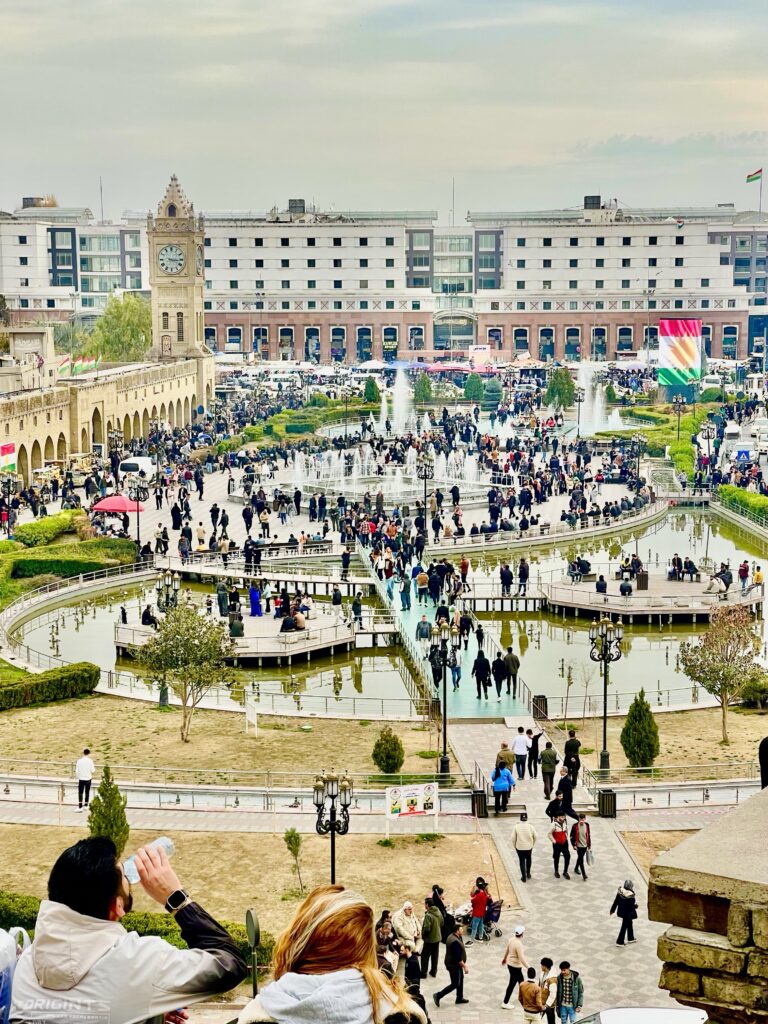

We visited the market streets in Baghdad, but the Erbil Grand Bazaar is of another level. There was so much to see, so much to buy. All the fresh produce, complete cows and goats, live fish, herbs, tea, tools, clothing. Little boys make some money selling plastic bags are walking with you with a small wheelbarrow (so you don’t have to carry the purchases yourself). The market men have little speakers in their stalls, shooting out what they have to sell. There are the mobil market men, who walk with large carts loaded with fresh fruits or vegetables through the street, maneuvering carefully through the shopping public and young boys with small wheel barrows, who offer their services to transport your purchases. These markets give employ to hundreds and maybe indirectly thousands of people. Often the prices are very competitive and allow people with a small income to buy their basic food items (actually a lot of the fresh products come straight from farmers so it might even be better and cheaper then in the supermarkets). Besides, these markets enhance social cohesion in communities and bring live into the streets of the cities. People from outside Erbil (even those from other countries or who work in other countries, come to Erbil to shop. There are, between all the stalls and shops, many money exchange guys with little desks (sometimes with brick size bundles of Iraqi dinars on top of it), changing money (we experienced that bank ATM’s in Erbil don’t work).


Arriving back at the truck another overlander just drove into the parkinglot. A German couple with a modified Landrover, with a built up living unit on the back. They also came from Kuwait and were on their way to Germany. We had a nice chat with them and exchanged some travel experience.
The next morning we invited them for a cup of coffee in our truck and again some nice stories to share. In the afternoon we made another tour through the city center of Erbil. Bought some nice Kurdish pastries at the bakery and had a mocktail in a restaurant overlooking the square. When arriving home, I started to feel sick again (I was not well the day before as well). This resulted in us staying another day in Erbil the next day.


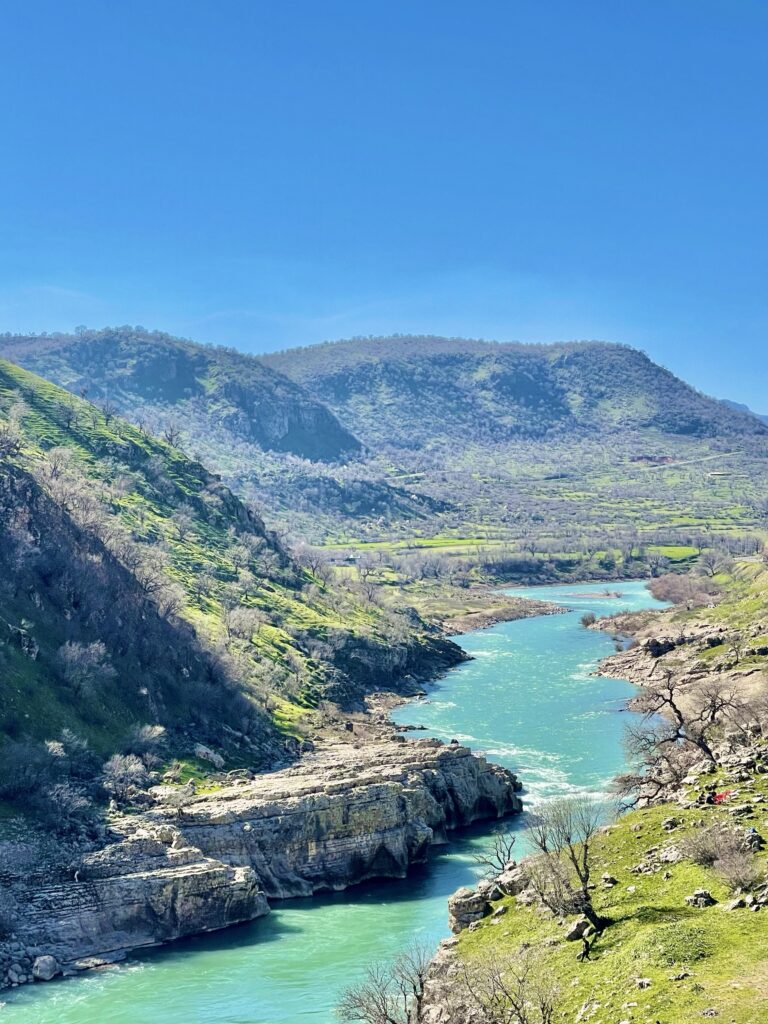
Feeling better after another day of rest and sleeping, we left Erbil the next morning, going towards the border with Iran. Leaving Erbil through the north of the city, you see another part of this booming city, with lots of construction, big villas, modern commercial buildings and more mountains. We drive most of the morning and did not encounter any roadblocks. First stop is the Gali Ali Bag waterfall, which is near the Zagros Mountain chain and the beginning of a small river, where Iraqis in the summer hang out with their families. The waterfall area is pretty much claimed by tourist facilities. Lots of concrete paths, fences and gates and a number of gazebos and small restaurants, surround the waterfall. A funny thing is how people in these areas love to make pictures of themselves and love ones. They all look for the perfect back ground, as if they are all influencers or movie stars. They often forget to look or focus on the location itself and enjoy the scenery or read what is the scenery about. And yes also here, random people ask us to come with them for a picture, like we are the cool thing to be photographed with.

From the waterfall you drive through a valley and along the small river we see many private or commercial spots with tents, chairs, gazebos etc. These are either private or places families and groups rent for the day or weekend, to hang around in the hot summer months. Here in the mountain area and in the valley it is cooler and there is water children can play in.


We continued and passed another city, and then reached the first checkpoint of the day. The Pershmerga check the paperwork and ask what we want further down the road. Our goal is the Halgurd Sakran National Park.

The road from Erbil to the Iranian border is originally called the Hamilton road, named after the engineer from New Zealand, who engineered the road for the British between 1928 and 1932, which was at the time a great engineering and construction accomplishment. Nowadays, a large part of the road has been upgraded and widened, but once you get to the higher regions of the Zagros Mountains, you realize that indeed it was a master piece of work. After the city of Soran it becomes more challenging, not only becomes of the fact that it is a 2-lane road, which is not that well maintained, but also the hundreds of (old) Iranian fuel tankers driving up and down from Iran to Kurdistan and back. Iran is supplying Iraq with natural gas for its power plants, which especially in the hot summer months need to supply large amounts of electricity. In exchange, Iraq pays with raw oil instead of US dollars, due to the US sanctions on Iran.

Along the Hamilton road, especially if you get closer to Iran, you see many truck repair shops but also many big diesel tanks with a simple motor pump, to supply fuel to the trucks for discounted prices. It’s a whole ecosystem developed because of the US sanctions. In certain areas you see people selling bottles of gasoline. They buy the gasoline in Federal Iraq, where the fuel is subsidized, to sell in Kurdistan, where fuel is not subsidized. (Can be a difference of up to 100%). Sometimes you see whole streets with small and big bottles of gasoline or even jerrycans. They are like molotov cocktail streets!


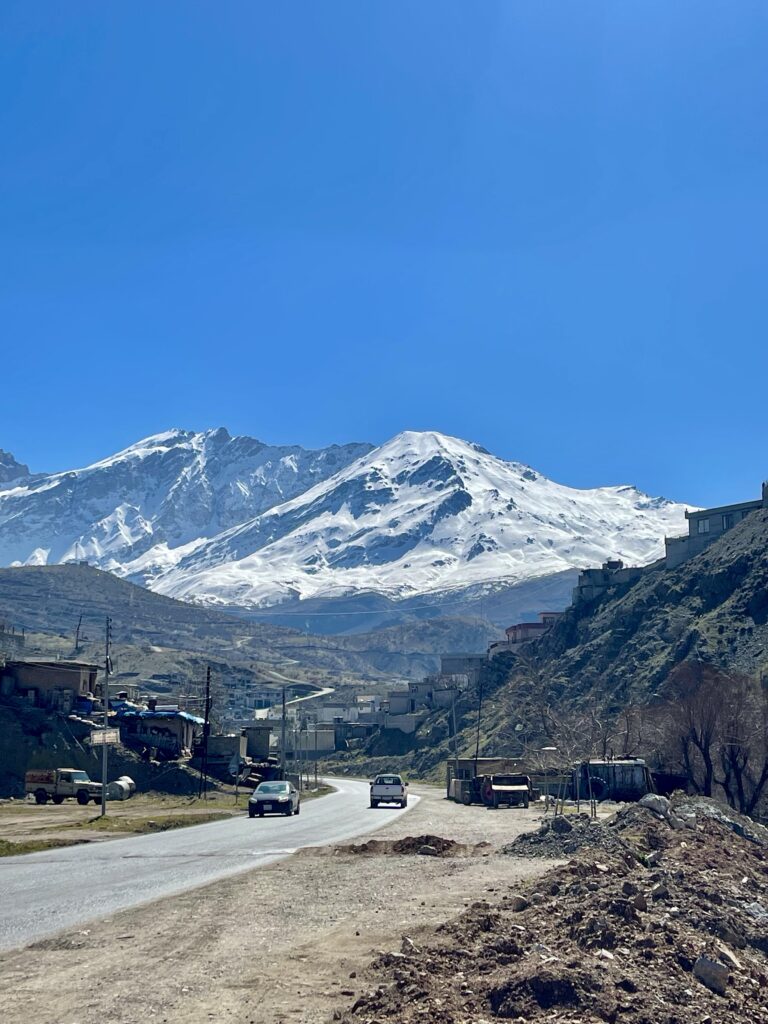
Reaching the small town of Choman, we had the next checkpoint. Here they were suspicious. When I drove up towards the boom and reached in my left pocket to get the passports, one of the soldiers (thinking I was grabbing a gun) loaded his automatic rifle and almost pointed it at me. Luckily he saw my hand coming back up with the passports and got relaxed again. I had to go to the commander in the office, who was actually asleep. Had to wake him up and after showing him our visas, he waved us through. From the checkpoint we took a side road into the mountains towards the Halgurd Sakran National Park where Iraq’s highest mountain is located (3611mtrs).
The scenery is spectacular with the high snow covered mountain tops. Along the road we see many summer houses of the Iraqi city people, most of them now empty. The higher we get, the colder and more and more snow and ice on the road. Then you reach the point that you can’t get further since the truck tires looses grip. So I turned around and then in a sharp bend going down, it happened. The truck started sliding and I lost control of her completely. It happened in the sand dunes in Saudi Arabia before, but this is different. This goes much faster and even steering doesn’t help. I saw a big ditch in front of me and thought, ok, its over now. But then the back of the truck goes faster down than the front and I came to a stand still just before the ditch with a wall behind it. So then I realized what it means when there is ice on the road.

I turned on 4×4 and low gear, turn the wheel a bit and drive slowly backwards, looking for a. spot with no ice so at least one of the tires has some grip. I felt traction and we were able to get away little by little, very slowly, from the ice without sliding further down the road. This was my first slipping experience with the truck on ice and I considered this as a warning for when we enter new destinations in colder climates.
Not wanting to go further the hunt was on for a safe camp spot, on a piece of land not yet claimed by somebody (fenced in). A flat piece of land with a great view on the surrounding mountains. The sun was still shining, but there was a lot of wind and it was cold, very cold. It felt like minus -20, so for the first time we had our polar coats on, while sitting outside on our chairs, watching the beautiful mountains. The area was deserted, not even dogs or goats. When the night fell (or when it became really cold), we got inside and let our diesel blower heat up the camper like a sauna. Nice and comfortable we prepared diner, had diner, our hot chocolate and got ready to go to bed.


Around 10.00 in the night, somebody was banging loud on the door. It’s dark outside, we don’t have the protection of the police or army, we are close to the Iranian border in the mountains. I first turned on my big exterior spotlights and then opened carefully a window so I could see who was knocking. Two guys in different army outfit and no insignia on their coats, but with big automatic rifles. They said that they were from the Peshmerga (the only word I understood). I said “Hollandi and caravan”, the 2 words I know they would understand. They said a lot but I didn’t understand a word. However, one was smart enough to call somebody who spoke English (his commander). I explained the gentleman on the phone, but he said that he has to contact the “leader” about what to do with us. A good 20 minutes passed, when they knocked on the door again. One guy gave me his phone and the commander was on the other side of the line. He had spoken to the “leader” and he was told to “evacuate” us from our location to the nearest Peshmerga outpost. According to him, we were very close to an area with mines and unexploded ammunition, that the Turkish Airforce has a habit of bombing our area and that they do that because there are bad people around. Well doesn’t sound that like a 5-star camping!!! Three good reasons to move…..

So almost in the middle of the night we had two follow the car of the Peshmergas over snowy and icy roads in the dark to the outpost. When we arrived, they were expecting us and pointed a location for us to park. Under their watchful eyes, and after all the excitement, we fell asleep quickly.
The next day we drove down the mountains towards the main road, we still had a few kilometers to do on the Hamilton road to the Iranian border. We were part again of the “train” of fuel trucks going full to Iran and return empty, to load again. The scenery got better the closer we got to the border. The border post is high in the windy mountains but we didn’t go that far. We turned around just before it, and drove back the same Hamilton road, towards the city of Soran, from where we took a new road, up north to look for the Shanidar cave. When we reached a checkpoint, there was a sign of another cave just before the checkpoint. I drove up to the checkpoint to ask the soldier if this was the right direction, he said yes, but of course I had to do the passport thing again. I had to report at a small building. First door I opened, there were soldiers busy praying (was the prayer room), second room there were some soldiers sleeping on the floor but at the next window, I found the right guy to scan my passport. With the long ash worm on his sigaret almost falling in my passport, he did his thing without looking up, but I was good to go again.

The road to the cave was a long, steep, bad road, up the mountain, with many sharp turns. We drove all the way up, but didn’t see any signs anymore of where the cave would be. We doubted if the soldier knew what we wanted or if he knew what he was talking about. On the way up we saw abandoned military look-out points made of sand bags, overlooking the valley below and controlling the road up. These were remnants of a line of defense during the Iran/Iraq war.

All the way on the top of the mountain range we climbed, there was a flat piece of grass land with parts of concrete slabs, which was what was left of an army camp. Great spot to park the truck and call it a day. It was quiet, no traffic, no buildings, just beautiful mountains. We enjoyed the sun going down behind the mountains, when suddenly a private Jeep Wrangler drove off the road towards us. Five men in military outfits jumped out (unarmed this time). They were Peshmerga, but off-duty. They were doing a fun ride with the jeep and saw us. They wanted pictures with us and the truck. Of course no problem for us. After a “see what I can do with me Jeep show” and loud music, they left the scene. Nice guys and for us it was a confirmation, we could stay where we were for the night.


Driving down the hill again (after we convinced ourselves there was no cave in the area), we noticed a lot more traffic on the main road and people picnicking along the road. Driving back on the main road, we drove along a river through valleys and thousands of people were picnicking everywhere. It was a Kurdish National Holiday we found out. The day was wonderful, the temperature was nice warm, blue sky, the route through valley’s, along rivers was amazing and all the people being out with their friends and families. It was such a peaceful sight in a country with so much troubles.


After a while we finally found the Shanidar cave. It is this cave where in 1953 the remains were found of Neanderthal people, but in such condition that a lot could be learned about Neanderthaler society. For archeology and the science of human development, this is one of the most important sites in the world. It is also the location of the remains of the oldest human beings in present day Iraq.
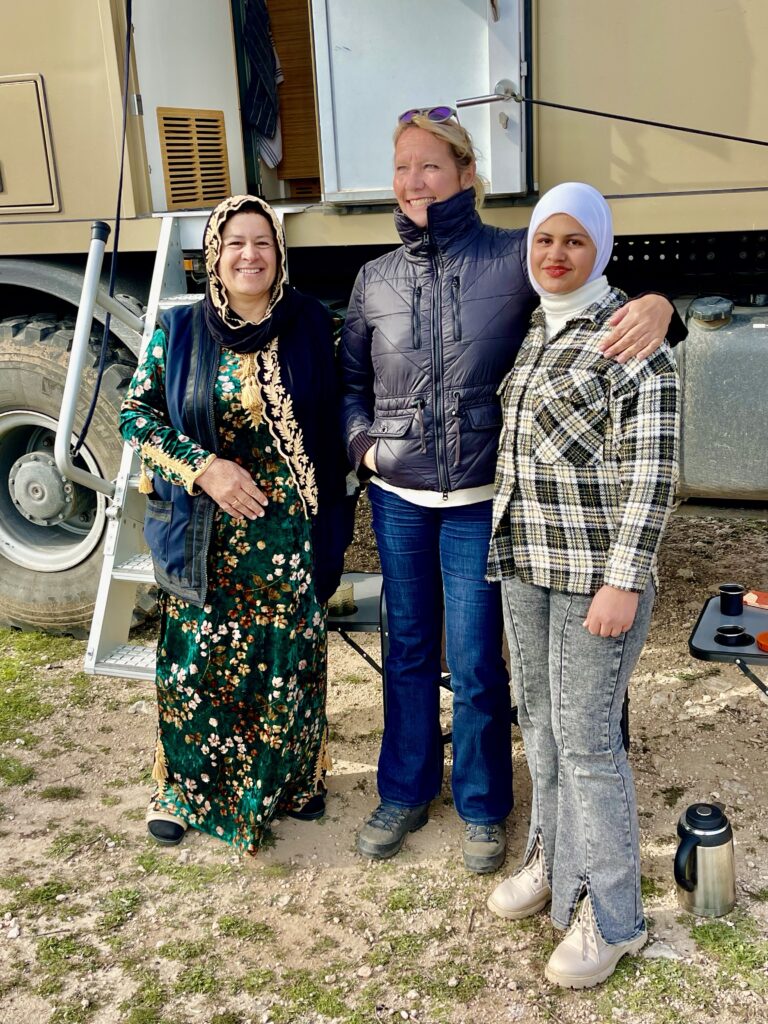
Before we entered the cave, we passed a Kurdish family, who were having a picnic under one of the shelters. They invited us to have some tea and sweets. We didn’t refuse this time. It was a real charming family. One of the daughters spoke good English so we had a nice conversation. She was a University student doing her Business Administration study. She told us about the horrible time her parents went through when Saddam Hussain was still in power. Saddam tried to “exterminate” and relocate the Kurdish population from Kurdistan (move them to the south of Iraq). He bombed villages, gassed villages, people where randomly arrested, locked up and tortured. Also her father was jailed and torturted for 3 months, while her mother had to flee into the mountains with her children. The Kurdish people still don’t have the same rights and privileges as the Arab Iraqis.


After eating some nice home made sweets and cakes, we left for the cave, a pretty steep climb up the hill. A huge partly fenced open cave looks out over the valley from where we came from. In the middle at the front a deep pit has been dug, with the walls protected by metal sheets to avoid collapsing. The pit is about 12 meters deep and this is the area where the remains we found. Scientists state that the remains come from a timeframe of 60.000 – 80,000 years ago. The floor of the cave became higher and higher due to debris and sand blowing into the cave, hence the deep digging by the archeologists.

For most of the (Iraqi) visitors a visit to the cave is just for a photo shoot, a picnic or painting graffiti on the walls of the cave. People have no idea that 60.000 years ago, the first people lived here and that these people had one of the first surgical carried out on one of them, showing that care and understanding of life and pain, was developing in the first humans.
From the cave we drove to Barzan, from where we took the road along a valley with a beautiful winding river and through a narrow mountain pass, towards the town of Akre. Along the way we could see that spring was coming with the wild flowers coming up at the trees getting their blossoms. The mountain pass is a gate way through a mountain range, heavily protected by the Peshmerga. It took us a while at their checkpoint before we could continue. But it was worth it (although, for a truck our size it was just, on the narrow road).



Akre is honored to be the most beautiful town of Kurdistan. The old town of Akre is “glued” against a mountain slope, with on top of that mountain the remains of the ancient castle. When you drive from the new town towards the old town, the roads are getting narrower and steeper. Like everywhere in Iraq, there are hundreds of cables and lines crossing the road, which are usually high enough, but now they were hanging lower and lower. Several traffic policemen stopped me, trying to tell me that the truck was too big, but I just acted as if I did not understand them and continued driving (the fact that they still doubt whether I am a – foreign – military vehicle still helps).

I drove further and now I wondered if I made the right decision. The road was going up in a straight steep line, into the old city. Just before it got too narrow, I saw a big parking on the left and turned in there right away. At least I could make a turn there if I had to go back. It turned out to be a paid, almost empty, parking and the guy in charge was happy to locate a spot for me. Right away he started making pictures of us, the truck, he, us and the truck and invited us for diner and even to sleep at his house! Can you imagine, you just want to park your truck and you get the full package!

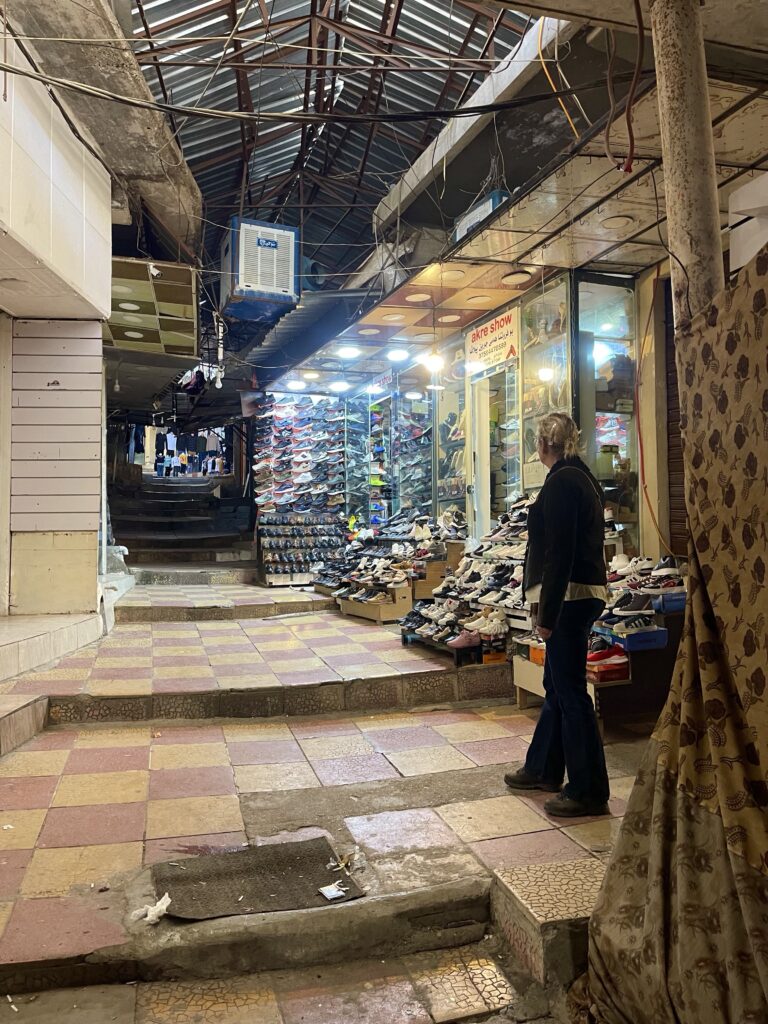
I thanked him (we have our own bed and Marja had her plans for diner already) and we started walking the road up, where we couldn’t drive. And I realized, the parking was really as far as we could go. The old city of Acre is a nice little tourist town, with many restaurants and shops. From the centre you can walk through little covered alleys to the old bazaar (which is part of the web of little alleys), and from there you “climb” up through the old town. Cars can’t reach most of the houses, so people have to walk a lot. The steep climb passes along an old Christian monastery (partly destroyed) and further to the ruines of the ancient castle on top of a mountain plateau, which gives you an amazing view over the old town and its surroundings. Because of the National Holiday (and the amazing weather that day) it was packed with people, having picnics and enjoying the view. Of course, as the only Europeans, we were again in demand for photo shoots.

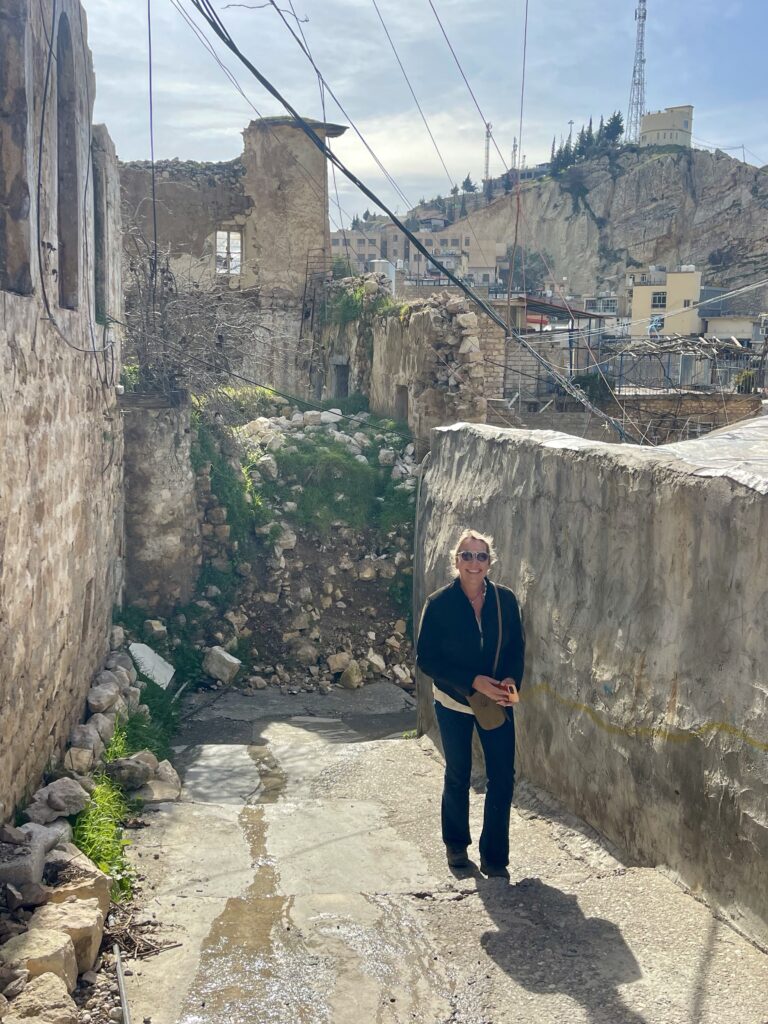


We stayed as long as possible, seeing most of the people leaving and catching the last glimpse of the sun going down. A few romantic couples remained and some even arrived to get that last moments of the sun. Despite the moslim regulations on showing public affection, it nice to see, that young people let the language of love talk and not that of the Koran.


After a last stroll through the old town with the lights coming on, we headed back to the truck. We were the only one left on the parking and were allowed to stay for the night.

Next early morning we did a more extensive tour through the old town. It was very quiet, the town was still asleep (it was the Sunday). Got some groceries at the small super market, whereby the owner was very creative with packing the eggs safely. (Most of the time eggs are sold in big quantities, so either you bring your own egg box or the seller has to make something).


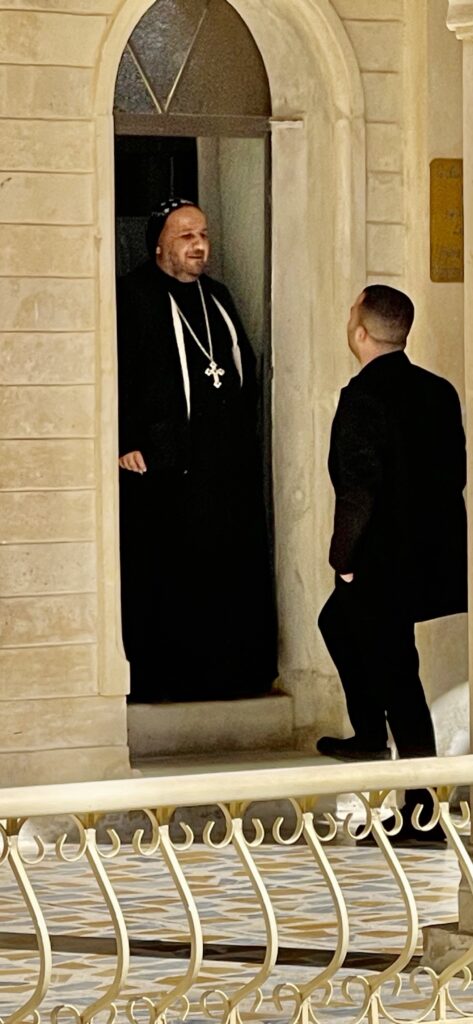
One of the last operational monasteries in Iraq is the Mar Matti Monastery between Acre and Mosul. Its from the Syriac Orthodox Church and is one of he oldest Christian monasteries still in existence. Its situated high against Mount Alfaf, facing the Nineve plains. The monastery was founded 363 AD by Mar Matti, the Hermit. The monks used to live in a hermit way. A life in isolation and only with the least necessities.
During its existence, the monastery has been attacked and destroyed many times. The terror group Isis came very close to the monastery (from where the monks had already sent previous centuries old manuscripts further into safer parts of Kurdistan). Luckily, the Kurdish Peshmerga were able to stop the advances of Isis. Up till today, Peshmergas stand guard at the entrance of the monastery, to protect it against any enemy. (In the past it used to be often the Kurds themselves who attacked and plundered the monastery).

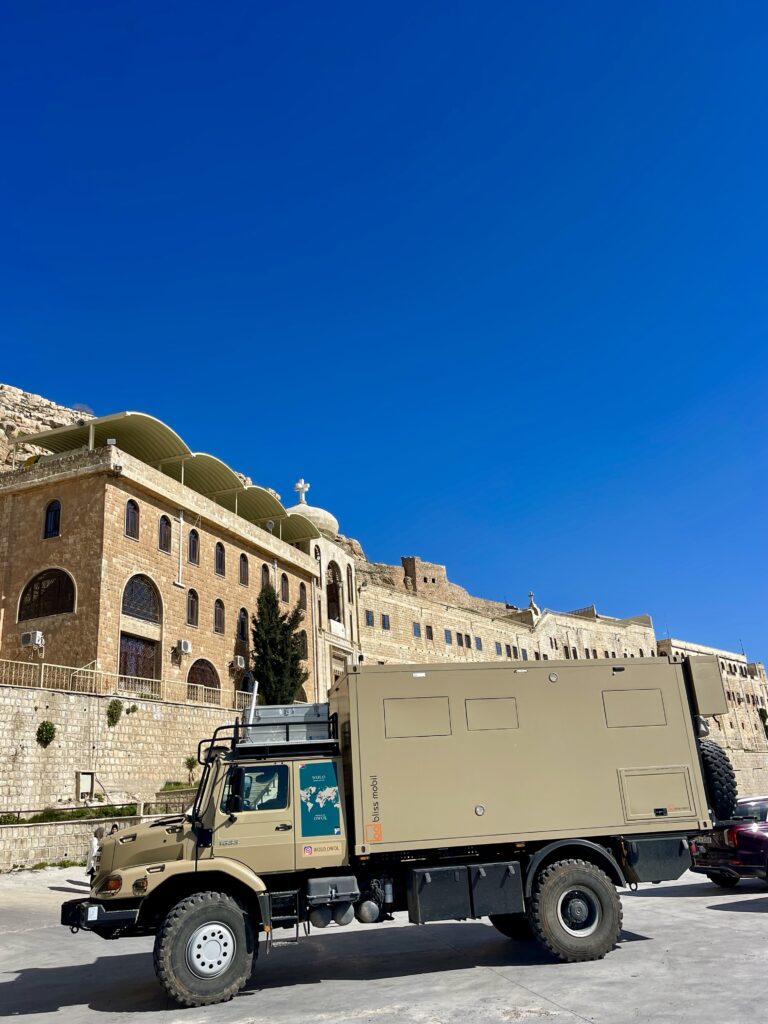

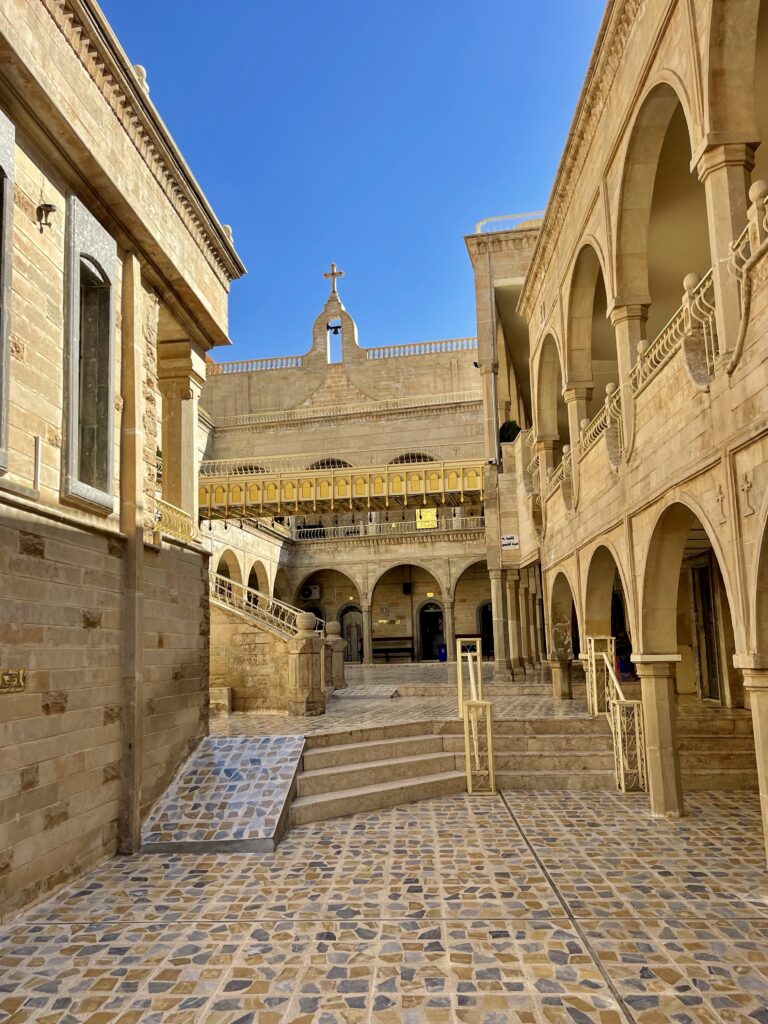
Since we planned to visit Mosul as well, which was only an hour away from the monastery, we decided to go there the next day. Mosul is the second biggest city of Iraq, but suffered the most of all cities from the horrors of Isis. It was the capital of the caliphate of Isis and tremendous crimes were committed in that city. Large battles took place between Isis and the Iraqi security forces to defeat Isis and chase them out of the city. We had read that the security in and around the city was strict and that some travelers reported that they were not allowed to continue their journey to the city. So a fresh start in the morning would be better than trying to get there later during the day.
A wonderful location near the monastery was our night camp, with a great view over the Nineve plains and at night the millions of lights of Mosul in the distance, but not before we had another photo shoot!
The first checkpoint we encountered, was the one when leaving Kurdistan territory. The Peshmerga took a while to check us out. They warned us that three more checkpoints were ahead of us, of which one was a militia (and the way they said it, did not make me feel very comfortable). But after while we got the green light to continue our journey.

Next stop was the Federal Iraqi border. The uniformed guys stopped us and a private car stopped behind us. A guy in a suite with a revolver in his belt, came to us (secret service). He spoke proper English and had family in Holland and Germany, he was nice. Some of them wanted to see the truck inside and also wanted to make pictures with the truck. We were allowed to continue, but again, they warned us for the next checkpoint, the militia.


Quite a different scene indeed, when we arrived at the next checkpoint. Lots of heavily armed men in a collection of self styled uniforms, with big badges on their arms, big flags of their unit and K9 dogs. I had to walk to the center of the covered checkpoint area, where around a fire pit, a couple of men were warming themselves. One guy, not too big, with a leader jacket and a black baseball cap and a little beard, seemed to be the guy in charge. I handed him our passports (over the fire pit!), he showed some dis-intrest and kept on saying Arabic, Arabic (as if I had to speak Arabic to him). Then I had to walk with him to the truck where he stopped and laid the passports and the vehicle papers on the front bumper. About 8 of his colleagues in all kinds of camouflage outfits, were in the meantime encircling us. He was asking around if somebody spoke English and he acted in a way as if it was a big problem. In the meantime one of K9 guys asked me to open up the truck and started looking in the cabinets, while another was looking in the truck cabin.

Another guy was so interested in our Instagram, that he wanted pictures with us and the truck. A colleague jumped also in for the photo, but since he was having his rest time he was on slippers, so we were not allowed to make photos from his feet (he came back 20 minutes later in full gear, including hand grenades on his bulletproof vest). At the same time the guy with the leader jacket, also found his way in the camper and sitting on our sofa as if he just became the new owner of the truck! And in the meantime they are all talking Arabic with each other, so we had no idea what they were talking about.

A next search started now, this time the sniffer dog (a full breed Belgium shepherd), was put to work and went around and under the truck. The leather jacket guy, now tried to explain me that we could not go Mosul and he showed his hand like being handcuffed (like we could be arrested or something like that). We have heard many stories of travelers who were not allowed to get to Mosul in very recent times, so I expected something like this, but why doing all the searching?

The searches were all done, but now Marja was busy to show all the other guys photos and Instagram and the guys were showing her pictures of themselves and their families. With the translator app she even had a pleasant conversation with them. It looked like the cold was out of the air now. But you have to realize this was the militia, the Popular Mobilization Force. A Shia militia linked and supported by Iran, who don’t have a good reputation in the West and are even not so popular with other communities in Iraq itself (they also seem to be involved in organized illegal smuggling schemes, so they are said to be also a criminal organization).

But then just of all of a sudden, the short guy in the leather jacket (little mobster), said we could go ahead (which I already didn’t expect to happen anymore by now). We jumped in the truck quick, said goodbye to all our “new friends” and hit the paddle, not realizing that I was near a low hanging communication cable. And yes, just too late, they signaled me to stop, because I hooked the cable and tore down the mast with the communications satellite dish, which was now directed straight to Mars. A lot of screaming from my militia friends made me hit the breaks, realizing something had gone wrong.

Good thing is, they don’t get mad about these kind of things. They were actually blaming each other, for either having the cable hanging so low or not helping me driving out. Anyway, one of the militia man jumped on the truck with in his hand a flag post with flag to push the cable of the truck and after that started waving the militia flag (which his commander didn’t appreciate, he may have been executed later that day, I can’t find him on Instagram anymore). Well I think we got the full Shia militia experience that day and were now entering the outskirts of Mosul.


Right away you see evidence of the big battle which took place here in 2016, when different Iraqi Government army and police units fought against ISIS insurgents. It took weeks to re-take the city from Isis, against great losses of human lives, wounded and destruction of the city. We saw many houses, which were destroyed by bombs, mortars and machine gun fire. This made a huge impression on us, ofcourse.


We drove towards the city from the north and realized that life in that part of the city (the east bank) is more or less back to normal. Many new buildings have been built or are under construction. There are new (paved) roads and there are a lot of businesses operational. When you reach the Tigris river, you have a view on the west bank (the other side of the city). That is the area where the Isis insurgents put up the toughest resistance and therefore they were literary “bombed out” of the city. Its were the old town of Mosul is located. From here you can really comprehend the ferocity of the battle which took place here. So many destroyed buildings…..
We parked on the bank on the river to take a break to “digest” our first experiences with Mosul (inclusive the checkpoint controls). Behind us the huge Grand Mosque of Al-Nuri is visible (which was completely destroyed, inclusive its two huge high minarets). It’s being reconstructed now and it showcases the spirit of rebuilding Mosul.
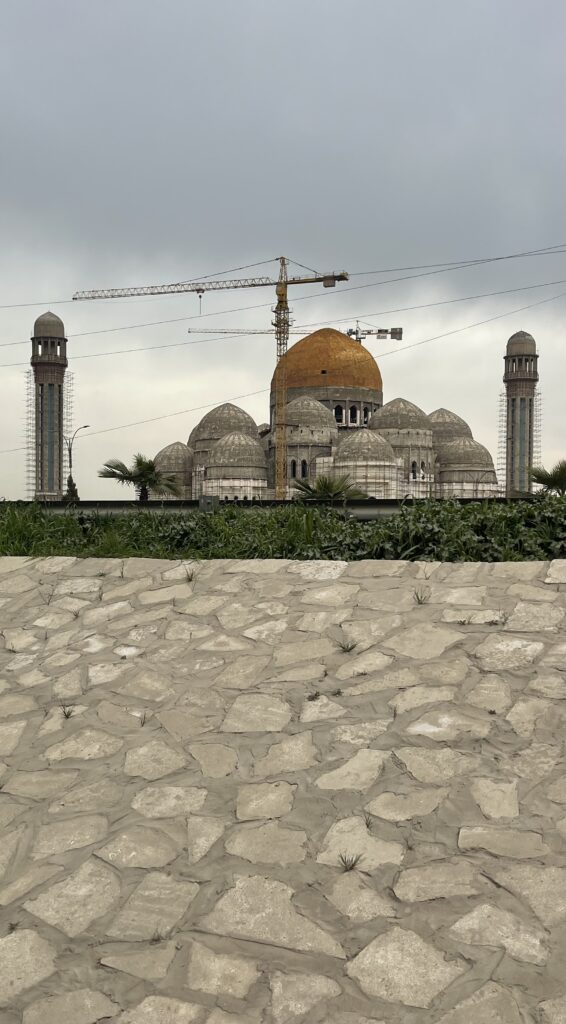
After the break we crossed the old bridge into the old town, which is like you enter an other city. The parts not destroyed are old and the streets are narrow. It even feels like the people are different than those from the other side of the river (there were a lot of people in Mosul and nearby villages who sympathized with Isis, so we were not sure if our presence was appreciated, especially in a western style army truck).
We drove to the edge of the old (destroyed part) of the old town and found a parking spot near a mosque under construction. From here we started walking towards the river side walking the street of the many destroyed houses and buildings. Here and there we saw a house or part of a house where people live. There are colors on the doors and walls, plants and children playing around, giving the area a less ghosty feeling.


There are many signs in the area, warning people for unstable buildings or the presence of unexploded ammunition. So areas have colored bricks on the ground, indicating a path, which has been cleared from explosives. The amount of bullets holes and marks on the houses is enormous, giving you an idea of the fire power used here during the battle.


Along the way, we encountered a group of people. There were two girls from Australia and Poland (tourists) with their guide, a 2-men TV crew from the local TV and an older local man who was telling in English to everybody who could hear it, that it where the Americans who destroyed Mosul and that there was never Isis in town. The TV crew asked me for a small interview (why not, a change from the picture taking was nice) to tell them about my impression of Mosul and the destruction.
Since the elderly man was on a mission to convince us and the girls about his conspiracy theories, we made our way out and continued our private tour through the destroyed old town. It’s estimated that the old town alone, will cost a billion dollars to re-build.
And then, after the last damaged building, the bazaar of Old Mosul starts (with the fish section), like there is no destroyed town or like nothing happened. After Isis was defeated, live returned in Mosul. About 1/3 of the population has fled the city (of 1,5 million people), when about 1500! Isis fighters took over the city and let the army and police (about 70.000 armed officers), run away. About 4000 army soldiers and police officers who couldn’t escape, were summary executed by Isis.

People returned, businesses opened up, debris from the battle was cleared from the roads and utilities gradually returned. People in general are resilient. We have experienced that ourselves when coping with the devastating effects of hurricanes at our home base in the Caribbean.
We walked the entire bazaar and it was very busy, very lively (like the bazaars in Baghdad and Erbil). The bazaar is located between all the little streets and covered. Many people looked a bit surprised at us. Not many western tourists show up here due to the presumable unsafe situation, but we get smiles all the time, like people are happy that westerners are coming back.


Close to the center of the old town on a traffic junction, there is a small square with a shoarma shop, which had some tables and chairs outside. The sun was shining, the temperature was good and we were hungry. Eating a shoarma on a square where 8 years ago people were killed by Isis for whatever reason, felt unreal. But we looked around and there was nothing except for some bullet holes in unrepaired buildings, that reminded us of these dark days. Other people came along to buy their shoarma, a family seated next to us and a salesman with a big cart with vegetables passed through the cars, to sell his merchandise. The old man who I had to pay for the shoarma, gave me a big warm smile, but it was as if I could see a lot of sadness in his eyes. God knows what he, his family and friends have gone through.

Along the way to the truck, we stopped at a small bakery to buy some Mosul cookies and we bought some fruit at a small stall (where measuring the weight went to old fashioned way). We passed the site where once stood the Al-Tahera Christian church, but it was blown up by Isis. Almost all Christian churches in Mosul were destroyed by Isis and almost all Christians fled the city, afraid of being killed (Isis policy was to destroy and eliminate all other religions, other than their own).


With the support of UNESCO this church is now being re-built and other will follow suit. Also some of the Christian families have returned to Mosul.

The area where we parked was not the nicest area and there might still be Isis sympathizers around, but I didn’t feel like driving anymore that day, so we locked ourselves in, put the ladder inside, locked the door and switched on a security cameras. Nobody could see or know that somebody was inside the camper with the metal panels over the windows. We had our happy hour and started preparing diner, when a loud sirene sounded next to the truck and I heard men talking outside the truck. I saw on the camera a big police jeep. I opened the window and saw the jeep with a huge machine gun on the back (the type that could shoot our truck in thousand pieces), 5 black-uniformed police men. They were either on patrol or were tipped that there was a suspicious truck in the neighborhood. They were friendly and didn’t even ask for our passports (they probably knew that we were already extensively checked at all the checkpoints). They indicated that if there was anything we would need, that we could count on them and that they will keep an eye on us. Well, if your are in the middle of a destroyed city at night, with maybe still some bad guys roaming around, that feels very comforting.

We slept very well that night, but didn’t want to be too comfortable. If you hang around in places like this, you might eventually attract the wrong people, so the next day we left Mosul. Mosul made a big impression on us, both the magnitude of the damage, but also that the people of Mosul just continuing their life again after all the horrors. Very hard to describe, hard to find the words to do so.
