After spending three nights at the Martyrs Monument, we left the early morning to go to the ruins of the ancient city of Uruk
We continued driving along the banks of the famous Euphrates river, through what is, or was, the marshes. Along almost the entire road, houses (well they looked more like ruins or half finished buildings) were built. You get the impression you are driving through a real third world country. You hardly see or recognize shops along the road and villages you pass and garbage, lots of garbage. Bill boards advertising products or companies you don’t see, but at almost every house or on poles along the road you see posters of men in military outfits, often carrying a gun. These are “martyrs” who died during the many wars and civil unrest in Iraq.


If you consider the history of Iraq, especially since the fall of the Ottoman Empire, the country had sparse peaceful moments. From the fight against the Ottomans, the colonial occupation by the British, the struggle between the religious powers of the Shia and Sunni part of the population, to the wrath of the Saddam Hussain dictatorship, the Iran/Iraq war, two Gulf Wars and the fight against Isis, Iraq was a hotbed for violence. Even now tension can run high between the different religieus groups, but also between clans and tribes or ethnic groups like the Arabs, Kurds and Turkmen.
Being the 5th largest oil producing country in the world (and in size a third of Saudi Arabia), you would expect to see prosperity, but the wars have cost the country enormously. Not just in money, but social and education development, environmental decline and health and well being (physical and mental). The government walks a very thin line in trying to phase the country away from war, social unrest and polarization by pleasing the many different intrest groups on one hand, and steering the country to development, improving the living conditions for its citizens and develop the economy in a sustainable way on the other.
While Saudi Arabia is having a clear plan (Vision 2030) to diversify its economy away from oil (by developing the tourist industry), Iraq has to deal with the most basic thing of a society, which is security. A country with a good level of security will attract investors and tourists. It will also help the young generation the focus on their development through proper education in a safe environment. This is so important.

With all that said, we feel first hand that security in Iraq is a major issue. Where we had some security checkpoints in Oman, Saudi Arabia and Jordan, these were not as serious (looking) as in Iraq. Army soldiers in full gear with armored vehicles and heavy guns, usually man these check points and there are many, really many of them. At most check-points our passports where photographed and our “from to where” routes were registered. Also the moment we stop along the road for a coffee break, within a few moments a police or army vehicle shows up to “guard” us. Iraq does not have the luxury to loose the momentum to become peaceful one day at the time. The kidnapping or killing of foreigners (especially westerners) would be very bad publicity for the country, and could cause major problems, and setbacks.


After driving for about four hours we reached the old city of Uruk. In the middle of dry marshes you see from afar piles of sand. When reaching the entrance gate, a number of uniformed men jumped out of an old office container. Not many people visit this site, so the officers are happy to have some distraction. As usual, there is great interest in the truck. We had to hand over our passports and could then drive into the fenced area towards the central guard house. A guard instructed us to park and indicated to follow him once we had parked the truck.

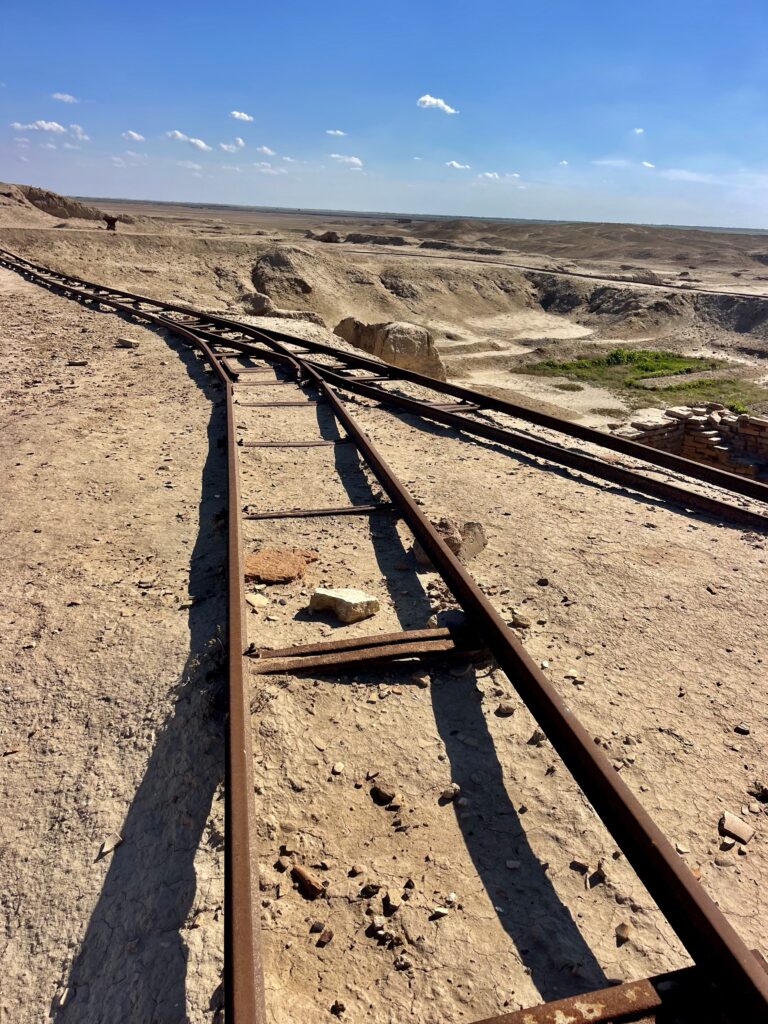
The site resembled an old open mine pit, big holes and piles of dirt, abandoned small rail tracks and sand tippers (the little lorries used to transport the removed sand over the rails, away from the digging site.) It is hard to imagine that we were walking on the ruins of one of the oldest, if not the oldest, cities in the world (over 6000 years old). The guard did not speak much English and was not in for a slow stroll. With a fast pace we walked over the excavation site. The first excavation started in 1853 and up till now only 30% has been excavated.
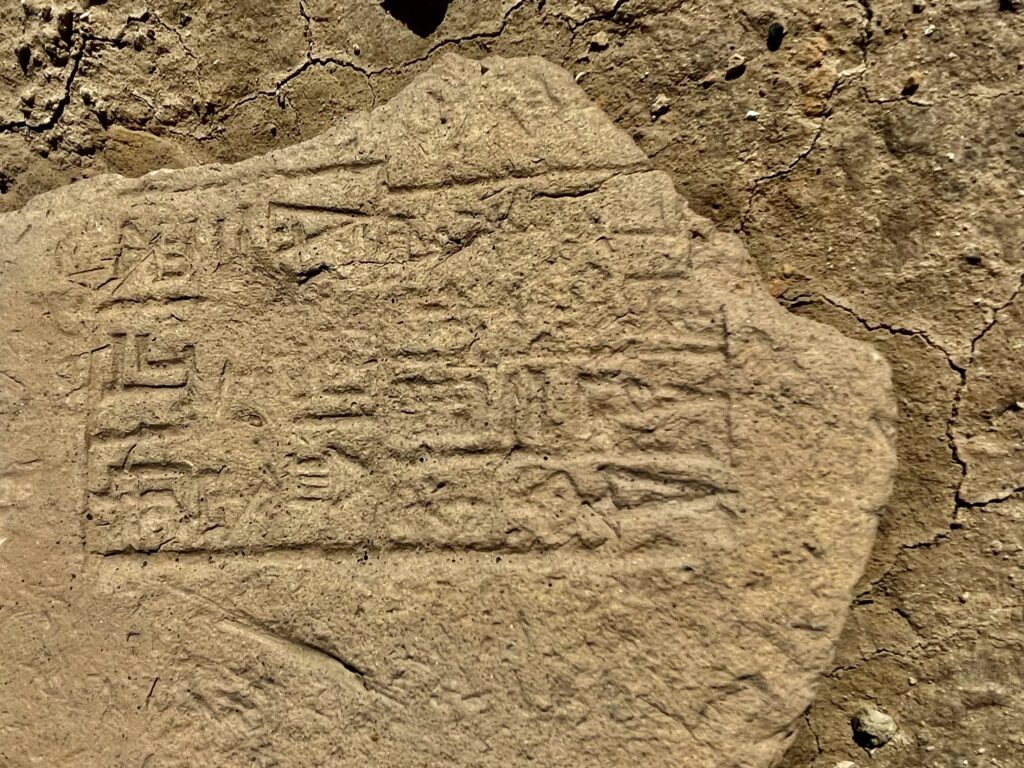
Everywhere we walked we saw the fragments of old pottery and even parts of tablets with written symbols. Uruk has been known as the birthplace of the first writing. Another interesting feature where the thousands of peg style mosaic stones in different colors (because they were made from different type of stones from different parts of the region.). These pegs were pushed in soft clay/cement, before it hardens. The top will show a round circle. With thousands of them you could make patterns on walls on columns.

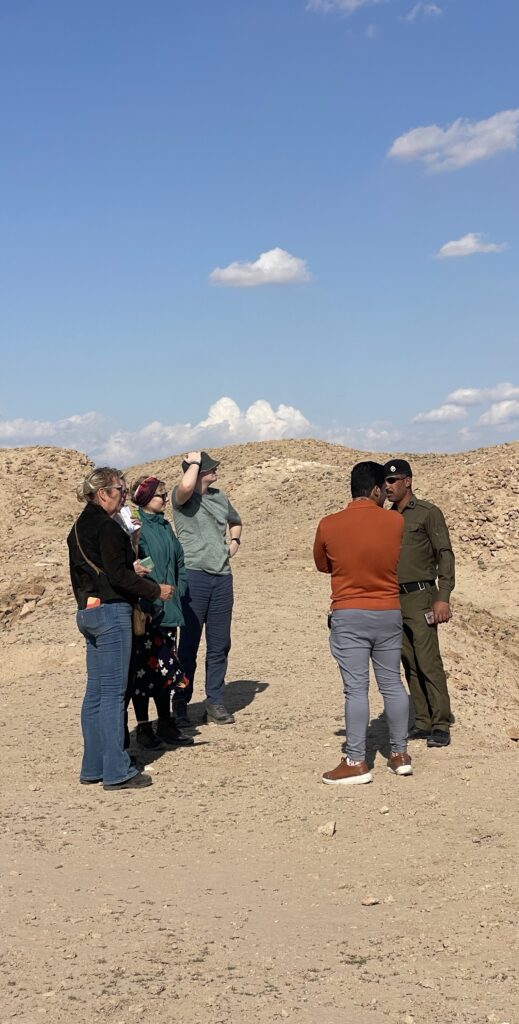
We met other tourists, three persons from Germany accompanied by their Iraqi guide. We walked together with them and another guide, who could explain a lot more than our guard, about the old city. We also met a famous art painter on the site, making paintings of the city the way he thought the city would have looked liked so many years ago. The guide with the Germans, was actually a police officer, replacing the official tour guide of the site for the day. He sold us an entrance ticket (only one, since he had only one ticket in his pocket, so with a big smile he told us he gave us a 50% discount).
Excavations are still carried out, a few weeks a year (when the weather is favorable and the situation in the country safe enough). Those parts that have been excavated, unfortunately, are not protected and are in decay. It’s understandable that spending money on archeological sites does not have top priority with the authorities, there are so many more urgents matters to attend. On the other hand, these ruins are part of the cradle of civilization as we know it. Most of our daily lives are connected to the seeds of progress planted here so long ago in the land once called Mesopotamia. Society as a whole is obligated to save and protect these remains and learn about where we as modern humans come from. Hopefully in the near future when Iraq is fully back on its feet, visitors and tourist will come (back), to learn about Iraq’s past, which is also our past, in fact, everybody’s past.
Since the day was coming to an end and wild camping is not allowed because of security concerns, we were told to park the truck on the small parking of the police station next to the entrance of the site. The officers were kind and helpful. It was not the nicest camp spot, but it was safe. Safety before anything else. There was only one issue…..dogs, barking dogs!! As it turns out, many of these police stations or army posts have a bunch of street dogs roaming around, waiting to get some left over food. During the day, the are lazy and sleep most of the time. But at night, oh boy, they let you know they are there. Barking, barking and howling like wolves, the entire night. A few times during the night, I run outside in my underwear, chasing the dogs with stones, not realizing the policemen on duty were watching me and were laughing about me running behind “their” dogs in the middle of the night…..
So, yeah, it was a bad night and we both were not in our best moods the next morning. But with some coffee with got ourselves starting up and after breakfast we hit the road again. Next destination was another ancient city, the city of Ur. Now we found out that I made a navigation mistake. We should have visited Ur before Uruk, which was a detour of an extra 400km. Time and fuel wasted and a lot of check points again, double checked. The detour was even longer than expected, since the road, which we had to take now, was blocked (8km before we reached the destination Ur). We had to drive another 100km extra on the big highway M5. We had not seen many gas stations so far, (luckily we topped up in Kuwait), so when we saw the first big one along this highway, I wanted to try it out (availability of fuel, price and how I could pay). As expected credit cards were not accepted (and I noticed that later at more gasstations as well). I said to the attendant that I can only pay per card, that I did not have any Iraqi cash on me. This because ATM’s are not easy to find either. Another truck driver overheard the conversation and told the attendant that he would pay for an X amount of diesel for us, so we could make it to the next town to get Iraqi Dinars. I only understood this afterwards! That was so super kind of this guy. An example of the Iraqi friendliness.

Not expecting having to drive this long extra distance, we drove off the road about 100 meters, to park the truck and have a coffee. Well, within about 15 minutes, I just took my first zip, an army van stopped on the road and two soldiers with big guns, walked to our truck. I jumped outside with our passports in my hand to identify ourselves. The soldiers where friendly and I was able to explain them, that we were just here for a short break. They smiled and walked away, but did not leave the spot, until we drove away. It seems like we are considered okay as long as we are moving along the main road. But the moment we stop, it feels like we can be a target, so we have to either stop within or nearby protected areas, or have some police or army officers close to us. And this will be the case as long as we are in Federal Iraq. We were now just before Nasiriyah and another checkpoint to pass. A few times you have to come with an officer and following him to his superior. Two plain cloth main were sitting on their beds and were eating from a small table. These were the man in charge. They had faces and postures who said enough. Do absolutely not mess with these guys. However, they asked me if I wanted to join their lunch or wanted coffee. So not to bad. One of them spoke English (the one guy you see in movies interrogating a prisoners tide up to a chair, with his teeth knocked out) and was friendly (oef, I am on the right side of this guy). He made pictures of the passports and we were good to go.

Until now we had not been able to locate an ATM machine or bank office, so we were still using our US dollars for payments which is not always in our favor and sometimes people don’t want to accept the smaller bills. Through Google Maps we were able to locate a bank in the city of Nasiriyah. Marja, brave as she is, jumped out of the truck, while I stayed inside, half parked along the busy main road in the city. First she tried in a hotel where an ATM machine was supposed to be inside, but that was no longer the case. Then we drove to a bank, but here the machine didn’t like our cards. The bank manager told us to go to another bank nearby. So we drove a little further into town (which is not my favorite, seeing how chaotic the traffic is). But, here, at this location of the Bank of Bagdad, Marja was successful, now we had our Iraqi Dinars in the pocket (1 Iraqi Dinar is about 0,0007 US$/Euro).
Driving in Iraq is like driving on a bumper cart track. There are rules, but nobody is following them. It’s the first country where I have not noticed any speeding control (yet) and where driving in the opposite direction on almost every road is pretty normal. Most traffic signs have been stolen (metal is in demand), so it is sometimes hard to figure out what is allowed or not. Also, many roads have no lines, so people drive the same way they would do in the desert.

There are big infrastructure projects in progress, but its unimaginable to describe how these projects are carried out, with all the traffic still flowing around the workers. There are hardly any detours or signage to indicate where to drive, so everybody makes his own plan. The good thing of driving a truck and drive a bit assertive, is the other drivers let you pass, to avoid being run over.
We left the town of Nasiriyah and drove towards the ancient city of Ur. Again check points and same questions. We have lost count of how many times we have been stopped by now, and how many times pictures of our passports and car papers were taken. There is also a big variety in law enforcement agencies and military units, looking at the different uniforms and vehicle prints. Looks like every tribe of clan has its own militia. This time we were stopped by even more serious looking guys in blue camouflage outfits, helmets and their faces covered (like SWAT or Special Forces). In general they are all friendly and correct but to have a conversation is impossible due to the language barrier. Usually it is joking about how many wives and how many babies they have, as that is something very important to them, and they cannot understand that I have only one wife and one baby. I can tell that often they are not sure to joke about that or to show they feel sorry for me. I explain them that they have no idea what they are talking about, what it is having one Dutch wife, let alone more of them…..
The old town of Ur is located near an airbase and military baraks. So again a pretty safe area. We bought our tickets (all historical sites in Iraq have the same entrance fee) and drove towards the site. A heavily guarded UN convoy with armed soldiers and lots of blue lights was near the site as well. One of the drivers standing next to one of big white Toyota Land cruisers, says “Henk and Maria, right? How are you?” I was very surprised of course, but it turned out he is one of our Instagram followers! Small world nowadays with social media.

The passengers and the soldiers were walking at the entrance of a big temple mount (for which Ur is famous, it even shows on one of the Iraqi dinar bank notes). The main person of the group turns out to be from Holland and is the resident representative of the United Nations Development Program (UNDP) in Iraq. This gentleman is responsible for allocating and supervising obo the UN, the (development) projects, financed via the UNDP. One of these projects (though a small one), is the financing of the construction of wooden walkways in the Ur archeological site, so that visitors do not have to walk through the sand or mud (after the rain).
It was nice talking to him, as he gave us a brief, but interesting, inside in the projects and challenges coming with these projects in a country like Iraq, which is slowly recovering from the wars.
After they left we did a little tour through the site, which is more or less from the same time as the previous one we visited (Uruk) and was founded by the same civilization, the Sumerians. As said, there is this huge dirt solid mount, completely walled in, with large steps going to the top (which used to be even higher), where a temple used to be. The temple was dedicated to the Sumerian God of the Moon (Nanna). It is hard to believe that this structure (a Ziggurat) survived 4000 years of harsh weather conditions and human conflicts. Another interesting feature of the old Sumerian civilization is the way they did there construction. They used bitumen (oil kind of substance) as a kind of mortar to “glue” the baked bricks together to built up walls. (Cement didn’t exist yet).


That night we were allowed to park near the entrance, between the police station and the entrance to the army baraks. Is was again not the most romantic spot, view was at a fence, garbage (even a dead dog) in front of us, and no privacy. We still made the best of it, had a little happy hour on our chairs in the sun, and waving to everybody passing by.
But then the night came…….dogs again. It is unbelievable the number of street dogs in Iraq. (So different from Oman and Saudi Arabia). These dogs hang out close to humans for left over food, they form whole (wolf) packs and at night they start barking for nothing. Again I had to run after them and throw some rocks to chase them away. It seems like they either like the camper or not, because they encircle the camper the whole night and keep on barking.
With sleepy eyes we started the day, and we had a long drive ahead of us the next morning. A pretty good highway was bringing us near the Holy City of Najaf. As we already found out, it would be hard to find a place off road to stop, to have a coffee, to relax or even empty your tanks. There are either people, houses or businesses all along the road or in desert areas (like the road we were driving on), but you won’t find the right spot to get off the road anyway.
However, with my experience I noticed a track and piles of sand in the desert, where we could do both, have a coffee break and empty the tanks in a pit. A little Dakar Rally style was needed to make that sudden move from the high way towards the track (but people here are used to funny driving, so nobody was surprised by my sudden move). I drove about 150 meters away from the highway and parked the truck behind a row of small piles of sand, but I was still visible from the road. The moment I switched off the engine, a police car made the same move and drove off the highway on the track towards us.
We quickly jumped in the unit to start making coffee. With an empty cup (coffee was of course not ready yet), I walked out the unit towards the arriving police car, to show them the reason for parking. Three officers with guns ready, stepped out and asked the same questions, where are you from, where are you going, what are you doing here? Well before they understand my answers! They are just not familiar with tourists driving in off-road campers, who like to be on a sort of private and quiet place to have a coffee. Many phone calls were made to all kind of superiors. Passports where checked again. After I finished my first cup, they said it was all okay and sked how long I was planning to stay at this spot. After my next cup we would move on again, I said. So they drove off, but waited along the high way, to make sure we would really leave the spot.

In the meantime back up arrived and there where now two police cars waiting for us to finish our coffee break. But I still wanted to empty my tanks as well, which I figured they could not see from where they were now, since I was still behind the row of sand piles. The moment I wanted to open them, one of the officers came back (running), to make pictures of our passports and of the truck and of him and the truck, an me, him and the truck…….I had to act fast, we jumped in the truck, started the engine, opened our tanks and started slowly rolling. When the tanks were almost empty, another office came walking towards us. I quickly stopped the proces and started driving towards him. Luckily he didn’t noticed anything. This was one the officers from the second car. He jumped on the side step of the truck cabin and with a big smile he asked if we had tea or coffee! Of course (I just committed an environmental crime under his nose).

Back on the road towards Najaf (which is the 4th most important holy city for the Shia Moslims). Najaf is where the Holy Shrine of Iman Ali is located. It is a pelgrims place and millions (8 million each year on average, which will grow to 20 million in the coming years) of Shia Moslim pelgrims visit the Shrine every year. Najaf is also the location of the biggest cemetery in the world (6km2) and this contains almost 6 million bodies. Many moslims from all over the Arab world want to be buried here and family members drive hundreds of kilometers with the deceased’s body in or on top of the car (in a open wooden coffin).
We drove around another hectic traffic city to find our overnight camp spot, which according to bloggers, was a paid and secured parking lot. Indeed, a large walled in, almost empty parking lot was just minutes walking away from the Shrine. And……..no dogs!!

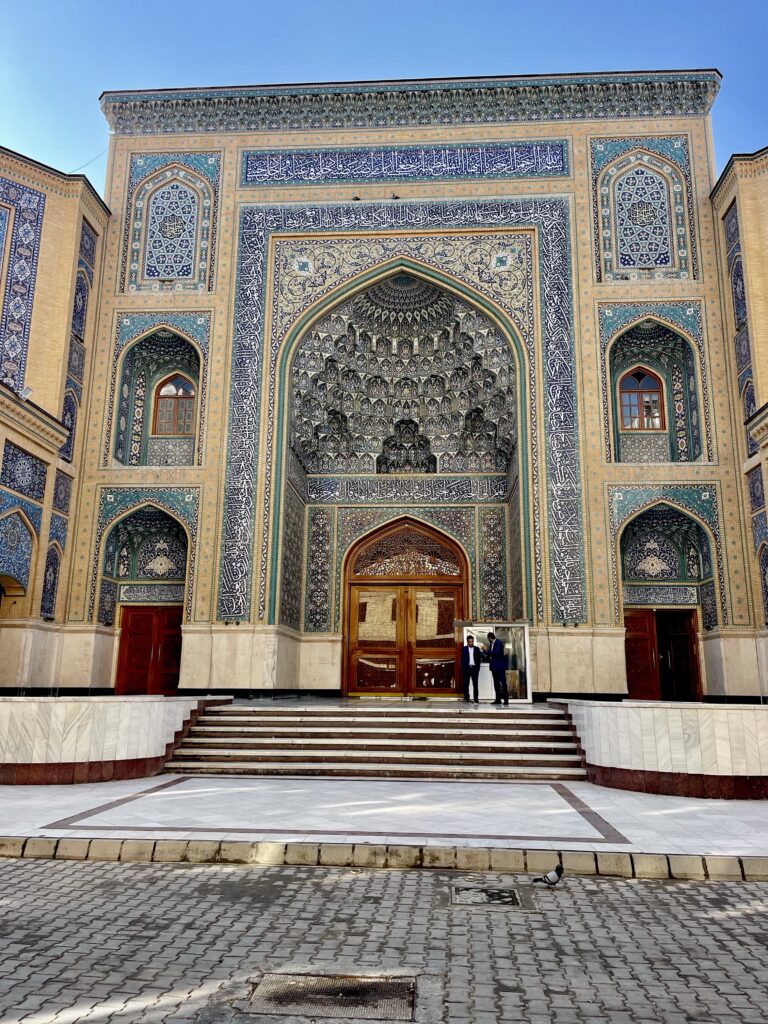
Finally we had a good nights rest and in the morning, we walked to the Shrine. The area around the shrine was bustling with merchants and pelgrims and unfortunately dirty (again). Roads and side walks were broken up and a lot of broken materials all over the place leading up to the entrance of the Shrine area. As usual, at the entrance, men and women have their own entrance and security checks. Walking in as a Christian Westerner (Christian by birth but not practicing) feels weird, especially when you don’t see any other westerners around you. But Iman Ali emphasized at the time, that this shrine would be accessible to all people. So, we were welcome.
A long escalator brings you to the top of the hill where the Shrine area is located. Everything goes orderly and there are guards everywhere. (Mosques and Shrines are targets for terrorists). On top of the hill you find the huge mosque with the shrine on the left and on the right all kinds of shops for food items or souvenirs, and small pelgrim hotels. It’s called the bazar area.

Just at the end of the bazar you reach the security check, where Marja got a beautiful black abaya offered, which she was obligated to wear. Hundreds of people were already walking around going in or out the mosque. Again women and men have their own entrance and there are open and secured lockers for your footwear (you are not allowed to enter mosque with footwear).


It is a huge complex and it is easy to get lost, so we located a meeting point. I had my shoes parked at the booth for secured storage and walked on my socks together with some imans into the mosque. First I encountered an open garden style area where men were siting or laying on the ground, from there I went in the room where the shrine is. And that is shockingly impressive! Its ceiling is full of mirror pieces, chandeliers, colored stones. There are men everywhere on their knees praying. It’s packed and the sound of all these praying men, is intriguing but all together I was very much overwhelmed. Even more when I reached the small room were the actual shrine (with the body of Iman Ali) was located. All the men in front of me, where trying to touch the shrine, which is the ultimate goal of each pelgrim. Some men were crying or even got hysterical. Some pelgrims have to travel from far and save up for many years to visit the shrine.

On my way out a deceased person, carried in an open coffin (but wrapped in cloth) by six relatives entered the mosque. Before a Shia muslim is buried, his body has to go around the shrine. All these rituals and being buried at the cemetery, are part of the process for going to the after life.

I left the mosque and waited for Marja at the spot we agreed upon. It took a while, since she had to walk a far greater distance in the mosque to reach the shrine. Inside she noticed that Arab women can be as rough as Arabic men. Everybody for herself, to reach the shrine and touch it. Even a mother pushing a wheel chair with her small kid, had a hard time trying to reach the shrine. That was not nice.
On the way back, we bought some Arabic cookies at the bazar. Despite all the flies in and around the bakery, the cookies were not bad at all!

Time to leave Najaf and travel to the Al Ukhdair Fortress via the other holy city, the city of Karbala. A mere 60 km to the next city, but still three more check-points. The last one again same procedure, parking the car just next past the stop point, handing the passports and car documents. Now I also had to walk with the officer to his office, and as usual, more officers where interfering and asking each questions about me, but especially the truck. The officer was checking each stamp in my passport then handed my passport to another officer with whom I now had to walk back to the truck. There a big belly crumpy “general” was watching our truck. This gentleman was going through my passport, checking every stamp. He took his time. Then he checked the truck papers, which are all in English, checking them, re-checking them (and he didn’t speak or read any English). After about 30 minutes he was done with his “show of authority”, gave me back the papers and said “go”. Way to go to attract visitors and tourists. Don’t mind the checking, that’s all good and understood, but don’t pretend or be arrogant. Just be efficient.

We passed through Karbala and were now going west wards into the desert area, where there are also a lot of farms (with the crop circles). Again check points. First special forces who let us pass easily, then the last one, I had to park, step out and go in an office. This one took time again, since the officer in charge, was constantly on the phone (about us). I was all the time guarded/protected (whatever you call it) by some kind of Iraqi Rambo. The point was that we had to be escorted by the military if wanted to go further. We had the wait for a while, then the officer in charge suggested that the “Rambo” guy would drive with us in the truck cabin, since the escort was not coming yet. We went through this before in Jordan, where we had to explain that we have only two seats in the front and sitting on Marja’s lap is not an option and visa versa.

The officer then decided we could start driving and that the escort would catch up with us. Felt a bit strange, since we thought that we really could not go in without protection. This is desert area and still home to ISIS cells. The road was actually busy with trucks carrying aggregate from the desert, so we were not alone. It was about an half hour when an army jeep with soldiers and a big guns, drove towards us, signing with their lights. They turned around and we followed them towards the old fortress.

The fortress of Al Ukhdair is huge, with high walls and towers. All is in tact (restored over the years). A little office in front of the castle is where we bought our tickets from the lonely cashier. Not many people (especially no foreign tourist) visit this location. The fortress is big and you get lost easily. Since it is still a dangerous area, we escorted through the fortress by 2 soldiers. We met two brave Italian ladies who where there with a guide and were also showed around by soldiers. It’s really an impressive structure so in the middle of the desert and was an architectural feat when it was constructed in the first millennium BC. Deep below in the dungeons we found hundreds of big heavy metal canon balls, which were used against attacking enemies.


Since it was such a beautiful and quiet area, we asked if we could park the truck next to the ticket office and camp for the night. All the soldiers were surprised with my request (the guide of the girls helped me with translating). A higher officer staying in a little house next to the ticket office was consulted and the guide tried to help, but I was a big no. Especially at night, there is the risks for attacks, robberies or kidnapping in this area. So we were told to go to Karbala and park and camp there, in the city center. We didn’t look forward to that, but it was already late afternoon. No choice then to go that way.
According to bloggers, there should be two guarded parking lots in Karbala, so we hoped to find a similar spot as the one in Najaf the night before. Karbala is the next Holy City, after Najaf. It is smaller, but not less important for the Shia pelgrims. It’s actually attracting more pelgrims than Mecca each year. Last year Najaf (about 500.000 inhabitants) welcomed 22 million pelgrims, compared to 3 million in Mecca and with that is the largest gathering in the world. Since masses like that have been targeted by terrorists (which happened twice not long ago), security is super tight. Check points in and around the city all over, soldiers on every street corner. It’s sometimes intimidating, but it gives us also a comfortable feeling of security.
Traffic was again hectic, very hectic, since a lot of pelgrims are arriving in and leaving from town. They visit or have visited the holy shrine of Iman Husayn. One of the most important Imans for the Shia muslims. We reached the parking lots but they were small and full. We had no other option than to leave Karbala (unfortunately, we were not able to visit the city nor the shrine). We decided to go to Babylon, which is a major tourist site and would probably offer parking.
The sun was already down and I now had to drive in the dark which I didn’t like. Cars without lights, no working street lights, pot holes in the road and the reckless driving of the Iraqis. Luckily they don’t have camels here passing the road. We arrived at Babylon around 19:00 and thought to be able to park near or next to the police post next to the entrance. However, the moment I stepped out of the truck a police officer shouted “nonono”. I was not even able to say “good evening”. Whatever I tried (even with my Google translate on the phone), he kept on saying “nonono”. So I assumed he was afraid to take some kind of responsibility for us.
We drove away and according to a bloggers site, their was an Iraqi family not to far away, who hosted foreign travelers (not sure if that would include big camper trucks). We had to take a side road somewhere from the highway, which during the day is already not easy, let alone at night. Of course we passed it at first, and had to make a U-turn on the highway. We drove in and within 100 meters we already bumped into a check-point (turns out that almost all side roads from the highways have a police or army check point). The police officers were very much surprised. While on the high way, they might have seen European tourist now and then, but on a small country road, chances are almost zero. I had to park the truck off the road, next to their police post building (a one room building of 5x5meters). They had not the slightest idea what we were doing here and I tried to explain that we were on our way to Baghdad and that we just needed a spot to park the truck to sleep for the night. I even asked them if we could just park next to their “office”. Unbelievable how much talk and discussions this could give between four grown up men. And how many phone calls they had to make. A yes or no would be sufficient you would think.
One of the officers was quite handy with his translation app and he started to ask all kind of questions. If we had water, if we needed food or needed to go to the toilet. And I said no to all he asked, but before we knew, we were told to get in the “office”. There was just a big carpet on the floor (so we had to take off our shoes), one of the officers was making tea on a small burner. There was a plate with chicken (partly already eaten), some rice, beans and pickles (with next to it the bones from the part of the chicken already eaten). We got some of the round flat bread and there was a bowl of water. We were invited for diner! It’s an insult to refuse, so we sat down and started to eat (with our rights hands, remember). The officer making the tea, was now also pealing boiled potatoes for us.
The food was not bad at all, we didn’t have diner yet and it was getting late. When we finished the food, the other officers also came inside and sat down on the floor next and in front of us. They wanted pictures with Marja and the “translating” officer, was constantly asking all kinds of questions through his Google Translate. Always the same kind of family related questions. In a fun way I said that I wouldn’t like to have four wives, too much trouble. Then one officer quickly pulled his gun and make the move like he was shooting somebody (with other words, if a wife makes too much trouble, he just shoots her). Well, that was very clear, but we both almost got a heart attack, when he pulled that gun. In Holland he would be suspended for a couple of months and maybe even loose his job. Not in Iraq.
Then out of the blue the officer with the phone, showed me another piece of translation “your break is over now”. Again I thought, are we really safe here? He saw my confusion and made a new text “you have to go”. So that meant that we couldn’t spent the night with our truck at their place. That was a bit of a disappointment. Now I didn’t understand the procedures anymore. At one location they insist that you park near them and at another they send you away without an alternative. That was what happened twice this evening then. So far.
We drove off and tried again at the next check-point on the main road. They checked the papers, but did not allow us to park. I saw a piece of vacant land and quickly drove up and switched off the lights (so nobody could see us). Within two minutes, however, there was already a police officer arriving, asking what we were doing. “No, you can’t stay here. Go to a hotel.” And again, we were driving in the dark, getting more tired and irritated. A couple of old trucks between piles of dirt and bricks, was our next option. I hid the truck a bit from the highway behind a pile of bricks. That was our camp spot for the night. Not very pretty, but the best we could do this night.
Unfortunately I had my battles with the street dogs again that night. Luckily I had a big pile of bricks to my disposal here, but a good nights rest was out of the question
