Many surprised faces around us the next morning! We were surrounded by workers, working around us and off-loading trucks, who had no idea there were people inside the big “military” truck in the middle of the yard. Their eyes were popping out when they saw two Europeans, fresh and dressed up, coming out of the truck. Yes, it’s not happening that often that a foreign tourist camper, camps at their place.
We left early, to be on time at the entrance gate of Babylon. We arrived half an hour too early, so we had time to have breakfast first. We were the first visitors of the day, so before a possible crowd (Babylon is one of the most popular tourist destinations in Iraq).
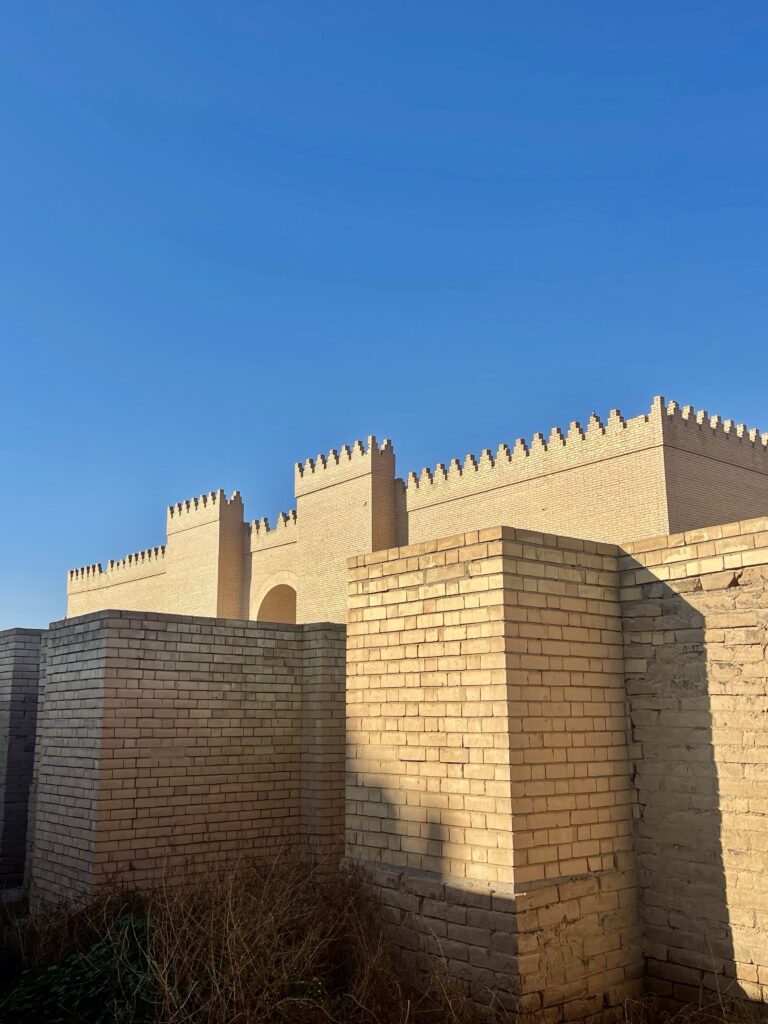
We bought our tickers and drove towards the famous “Blue Gate” of Babylon, though, the original is in the Berlin Museum and this one (which looks – according to me – so fake, it could be a structure from Disney park), was constructed by Saddam Hussain, who had a big part of the old Babylon reconstructed (on top of the remnants of the old town). Still, it was a nice scene for a picture with the truck, to proof the truck was there! It was so early, that even the many guides, normally hanging around the entrance, were not even there yet.

Babylon is an old town, almost everybody has ever heard about it. It speaks to peoples imagination. If not, for the “Hanging Gardens” (one of the 7 world wonders), though there is no proof they ever existed. Babylon is also known as the place where the tower of Babel was located (although, there are doubts about that as well). For sure Babylon existed for over 3000 years, was capital for different empires, of which of course the Babylonian Empire is the most famous one.
It’s that Babylonian Empire which gave Saddam Hussain inspiration for building a new empire, by invading Iran and Kuwait, which, according to historians, where once (partly) part of the great empire. He went so far as to destroy a nearby village (next to the ruins) and great a huge hill, on which he built a majestic palace, imitating the former rulers of the Babylonian Empire. To complete his palace (view), he had large parts of the north palace restored, by rebuilding the walls and arches on top of the remnants of the old walls. Hereby causing massive damage to the archeological site. However, without his “restoration” project, it would be difficult to comprehend the size of Babylon as a whole and the northern palace in particular.



For 2 hours we roamed freely, all by ourselves, through this huge ancient complex. We climbed the mount of dirt, from where we could see the parts of the town, which were not touched by the Saddam’s restoration project or not even excavated yet. From here we could see the mighty Tigris river, which passed the city in the old days and where vessels of trade passed along to bring or collect goods to and from the city. Although after years of lobbying, the Babylon site became an official UNESCO World Heritage site, the site is in a bad state of maintenance. There is a lot of graffiti on the walls, there is garbage, weeds and bush are crawling into the ruines. For a main historic tourist attraction, which generates a decent income, the authorities should take more care of this important tourist site. Getting a UNESCO qualification does not mean you can sit back and just collect entrance fees…….


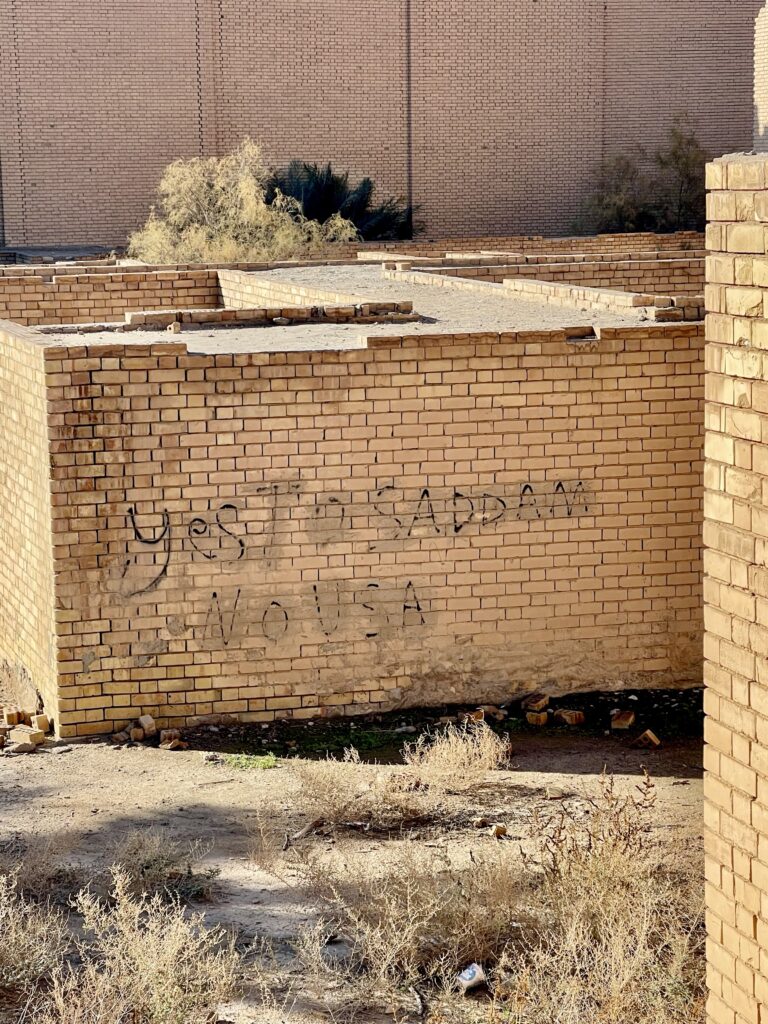
More tourists started to arrive, so then we left the city and started to walk up “Saddam’s hill”, towards “his” palace. The surroundings of the palace must have been beautiful. Well landscaped gardens, horse stables, a dock along the river, several service buildings (including one for his personal guards). After his regime came to an end when the Coalition forces entered Iraq, there was total chaos in the country. Law and order was gone and people started to loot whatever they could, including all of Saddam’s palaces and villas. Also this palace was completely ransacked. Everything of value has been removed, including even small items as light switches. All walls are covered with graffiti, showing the anger and frustration of the people at that time and times thereafter. But walking around in this “tourist” attraction, shows you the unbelievable wealth, Saddam Hussain had amassed over the back of the people of Iraq. But it also showed that not much changed between the days of the old Babylonian kings and todays autocratic rulers.


The whole compound including the palace are now a hangout for the Iraqi people and tourists. The view from the palace hill is beautiful and many young couples spend their sun-downers their. In the garden, there are picnic spots and small attractions for children, kind of a fun park. The people took back what was taken from them.

When we returned to the truck two Iraqi Intelligence agents came to us, asking what the thick white antenne on the truck was for. Didn’t get that question yet. When I said for Wifi/Internet, they were satisfied and moved on. Sometimes I wonder if they (the security people) got the priorities right. (Especially if I see how they check everybody at the checkpoints.)
Babylon was off the bucket list now, so we continued, up to Baghdad. We expected that the road to Baghdad (less than 100km from Babylon) would be very busy and full of strict checkpoints. But to our surprise, it was not busy and the checkpoints were very easy. So we arrived early on our camp spot. Driving and finding a camp spot in Baghdad is challenging, so before hand we were informed by the guide we met in Uruk, that there is a big parking place near an entertainment area on the outskirts of Baghdad. From there it is easy to get a taxi to go to Baghdad center or other areas.

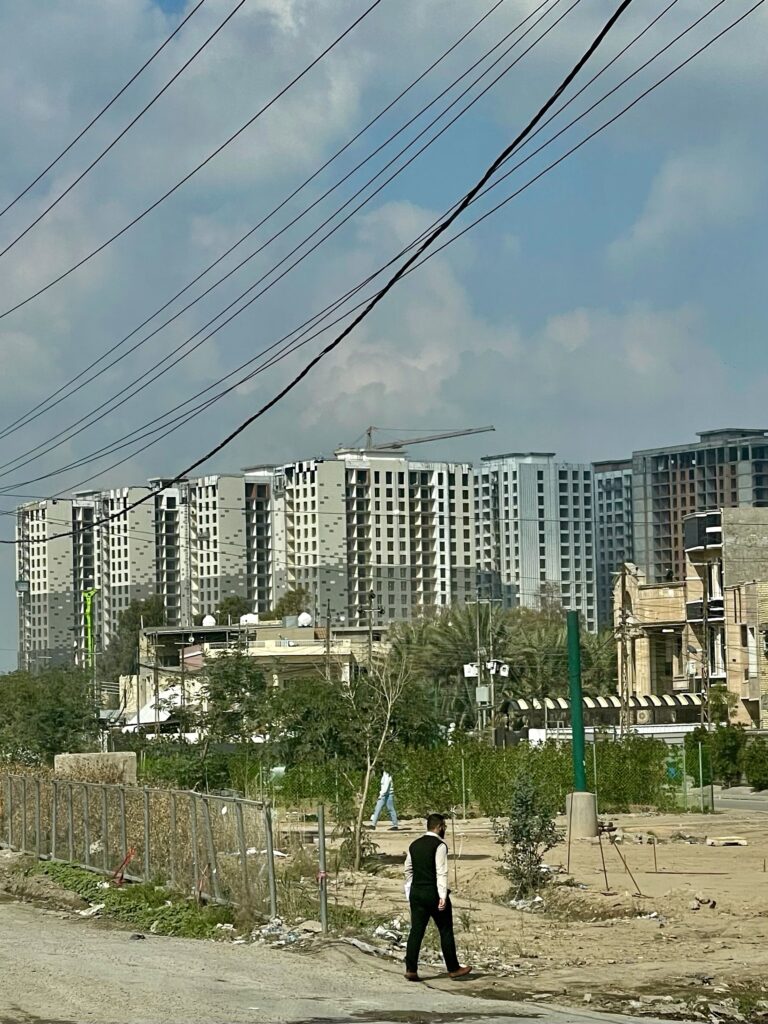
When you reach Baghdad, you reach “civilization” in Iraq. Modern high rises, enormous amount of new construction (Chinese companies are heavily involved as well) of which apartment buildings are the most common projects. Unfortunately with all these mega projects, Baghdad is losing its charm as the old Arab city. Old monumental buildings (although often in dire conditions), are demolished to make way for new apartment blocks.
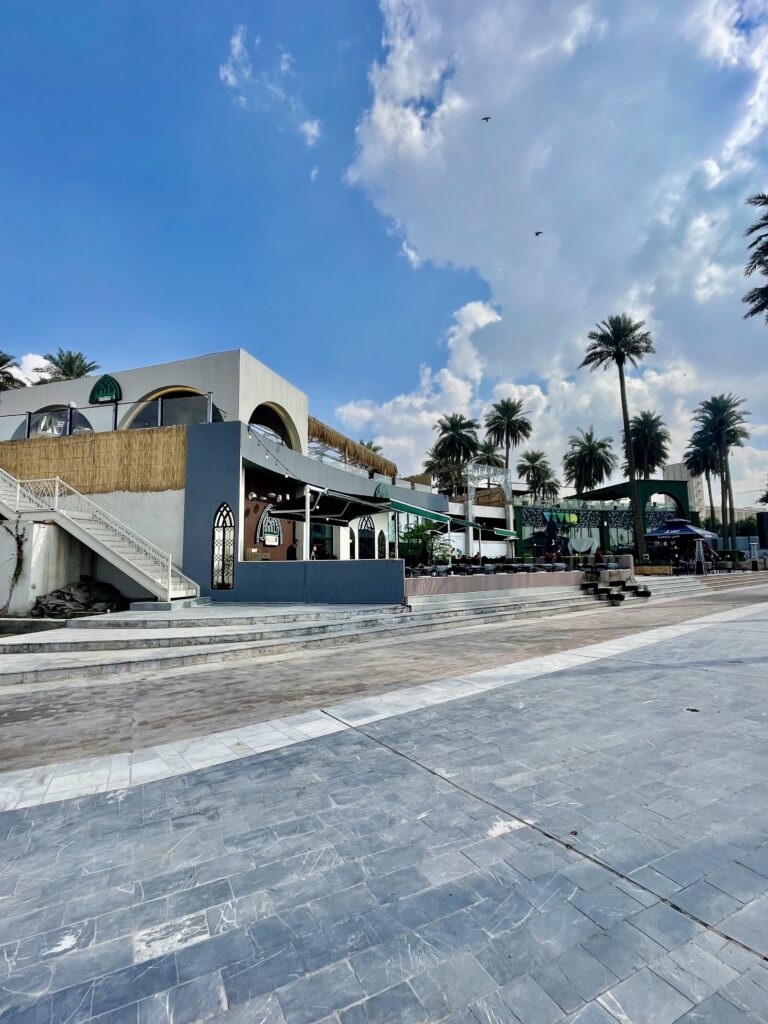
We visited the first real supermarket since we arrived in Iraq, brand new and very well stocked (walking distance from our parking spot). The entertainment area was also nice and seemed out of place after all we had seen in Iraq up till now. It was clean, girls in western clothing, many restaurants and nothing that reminded us about the islam religion. It seems that the elite in Iraq live in a different way than the rest of the population.
Next morning we took a ride from a random, friendly, Iraqi guy (taxis didn’t stop for us) to the Baghdad International Museum. Baghdad is trying to keep up with its population growth and construction boom, by adding roads, fly-overs and bridges. Construction is behind and therefor they try to squeeze the new infrastructure into, next and over the existing ones. This causes chaotic traffic situations and long delays to get in or out of the city. Our driver tried to make us relaxed (because it really is a survival of the fittest to get through traffic in Baghdad and I was happy that I was not driving with the truck here), by playing real (loud) Dutch music with open windows. He was proudly shouting to other drivers around him, that he was driving with people from Hollandi! I must say that we had a lot of fun and especially when the three of us – including the driver – sang the the Dutch song “Live, as if it is your last day”, which seemed so appropriate when driving in Iraq.
Instead of the expected 20 minutes it took us an hour to reach the museum, but at least we reached. The Baghdad International Museum, is the main museum of Iraq, where nearly all artifacts from the numerous excavations in Iraq end up. (Except those which were looted or taken during colonial times, to Berlin, London or Paris). You can visit all the historic sites in Iraq, but to really understand the history of Iraq, you have to visit this museum. It also shows you the beauty of the old civilizations, their engineering and art skills, but also the brutality towards each other. No matter how advanced or beautiful the ancient cities were, there was always another civilization or empire coming to destroy it and to re-build it. And it seems, history keeps on repeating itself.

The museum is huge and has an enormous collection, of which only a fraction is on display. The eye catchers are famous worldwide. What the mummies are for Egypt, are the Lamassu for Iraq. Enormous statutes, depicted as hybrids of animal bodies with wings and human male heads.

During the conquest of ISIS many remote historical sites, mosques and regional museums were plundered and destroyed. Even the Baghdad International Museum was under attack from looters, but this happened during the fall of the Saddam Hussain regime in 2003. Thousands of artifacts were stolen during the last days of the regime. When you visit the museum nowadays, men and women, will be thoroughly searched before leaving the premises (in case you put a 5 ton heavy statute in your pocket.


From the museum, we walked through town, crossing the bridge over the Tigris towards our next stop, the National Insurance Company of Iraq. Our Google Maps navigation brought us through a labyrinth of narrow streets and alleys with hundredes of little markets stalls. This is the old bazar area of Baghdad. It’s the old Baghdad we wanted to see today. Several dilapidated historical buildings could be seen, mostly uninhabited and ready to fall apart if you pushed against it. But still, you could see the remnants of the old Ottoman architecture. The state of most of these buildings is so bad, that restoration is almost impossible or otherwise too costly compared to demolition and new construction. With the rate these buildings are demolished, within 5 to 10 years, I think that not one of them will be there anymore.


We reached the office of the insurance company, where a friendly concierge guided us in the elevator to the floor of the vehicle insurance department. Our insurance, which we obtained at the border, was expired (which I only found out by accident at a checkpoint, since, there is nothing on the document that I could read or understand).
A large open floor with many old desks and worn out chairs, is what you see first. Of the 30 or so desks, only 3 were occupied. One of the staff was sleeping behind her desk. The desks had no computer screens, but piles and piles of seemingly dis-organized paperwork. And this is the head-office of THE insurance company in Iraq. (Wonder how the claims process will go……).

One of the other staff members was a friendly young guy, who understood what we wanted, but explained that we needed the assistance of someone else. After waiting a while and getting our first coffee for the day, Mr. Zaky showed up. A very pleasant middle aged man in a neat custom. A real insurance guy!
He looked at the expired insurance paper and understood what we wanted, just an extension. But first he invited us for lunch. Afraid that would mean no insurance today, since we were less than an hour before closure time (it was Thursday afternoon 14.00 and almost everybody is gone already, since Friday is the day off, and the office closes at 14:30), I politely refused. So he tried to convince us a couple of times, but then he accepted that we were not going for lunch. He prepared the new insurance document and mentioned the amount of the premium. Next hurdle was that the cashier was already gone for the day – and the weekend – and he/she is the only person that can take payments, not our Mr. Zaky. He asked us to come back on Sunday (which is the Monday in the Arabic world), but that was not an option for us, since we wanted to leave town on Friday, and we didn’t want to drive without insurance.
After a little while he took a brown envelope from the drawer of his desk, asked one of the other colleagues to watch, how I put the cash money in the enveloppe (he didn’t even touched the money). He sealed the enveloppe and I had to sign on it and write my name. Payment was done, so the cashier would get it after the weekend. Most important we had our insurance policy. Corruption is a very big problem in Iraq and people can get fired for the smallest suspicion. That’s why the procedure was like this.
We walked out to the elevator when Mr. Zaki came running after us, he gave Marja a little teddy fox!. What a nice guy! After we left Baghdad he kept sending us daily well-wishing messages (in Dutch!). Think we have a good friend now in Baghdad.

Having enough time left, we continued walking the lively streets of Baghdad. The great fun of cities like Baghdad, are thousands of small shops, carts and stalls along the street. Sometimes you see many of the same merchandise sold, in shops all in the same street. What surprised me were the shops where you could buy all the uniforms of every army and police unit in Iraq, including all the gear (weapons excluded, but they might have been in the back of the store). So I was wondering if every uniformed guy who had stopped me on the road, was really a police or army officer or that these shops are actually meant for the police and army officers to buy their own gear.


We reached the famous Shabandar Cafe, a popular tea house for locals and travelers alike and in the meantime an Instagram location. Its on old place, full of pictures of (famous) people who have visited the place over the years. You can only drink tea, which is brought to the clientele by waiters running around. You sit on benches with lots of cushions, have your tea, chat a bit and leave again. At the entrance/exit you tell the elderly owner how many cups of tea you had, pay and leave.


From the cafe we entered an area which was probably a bit more turbulent. So a special police man was assigned to us, to “guide” us through this neighborhood. This was a real serious guy. Never saw a police officer with so much stuff hanging on his belt (even a couple of hand grenades…..).


Crossing the bridge over the Tigris again, people were feeding the many seagulls as their Thursday afternoon entertainment (like feeding the ducks or goose in other places on the planet, people tend to do the same things all over the world). Now we were also incorporated in the entertainment. We had to feed the birds and then people were making pictures of us. Dutch people feeding seagulls. Dutch people don’t like seagulls! (But they don’t know that in Iraq).

Spending the night on the streets in Baghdad is not (yet) recommendable for westerners. There is a special “green-zone” in Baghdad where all the major government institutions are located as well embassies, UN agencies, big NGO’s etc. Including the residencies of a lot of the foreign employees. That area is heavily guarded and these people also don’t wonder around outside this zone at night. So we stayed with the camper on the safe parking spot that night.
Going north towards Kurdistan the next day, we stopped at the third important pelgrim city in Iraq, Samarra. For non moslims, Samarra is known for its famous spiral minaret, next to a huge mosque complex. There are no other known minarets of its kind still existing today and its an architectural marvel piece.

Arriving at the security checkpoint of the town, we were checked again but then told that we had to use the other road to town. So we drove half way around town to end up to the next check point. This time the check point was manned by men of the Iranian militia. In Iraq there is an presence of Iran (backed) Shia militia, defending the rights and interests of the Shia population (but also the interests of the Iranian Government). They also are involved in protecting Shia holy sites, like the one in Samarra. One of the militia members spoke pretty good English and even told me that he had family living in Belgium. We had to hand in our passports for as long as we stayed in the town and would get them back when we left.


Samarra is surrounded by water, levies and bridges. It was once the capital of a previous empire, who left Baghdad as the capital. Its unique as it has maintained its original layout of an old Arabic city (in Iraq). Once we reached the outskirts of the city, we saw thousands of people, hundreds of buses, vans and cars. Many police and army on the streets and it was tough for us to drive through. There was a huge car park, almost full and hectic with busses and cars coming and going. It was Friday and thousands of people came to Samarra to visit the holy shrine.


The shrine has been attacked by extremists a couple of times, whereby people were killed and wounded. Damage was done to its dome and minarets (not the spiral minaret). Hence the enormous present security around and in the city (more than we encountered in the other two holy cities). We could squeeze the truck between some other buses in the parking and right away, many bus drivers came forward, wanting to take pictures of the truck and us (with them).
Unfortunately, the old mosque and the spiral minaret are closed for visitors due to renovations, so we could only see it from a (not to far) distance. From here we walked into the old town along a number of check points and barriers. Again we were the only westerners (at least the blonde, blue eyed ones), so many eyes were or us. Marja was also the only woman walking around with her hair not covered and in jeans (she loves those rebellious statements, power to the women!!). It resulted of course, in the fact that an plain dressed security man (I think he was Iranian) asked us leave. Well at least, we did not get stoned to death! And by then we had seen enough anyways.

So we didn’t visit the shrine itself, and got back to the truck, picked up our passports at the check point, but not before I was introduced to a leader of the militia at the checkpoint (organized by the Belgium related militia men). The leader was a very imposing man, who was in charge of a unit who defeated Isis at Samarra. He was well respected and a true hero in the area. He had some intriguing stories to tell about the battles he and his men had fought. The details you can imagine yourself.
We continued our road up north and passed a huge fort just outside Samarra. To make up for not seeing the old mosque and the spiral minaret, I parked the truck near the fort, between hundreds of picnicking people and their vehicles. It was most probably the preferred spot for the inhabitants of Samarra to go to on a Friday, when their town gets flocked by pelgrims from out of town.
The moment we stepped out a big group of young men came greeting us. Even without any of them speaking English, they kept talking to us, asking us questions and they made hundreds of pictures of us. When I made clear that I wanted to see the fort, the “leader” of the pack, gestured to lead or bring us and what for the next hour and half happened, we were not really prepared for. The whole group joined us and started singing, making music on various instruments and dancing (still don’t know whether the words in the songs were positive of negative, or if they were making fun of us, but it seemed they liked the idea that we were from Holland). On the way to the fort’s entrance, the group became bigger and bigger and everybody was watching and filming us, as if we were famous people.
We entered the fort through a tunnel like ramp, going a few stories up. On the way up another group of young men and boys came down with more instruments and were dancing and singing as well. That group joined our group and we all went up to the big court yard high in the fort. They were singing as a contribute to Marja and were all dancing around her. Some were getting crazier by the minute and were touching us as well. Luckily there were some strong guys overlooking the situation and they started (like body-guards) moving us slowly back to the truck, but the singing and dancing didn’t stop. When we were almost back at the truck a police car showed up and everybody stopped singing and dancing, pretending nothing happened. We were happy, because we had no idea in what way we would get back in the truck and leave.
After the police left, most guys still stayed with us and kept on taking pictures. The leader of the pack then climbed into the cabin, almost on Marja’s lap. He indicated that he wanted a ride to his home, this we would pass as we were going in the direction of Tikrit. Since we only have two seats that was not possible, but he was already half in and I couldn’t tell him to get out. Besides that he had given us quite an amazing experience that afternoon. We found out that Snapchat in the area exploded again! So, to Marja’s chagrin, we drove away from the crowd, with the cabin door half open and Marja defending her seat. I had no idea how long this drive would take. The door was open, I could not see my right mirrors, Marja was very uncomfortable and he started to touch or grab all the loose items on the dashboard and storage tray on the freezer. (He choose the double cigarette charger, which I eventually gave him).
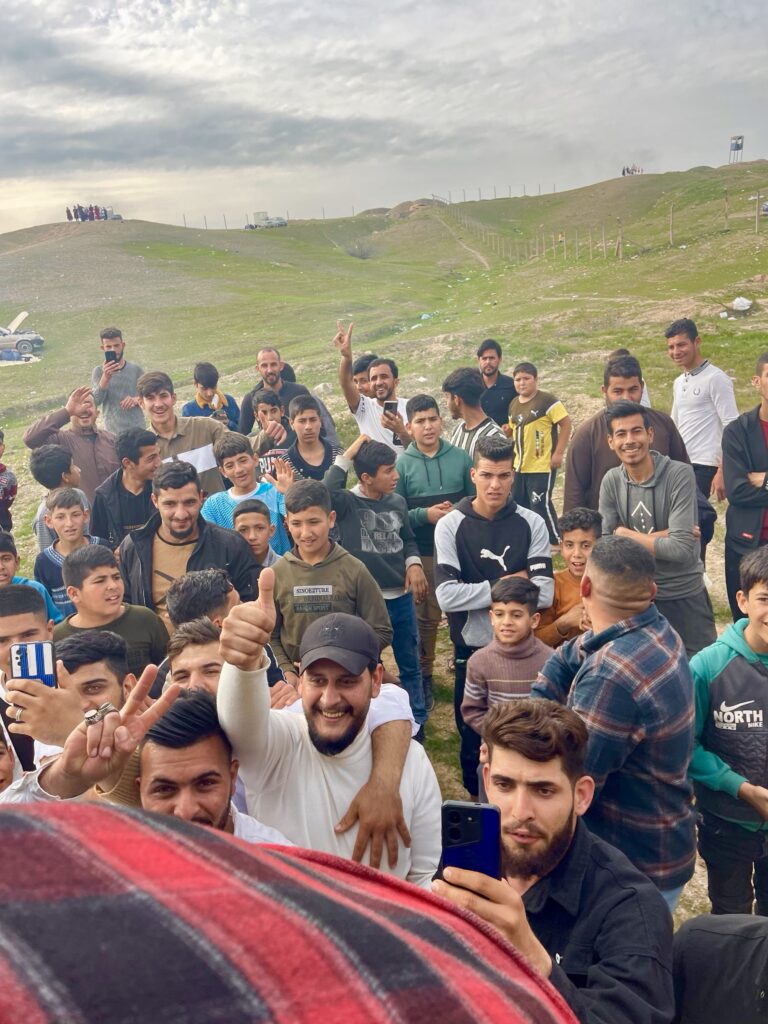
Luckily the whole ordeal didn’t take that long. After 20 minutes I had to stop and he jumped of. He was very thankful for the ride and the charger, and we for his entertaining afternoon.
Tikrit was another 50km driving and is the birthplace of Saddam Hussain. It’s the city were most of his loyalists came from. Up till today people from Tikrit are mistrusted by the many other Iraqi’s and the government. They feel marginalized and left out of government jobs and services for their city. When you drive out of Tikrit, crossing the Tigris again, high on the banks of the river, you see another huge palace of Saddam Hussain, one of his biggest. Its partly destroyed during the Gulf War by the Coalition forces, like the big mosque in Tikrit. It’s also abandoned like his other palaces and I understand there are plans to make it a tourist attraction. Towards Tikrit we could still see bombed houses, still untouched, since the end of the war against Isis.


We were still far from the border with Kurdistan and it was getting late. Finding a camp spot remained challenging. On the blogger site we found a location used by other campers, which was an abandoned partly destroyed house, where you could park behind out of side. And indeed, it was still there and a quick turn off the road, without being seen, brought us at the back of the building. The main building was just as high and as long as the truck, even same colour, so nobody could see us and…………no dogs! A good spot for a good night!

