After spending an extra day on the beach we finally left Musandam. The ride along the brand new coastal road was our last treat of this beautiful part of Oman. Leaving Musandam (Oman), was a bit complicated, since the Immigration officer informed us that our visa were expired, although we have multiple entry visa for a year which was not even one month in use. He could not explain and since we were not planning to go back to Oman, we didn’t bother to go into further discussions with someone who hardly spoke any English.

The re-entry into the UAE went easy and friendly. The moment you enter the UAE from Musandam, it’s a big difference. Lots of little shops and businesses along the road owned and operated by Pakistani, Indians and Bangladeshi. A sight we know from Oman and Saudi Arabia as well. Not the sight you would expect from the Emirates. When you think Emirates, you think about outlandish sky-scapers, luxury and beauty. But the Emirates is not just about Dubai city and Abu Dhabi city. There are five more Emirates with a lower profile. There are major industrial areas with big factories, refineries, oil storage tanks, open mining and the majority of the landmass is covered by a part of the Empty Quarter desert. Besides that 90% of the population of the Emirates are non-Emiratis, who actually provide the majority of the workforce. Depending on the kind of job they have, these people live from small sheds and tiny apartments to moderate homes and villas. So yes, not everybody in the Emirates is rich and lives in expensive penthouses.
We reached Dubai city by the end of the day. Dubai city is big and is still expanding. Sky-scrapers are popping up everywhere, new islands are pumped up faster then the sea level is rising and large new luxurieus communities are built on these new islands. Dubai is going through another construction boom and people from all around the world buy new homes and apartments. Hereby you can obtain a so called “Golden-visa” and be a resident. Dubai has a 0% income tax and corporate tax, making it attractive to many people and businesses.

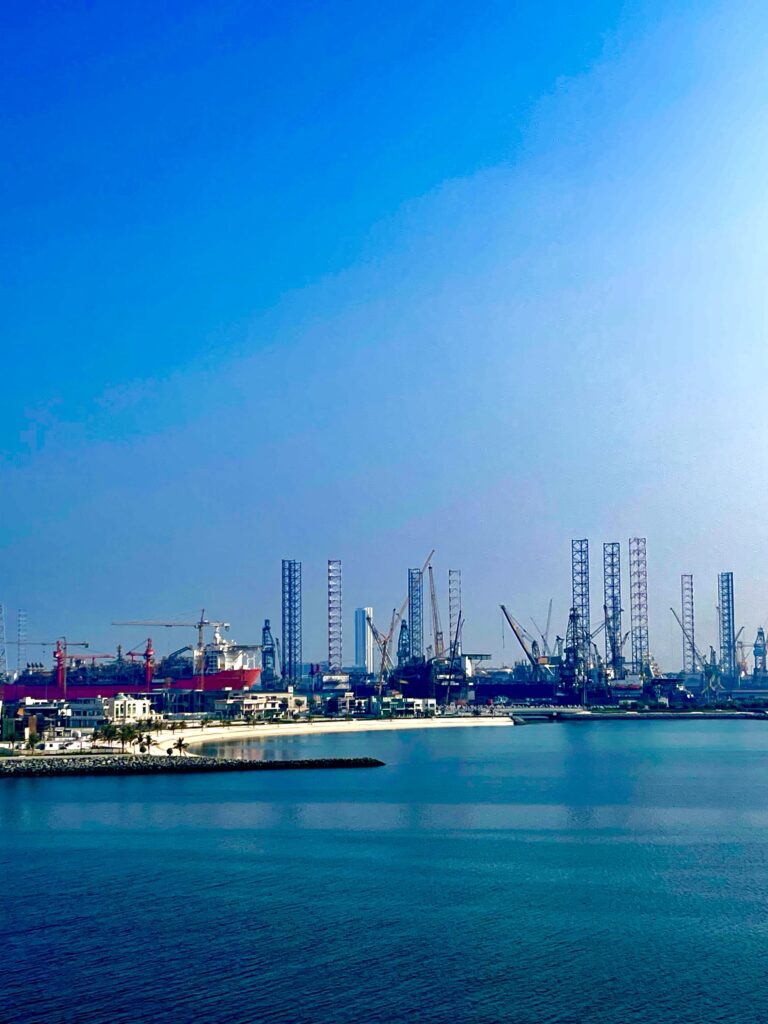
Finding a place to park the truck and camp is a big challenge in Dubai city. All land is owned by someone (if you find an empty spot anyway). At hotels parking was often not possible for the truck. On I-Overlander (an app for overlanders, giving wild camp locations) we found one spot. However at arrival, the spot was already built up with coastal villas. Nearby was a new hotel with an empty construction lot next to it. However, Dubai police is serious here about “squatters” and “illegal” camping, so we decided to book a room in the hotel. Which was actually a nice break anyway. A brand new hotel, with a great vibe and nearly all guests were from Europe. We got a room with a view on a bay with other hotels and in the back a huge shipyard for offshore boats and oil drilling platforms (what a contrast!).
That night we would meet people we know from Sint Maarten. They lived nearby the hotel and we would meet up at a new Libanese restaurant nearby as well. It was a great evening. Nice to meet fun people from your “home town” in a different setting. Although we showed them pictures of our truck, we insisted that they should drop us off at the hotel so that they could see the truck with their own eyes. And yes, reality kicks in if you see things in real time and location. It’s for a lot of people hard to understand how we live, driving around in a big truck, your house on wheels. We literally live in a “box”, but our life is more about what happens outside the box.
The next day we wanted to drive the “big street” of Dubai city, the street which is lined with the most remarkable sky-scrapers. The traffic in this big city is much more orderly then in Ryaadh eg, where I had a shortage of eyes to keep on all the “crazy” drivers around me. Dubai is also extremely clean and well maintained. We didn’t want to leave yet and by accident we found a large empty construction side.The location gave us also a perfect photo shoot opportunity with sky-scrappers and the Burj Khalifa (highest building in the world) in the back ground.
A 10 minute walk from the truck, brought us to the biggest shopping mall in the world, the Dubai Mall, which also has a huge indoor ice-skatting ring and an enormous aquarium. Attached to the mall (it is actually part of the mall), there is a China Town mall, dedicated completely to Chinese products, food and culture. The mall is a city in itself and is a popular hangout for the city people of Dubai. It is completely airconditioned, so a good escape from the heat outside. From the mall you can enter an exterior area, where you will find the largest fountain in the world. The Emirates have well over 425 world records registered at the Guinnes Book of Records.

Dubai’s ruler had a vision for the small (pearl) fishing village it just was about 60 to 70 years ago. Not as well served with the natural oil resources as its bigger neighbor Abu Dabhi, he knew how to transform the little Emirate (still twice the seize of The Netherlands), into the Monaco of the Middle East where the rich and famous would settle, enjoy life and where architects got the free hand to design the most amazing buildings. With a well designed airport, top of the line national airline, it became a very important regional hub and a stop over with time to spend on extreme shopping and adventurous activities (Dubai is also home to the largest indoor ski-slope in the world).
A whole day would not be enough to see everything in this huge shopping paradise. It’s a place where people just wondering around in the comfort of cold air and where children can find entertainment. It didn’t appeal to us, to see every shop, let alone to get in or even buy something we didn’t need. Dubai is the ultimate showcase of over consumption and waste. In a climate, which by modern human standards, would not be sustainable for humans to live (unless you spend most of your time in airconditioned places), the human presence with its extreme carbon footprint, is only increasing. Cheap real-estate, combined with attractive tax incentives, draws in the rich, which in turn draws in the thousands of laborers to support the well offs. For now this business model works well and combined with ever increasing tourist numbers, Dubai is doing great, something the Crown Prince of Saudi Arabia (MBS) understands very well.
When we returned to the truck, a security guard was waiting for us. Although very friendly, he explained that we were on private property and that we could not park there. Seems we beat the system once again, since we were on our way out anyways, after our Dubai Mall visit. Only very few overlanders managed to park so close to the Burj Khalifa for a whole day, we did it!
Seen enough of Dubai we drove out of Dubai city and were amazed how stretched out the city is. But also the enormous amount of traffic on the 10 lane highway. Dubai is a metropole, like New York, Paris and all big cities around the world. We saw it, we experienced it to a certain extend and it was time to move on. Abu Dhabi would be our next stop. Still a long drive, so we made a stop on the way and parked near new development of holiday bungalows. Fences left and right limited our options, but it was very quiet and no traffic. We even saw a group of small deer wondering along the fences (but on the road side), panicking when we passed by.
We left early with 3 objectives. Replenishing our water tank, stocking up on food and drink supplies and getting into Abu Dhabi city. On the Garmin map, a water filling station was indicated not far from our camp spot. It turned out to be a very large filling station with over 50 water trailer trucks lining up to fill up their tanks with water. A huge Pakistani man saw us and indicated that we could come in with the truck towards his office. Most probably more camper trucks have visited this station. A regular hose with tap water was brought to us and we could fill up our tank right away. The manager (an Emirati gentleman) came out of his office and offered dates and coffee. He came in to admire the camper. Then he invited us into his office. We had a nice chat, he talked about his family, the way he spends leisure time, showed pictures and we drunk more coffee of course. What a different experience from just paying your water bill at home!

Next stop was a big supermarket, which we found on the outskirts of Abu Dhabi city. A large, well stocked Carrefour was there waiting for us. First we had a little issue with another security guard telling us we couldn’t park the truck on the parking lot of the supermarket. The parking was almost empty due to the time of the day. I was not in the mood for a discussion, so I ignored him and we went out to do our shopping. It’s nice to also find some European products in these countries (we are still people of habits).
Dubai was big and busy with large multiple lane highways, but Abu Dhabi is even bigger. Abu Dhabi city (metropole), is centered near, around and on islands with mangrove forests. There is a mangrove national park in the middle of the urban area, where we expected to find a spot to park, camp and do some kayaking. We tried multiple times driving around the park on multiple lane highways, but there was no way to get there. So now we looked on I-Overlander and found 2 camp spots on the Cornice (the main boulevard of the city), but these were regular parkings for regular cars. We finally saw a small dirt road, driving (again) into a large construction lot. And wow, this was an amazing spot! On the edge of an island, next to a marina on one side and a huge luxurious hotel on the other side and in front of us the mouth of an inland water towards the sea with in the back the Abu Dhabi skyline. There was a nice breeze, it was very private and yes, the view, one of a million! We settled in, table and chairs out, having our happy hour. After an hour and half a security guard showed up (yup, again). Again we were standing on private property and had to leave. What followed was a long discussion between me and the guard, whereby I tried to use all my negotiation skills and convince him that we were just staying for the night and would leave in the early morning. He was just scared of losing his job. What convinced him at the end, was that we didn’t pass his security gate but came to the open back door. And the fact that his shift was almost over and the evening was setting in, made him to say that he never saw us, and never knew we were there.
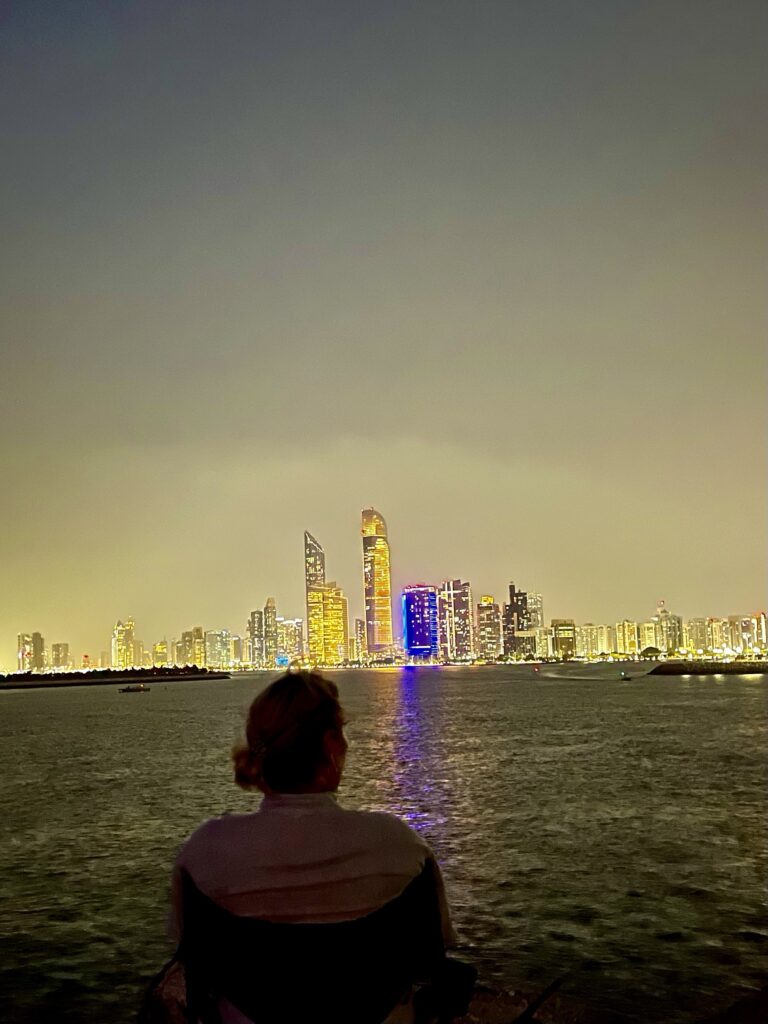
We had a wonderful night at this camp spot, the night set in and the city started to light up. The almost full moon rose behind the highest sky scraper of the city, which made the whole scenery magical. We kept the lighting of the camper to a minimum not to attract attention from the security guard taking over the shift We were parked far away from the office, guard house and other buildings. We were literally in the dark.
Knowing that when day light would come, the next guard would show up, so we woke up early. But even so early, the next guard was already waiting outside the camper. We got the same story and this guard thought we even came at night and he didn’t notice. He was not as friendly as the one the day before, so I to tell him several times that we were on our way out (it turned out that more overlanders had tried to camp here or even came to take pictures and all were denied access). Anyways, we did it again, parked were it was not allowed, had a great spot with a beautiful view.
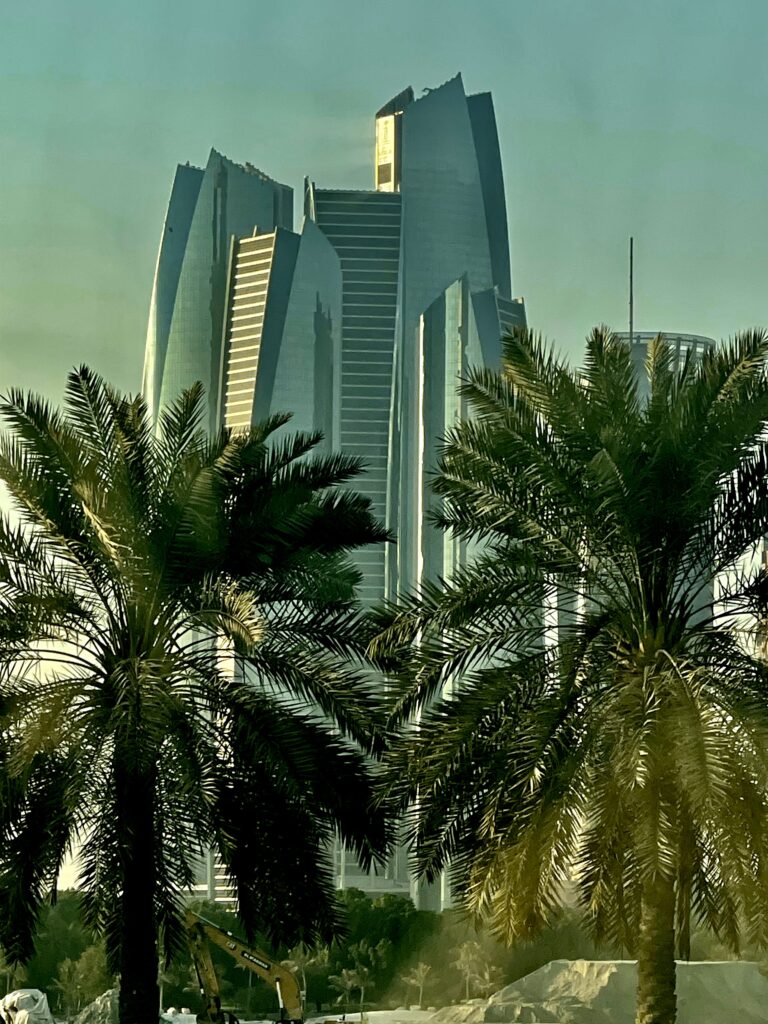
Since Abu Dhabi is another city like Dubai with fancy sky scrapers, we didn’t stay around much more. Abu Dhabi is the largest of the Emirates and 90% of the Emirate is desert (part of the Empty Quarter). About 100km from the coast, there is the large oasis town of Liwa, so we headed for that direction via the coast of Abu Dhabi. We passed an old fishing village, where we saw many beautiful traditional wooden sailing vessels. These are masterly crafted fast sleek ships, used in the old days to sail along the coast for trade and even piracy. Now, they are used to participate in the Abu Al-Abyad traditional sailing race.

From the coast we followed a long straight road, where the Ministry of Forestry is creating a forests on both sides of the high way. Where you see in countries with forests and jungles, the forest disappearing gradually on both sides of newly built roads, here the opposite is happening. Creating green zones in the desert is a new thing in the Arab desert countries. All the new trees are watered through a drip irrigation system, which runs for miles and miles through the desert sand. It’s really amazing what just water can do in the desert, to let flowers and trees grow.
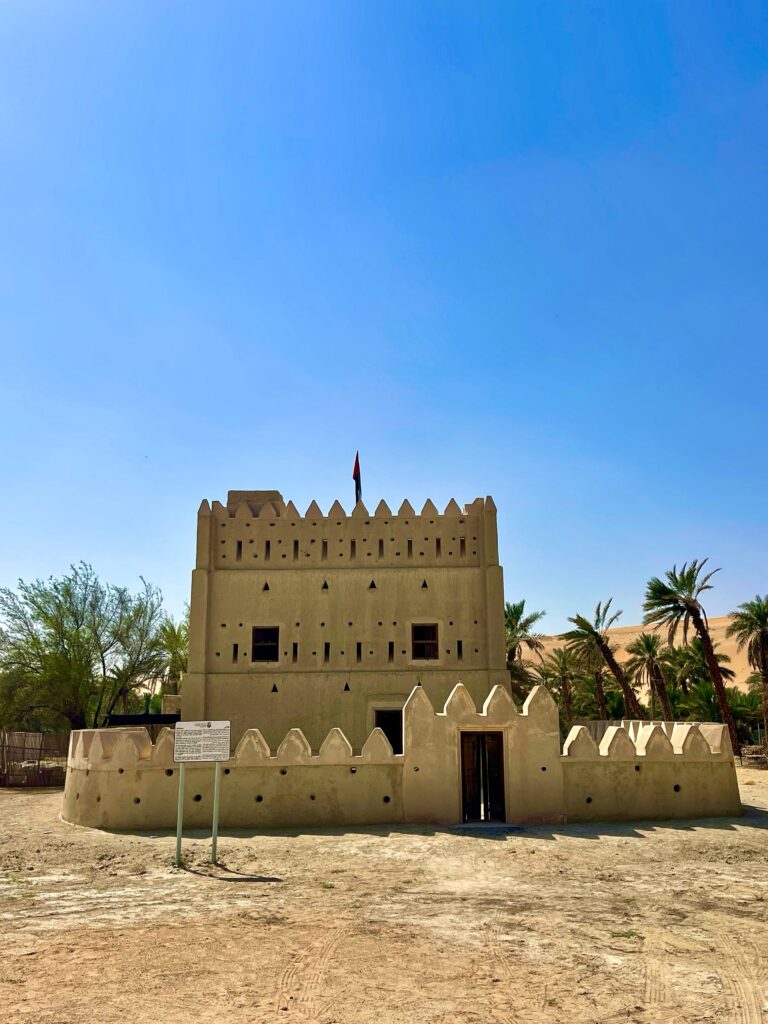
Liwa is really deep in the Empty Quarter desert (the Abu Dhabi part). It’s actually a very oasis, with lots of under ground water. There is so much water that the people manage to transform big high sand dunes into green mountains, with lush gardens and date trees. A number of old historic forts and family estates have been restored to their old glory to give visitors an impression of how it might have looked in the old days.
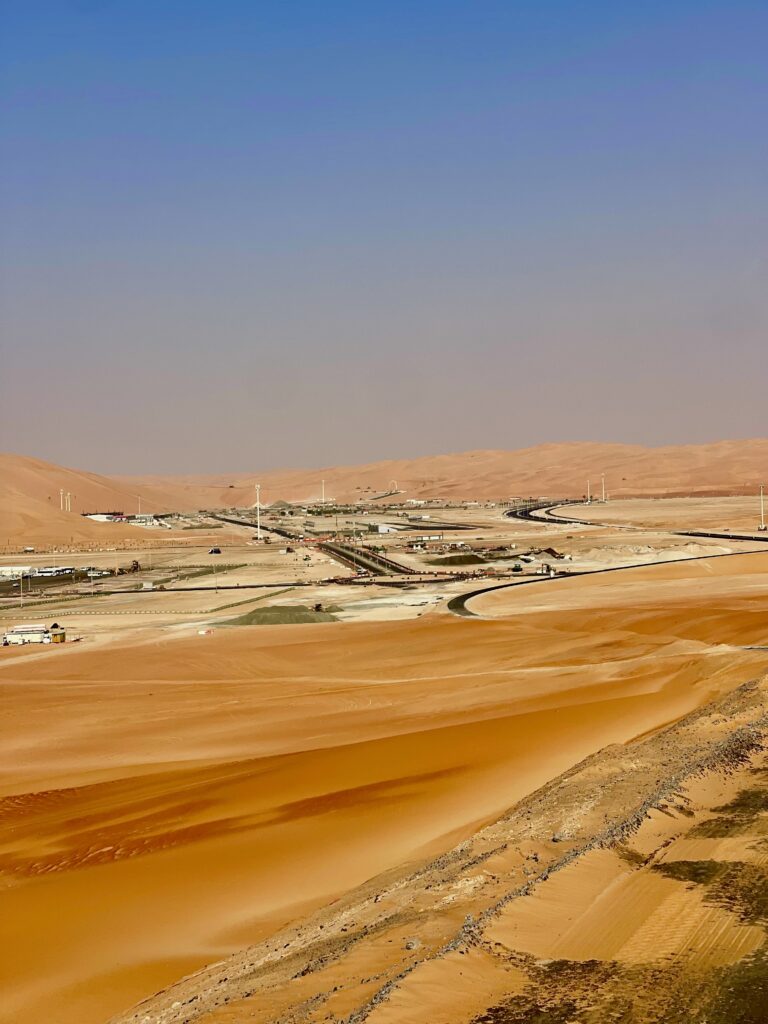
Near the Liwa oasis town, you go deeper into the desert to find there the highest sand dune of the Emirates (Moreeb Hill). We once visited the highest sand dune of the entire Empty Quater (even claimed to be the highest in the world), and now had a certain expectation. We were very surprised when we arrived to see hundreds of workers, large numbers of heavy equipment, working on tracks, roads, infrastructure like stages etc. It turned out the Moreeb Hill area is the stage ground for the huge annual Liwa Tal Moreeb Dune festival. Visitors from the entire region go to this festival in the winter period (december/januari), which last for about two weeks. It’s all about cars, motorbikes, quadbikes and buggies Dune Bashing. Cars driving up the steep dunes with full speed, drag racing etc. Besides, there are camel and horse racing. A huge camp ground with facilities is built in the desert to accommodate thousands of visitors and participants, who come withe campers, caravans and tents. It’s a place to meet family and friends, have fun and eat. A lot of traditional food is made, presented and shared. It’s just amazing to see, that in the desert, without any utilities and accommodation, such a huge event can be organized. It reminded me a lot of the Burning Man festival in the USA.
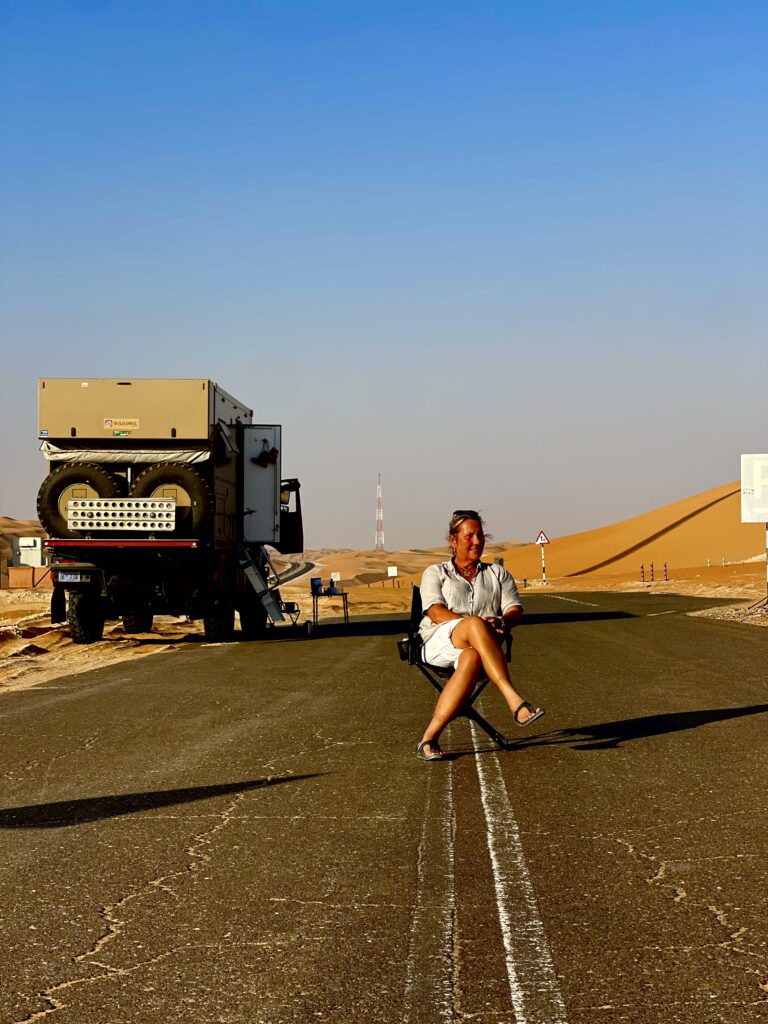
Anyway, our idea of arriving there all alone and enjoying the view and a climb the highest sand dune in the Emirates was abandoned. Instead of driving back on the brand new 4 lane road (especially made for the festival), we took the old abandoned small crumbling tar road back to the coast. The road was covered partly under the desert sand, which shows that nature eventually takes back what it lost to humans, the moment people, stop keep nature at bay. We parked on a higher part of the road for the nigh, and had our chairs and table on the middle of the road. Not realizing that the road could still be used by other adventures or guys who like to cross through sand and potholes, a big pick-up truck coming around the corner, almost kicked us from our chairs with his truck. We moved the chairs after that.
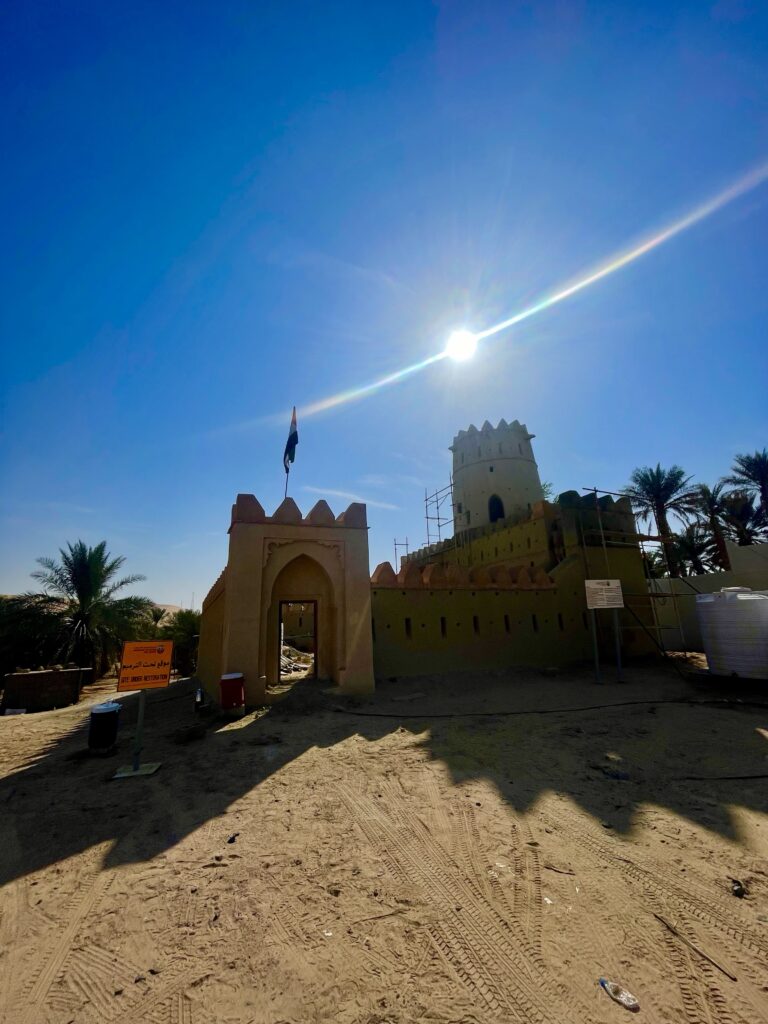
Next morning we drove back towards to coast of Abu Dhabi. We stopped at two more forts, which were either closed or under renovation. (And the Pakistani workers don’t like to be photographed, we found out). A huge fort on the outskirts of Liwa, was closed, but the guard (from Kenya), was so nice to let us in still. It looked like a brand new structure. It was a fort with big towers, court yard, big gates etc. But it was completely rebuilt and all the rooms we went into, had a beautiful modern bathroom and AC (all the AC’s were running at time, even though the rooms were not in use). The guard explained that it was actually a hotel, but not open yet. (Luckily electricity is very cheap in the Emirates). So the idea will be that guests will be able to experience living in a Arabian fort for a couple of days in the near future. As a side note, it was nice to see, what the designer could do with discarded date palm tree trunks. Especially the use in stairs.
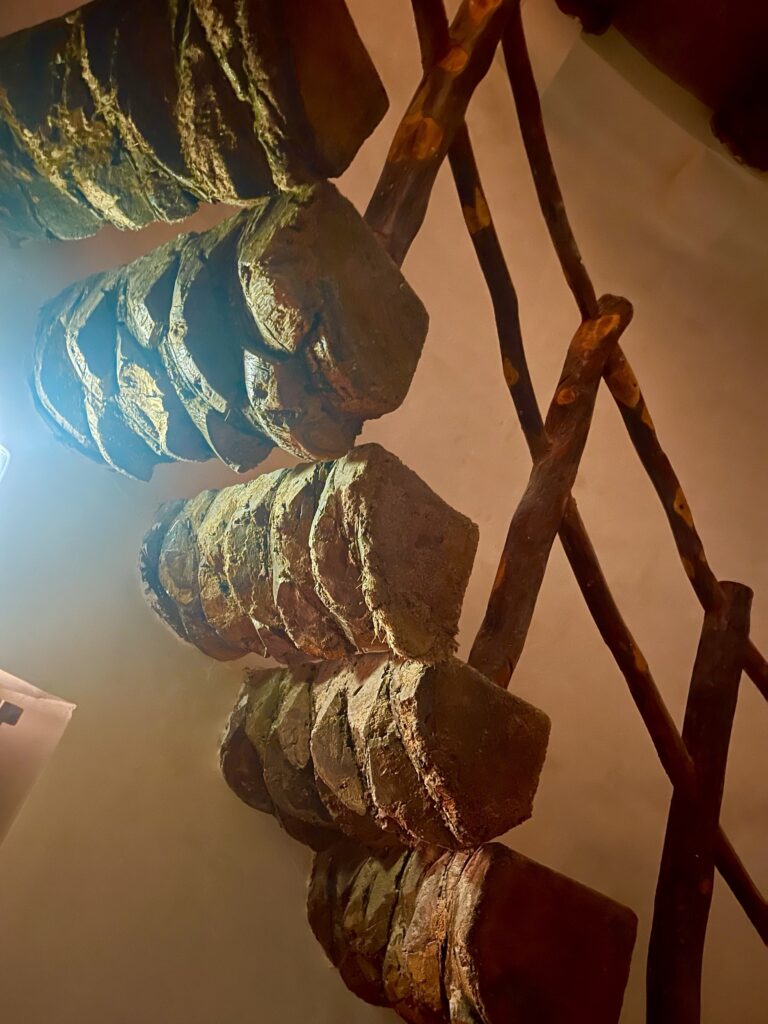

We drove back to the coast via another road, which was not lined with new trees, but only red/orange sand dunes. There are two islands near the coast, which we wanted to visit. There are ferry boats going to these islands. The farest one is Delma island, where we wanted to camp for a few days. However, when reaching the ferry port, it turned out the truck was too big for this ferry. We had to use the cargo roll on roll off boat, which sailed from the commercial port nearby. When we arrived that ship just left and after inquiring, it was more complicated than we expected. First we needed to ask for a port gate pass (on-line), which turned out to be almost impossible. Then we had to contact the boat operator (who was on the boat), to see if we could make a booking or reservation. Since he was out at sea, there was no reception, so we just send a message and would wait to hear from him.
Not far from the port was a nice beach to park the truck. A great spot, especially since it is not easy to find an undeveloped pieces of beach in Abu Dhabi. Many Emiratis have an out door place at the beach, escaping the busy town in the weekends. You find beautiful villas, but also caravans, sheds or even tents along the coast.

We woke up with a lot of wind (bit stormy) and a message from the boat operator, that he would not sail because of the windy weather conditions. So, that plan was off the table. We stayed another day on the beach. The breeze was a nice change from the hot weather and the sea water was really nice. Along the coast of the Arabian Gulf, the tides of water are very visible. Sometimes the water reaches almost to the truck and when the water is at low tie, you have to walk a hundred meters, to reach the water. For a long distance, the water is very shallow. Billions of small shell animals and little crabs dig tiny holes in the sand which attract thousands of birds.
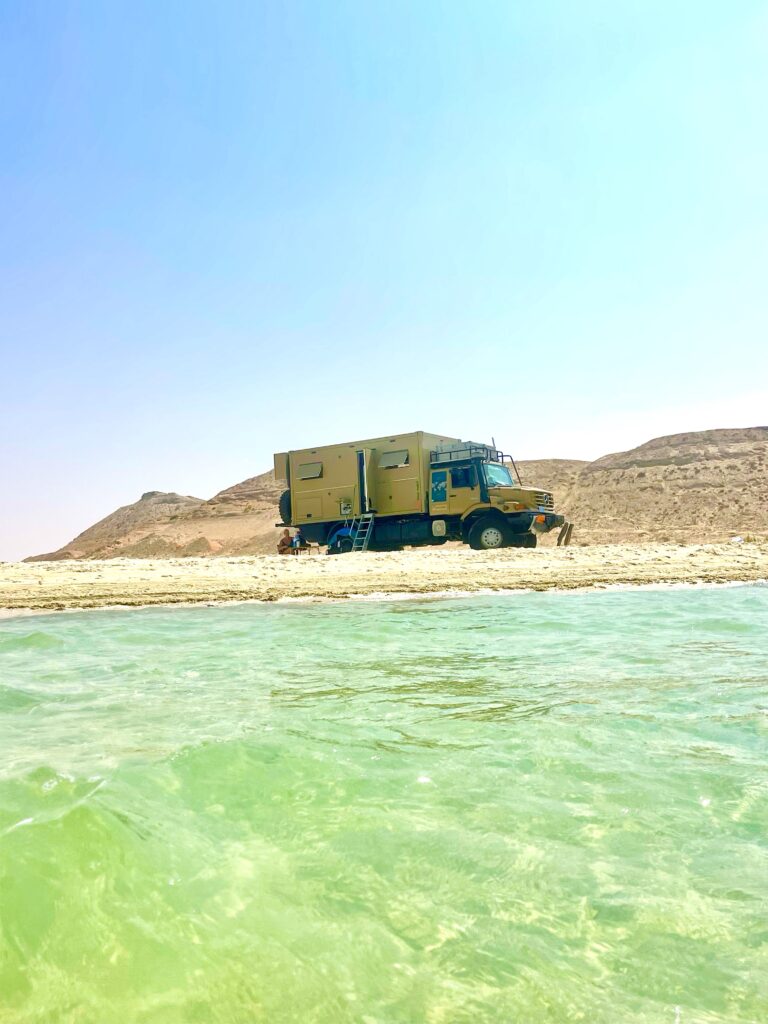

Sometimes the peace and silence is disturbed by guys who like to race on the beach or onthe sand banks with their 4×4 SUV’s or pick-ups. Off-road riding is a big thing in the Middle East. It gives the guys a sense of freedom, a way of getting rid of stress and be the macho. Can you imagine in Europe, people could just go off-roading once in a while with their cars, instead of being frustrated by only driving on roads in traffic jams and all the rules and regulations. From a nature perspective, the off roading is very destructive though. One of the guys stopped by to chat a bit. Surprisingly, he was driving with a (real) beer in his hand (and I was standing there with my 0% beer………). He was one of these guys (and we met many already), seemingly frustrated with life. Being married in an arranged marriage, running away from home (as often as possible), to his hide out with friends, to go drinking (yes, there seems to be more drinking in the middle East than we expected), fishing and have some fun.
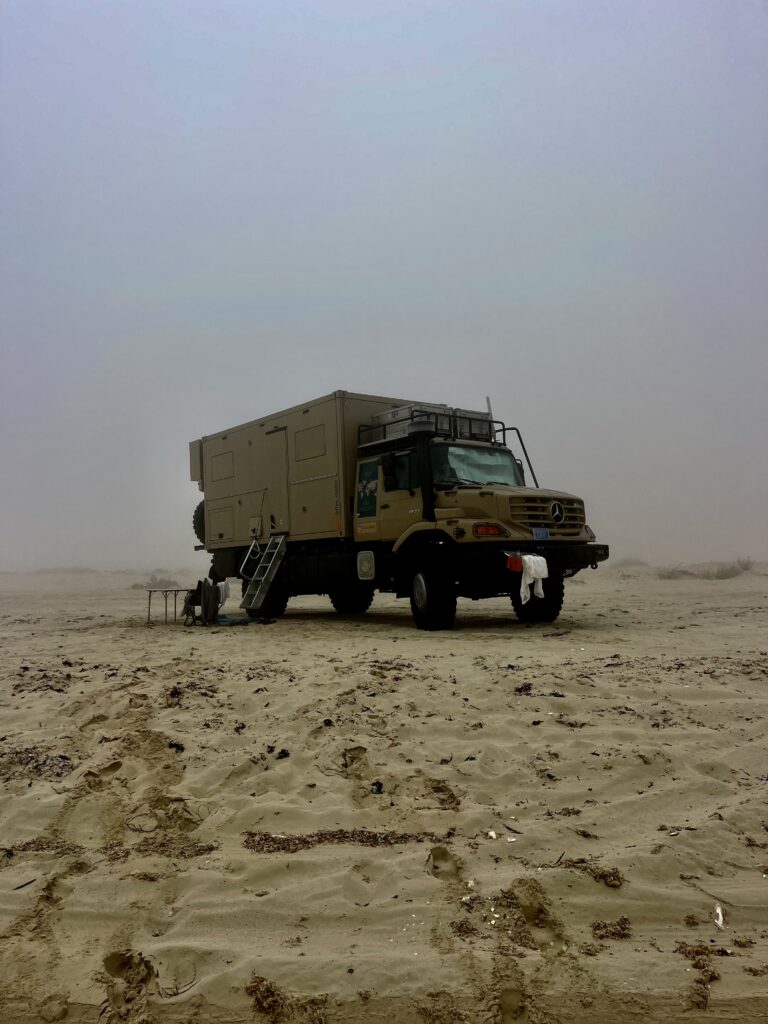
The next morning, we woke up in the middle of very thick fog. There was no more wind, no sound and it was low tide. We made a long walk in the fog along the beach, since the fog made it difficult for the sun to bounch her heat on us. It’s a wonderful experience, as if you really walk on clouds, the fog was so thick, that we could not even see 5 meters ahead of us, and then also that beautiful silence…
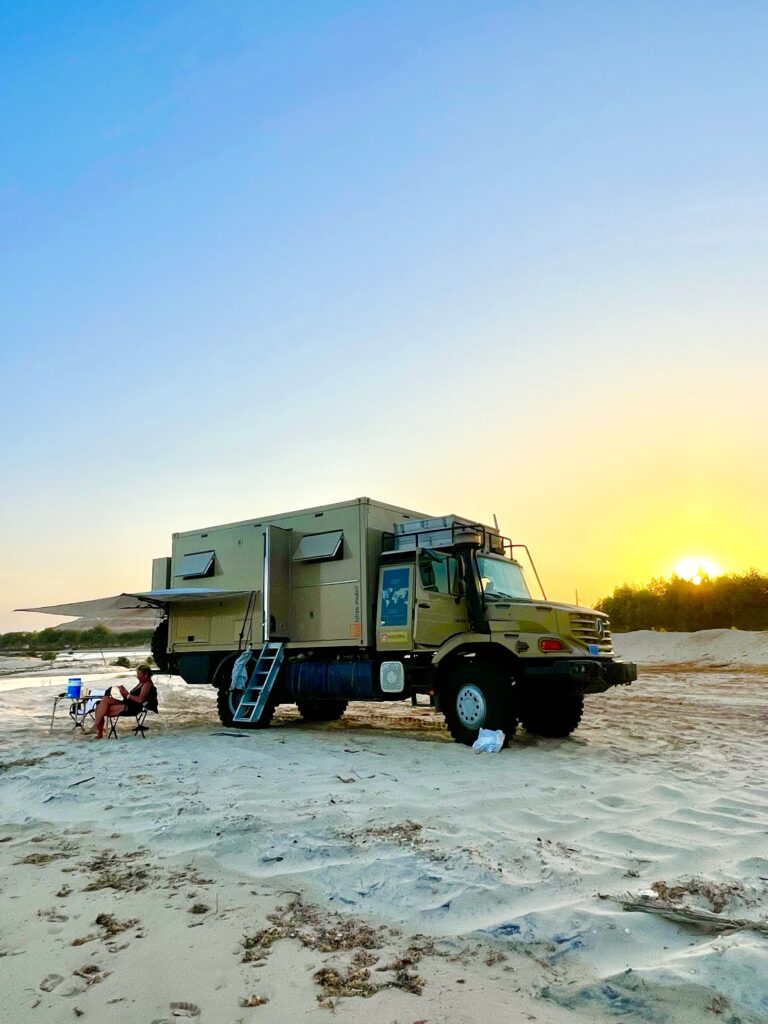
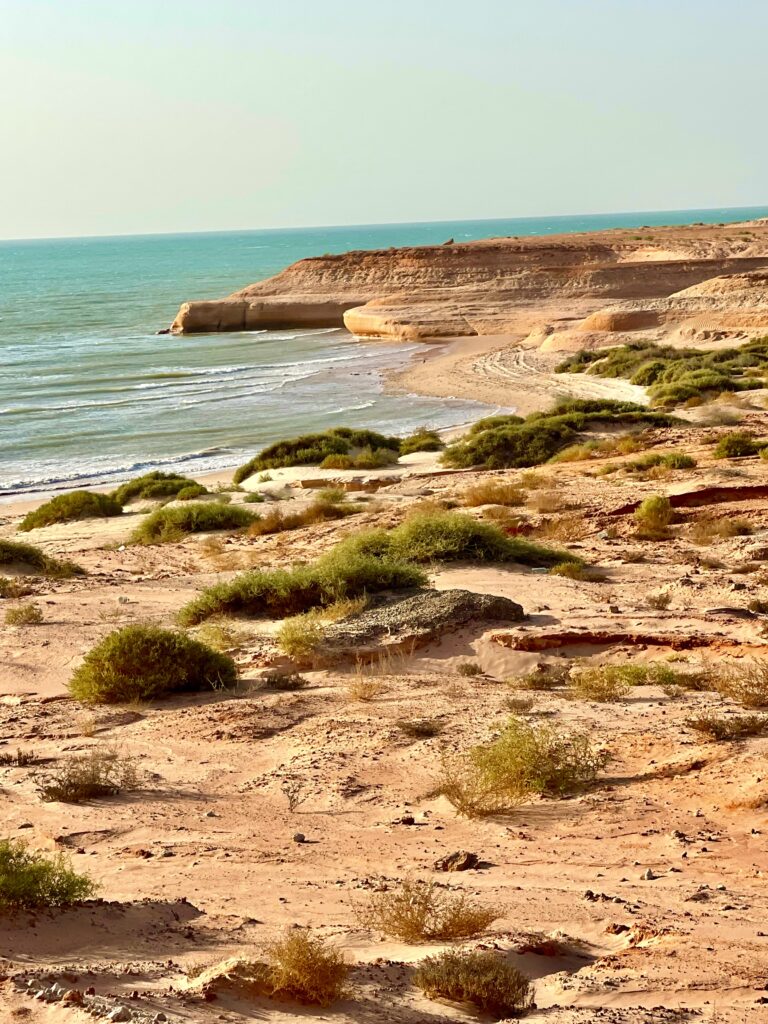
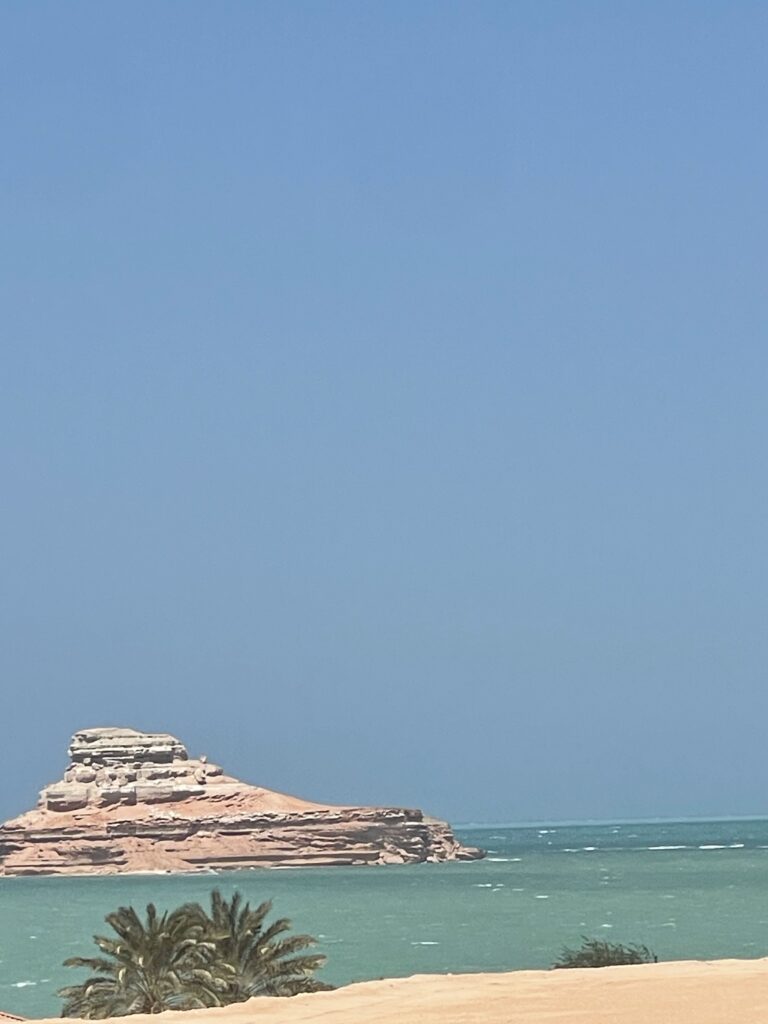
The next morning we tried to go to the other island called Sir Bani Yas. This island used to be one big game reserve, where you can find almost all the mammals species which are indigenous to the Arab Peninsula. Nowadays its a bit smaller (the reserve), since the island is now partly in use for a resort. Also here, we could not go, since you have to be a guest of the resort. So our island hopping plan was thrown overboard. A last small change was the last island, close to the border with Saudi Arabia, called Al Shuweehat. The island is not an island anymore, since a narrow causeway has connected it with the main land. Also here, most of the coastline was occupied by vacation or second homes (except for a large area, which was fenced off, this for the military). But, we found the last remaining spot on a a beach near mangroves, which made up for a good camp spot. Our last one in the UAE.
The next morning we headed for the UAE/Saudi border. We passed a brand new nearby city (Al Dhannah). It turned out to be a city completely dedicated to expats working in the nearby oil and gas plants and the huge nuclear power plant. The city looked super clean, well organized, nice shops, parks and other facilities. We took a coffee in a coffee shop and it was like we were in the USA. Spoke with some American engineers and was surprised to hear about the nuclear power plant. Abu Dhabi, one of the bigger oil producers, looking into the future and seeking alternatives for when they run out of oil.
After sniffing up some “western culture in the Arabian desert”, we drove to the border. Leaving the UAE was a bit of a thing.
