After spending some good family and friends time in Holland and Sint Maarten, we flew back to Kuwait at the beginning of February.
Just entering the plane of Kuwait Airways, brought us back to the atmosphere of the Middle East. Pakistani and Indian flight crew (like in most of the Arab peninsula countries, the majority of the work force comes from the eastern region), welcomed us with Arabic coffee (no champagne or other alcoholic drinks). The smell of Arabic aromas, so familiar in the public buildings, homes and shopping malls, made us feel we were back already, which became even more apparent, when the Islamic prayers came through the speakers. Without even taking off, we were already back in the middle east.

It is February, and it is still winter time in the Arabic countries. On arrival, there was heavy rainfall in Kuwait City and the temperature was chilly. (Kuwait is one of the hottest countries in the region during summer). I would almost say, “of course” we had a problem with our e-Visa, which we obtained prior to our departure. But we got that sorted out quickly. Again we experienced that these Middle East countries are more into solutions than in problems. My biggest fear for losing time was having to engage in discussions with Customs officers, about all luggage we had. We had a number of spare parts and a lot of “Dutch” food products with us. Luckily, we arrived at the same time as the National Youth Soccer Team of Kuwait, so we didn’t get the amount of attention they got. We just followed a guy with a badge accompanying another guy arriving, made it look like we were together with them. A taxi took us quickly to the same hotel where we stayed just before us leaving Kuwait in December, and with the two hours time difference, it was past mid-night already.
The next morning, a driver from the Mercedes Truck dealer, picked us up and drove us to the garage where the truck was parked. They did an excellent job in cleaning, servicing and fixing the truck. They also helped us filling up our water tank, so we were all set (for the truck) for our next leg of our world tour.

Nearby was a gas station (next to the head-office of the Kuwait Petroleum Company), where we wanted to fill up our fuel tanks. Now it turned our that the diesel was rationed! Yes, and that in a country which is a mayor oil producer. It turned out that it had to do with fuel smuggling into Saudi Arabia by Pakistanis. Yes, you read that correctly, smuggling fuel from one oil producing country to the largest oil producing country (where the fuel is a lot cheaper than in Kuwait!!). This apparently has to do with the quality of the diesel, which is a lot better in Kuwait than in Saudi Arabia. Still it puzzled me. The fuel station manager showed up and profiled us not as the typical fuel smugglers, so we were aloud to top up our tanks completely. Fuel is going to be a challenge in this area, even knowing that you actually literally drive over it………..
We brought a nice deal of Dutch food products with us, but we prefer to eat as much fresh food as possible, so we drove now to a large mall with a big Lulu Hypermarket. Parking is sometimes a challenge near these malls since they usually only facilitate for regular vehicles, mainly in garages (no big trucks). A piece of a vacant land not too far away, was where we could park and from there walk to the mall. A brand new, huge, fancy mall, which is the typical hang out for the residents of Kuwait in the summer time, when you drop dead of the heat when you stay too long outside. (What would they do if there was no airconditioning!). Again the smell of Arabic fragrance was everywhere. Why can this not be everywhere? It makes you happy and joyful when walking around in these aromatic atmospheres. I enjoy that a lot.
The Lulu Supermarket (a big competitor of Carrefour), was very well stocked. It is amazing to see the variety of the fruit and vegetables available. It comes from Syria to Egypt, from New Sealand to Holland. The nicest oranges we ever had, by the way, are from Syria. Prices of fruit and vegetables are cheap compared with Europe and for sure the Caribbean, especially if the products are from the region.

We bought quite a lot, as we expect availability of such items to be limited in Iraq, especially in the country side and small towns. With three full shopping carts and three packing boys we crossed the entire mall towards an area where we could bring the truck for loading. I had to run back to get the truck, since it was all the way on the other side of the mall. It’s always a bit embarrassing when you have these full shopping carts, when people don’t know that we buy supplies for lengthy periods.


We had to place all these plastic bags with supermarket stuff all over the truck, on top of our still unpacked luggage bags, so it was a bit messy inside and we could not drive too much to avoid making the mess even bigger. Nearby the mall was an area of bush, part of a drainage project near the 5 line highway. It was pretty private, but noisy, but we could not be too picky as we first had to get organized. We realized after finishing all the storing of luggage and supermarket items, that we did quite a lot of work that day. We made an easy diner and were dead tired, but very satisfied, that we got completely organized in just one day (starting by picking up the truck).
The noise of the highway kept me pretty much awake that night, so in the morning, still half sleepy, we drove to the airport, where we had to obtain a special permit from the Ministry of Internal Affairs, to leave Kuwait via the Iraqi border. Thanks to a bloggers site, we knew exactly where we had to go. A complex with a lot of uniformed police and army personal is where you have to report and obtain your visa paper. Within 15 minutes we got that (green) exit permit, with a smile and a hand shake. With that out of the way, we were now set to leave Kuwait and go to Iraq.
Since it was already almost noon and that we had no idea how long the border crossing would take, we decided to stay in Kuwait that day. We left Kuwait City and its satelite cities and drove towards the only three nature reserves Kuwait has. Kuwait in general, as we discovered, is pretty overdeveloped. Whether it is housing blocks, industrial areas, oil fields or even the huge camping grounds. These “camping grounds” are in fact the “man-cave” tents all over in the desert areas. It’s also not the cleanest country, but that is similar in the other Arab countries we visited as well.

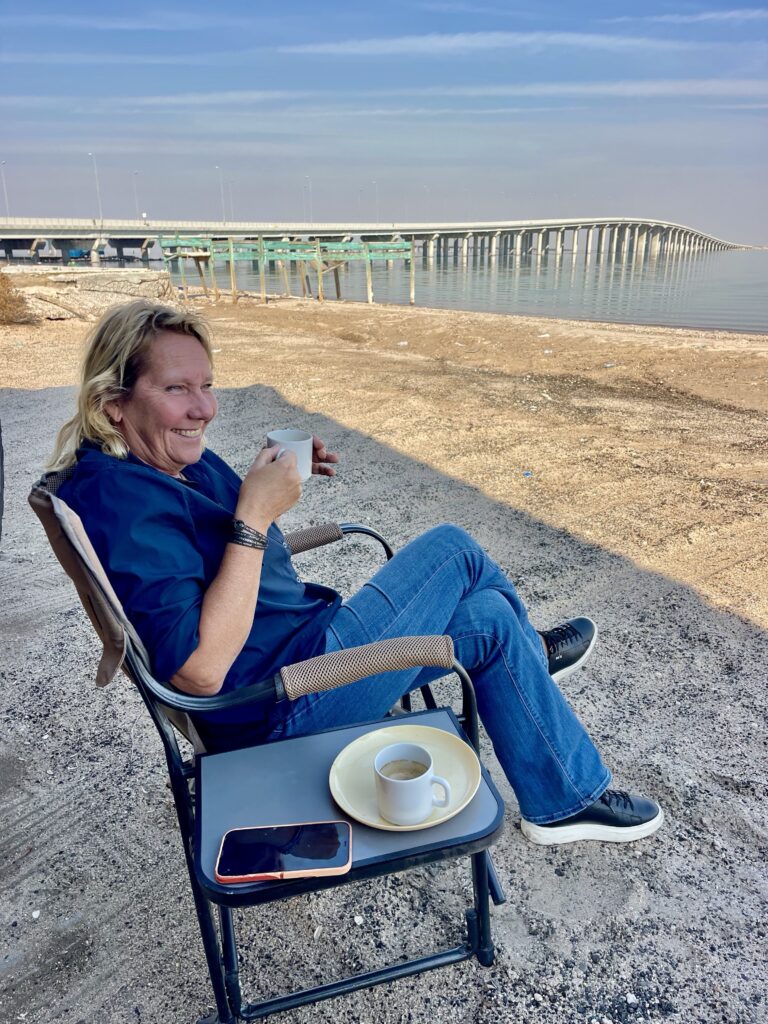
We drove towards Bubiyan Island through Saba Al Ahmad Nature Reserve. Indeed a well fenced of area, with no occupation or development and no garbage. There was supposed to be a new bridge from main land Kuwait to Bubiyan island, but although the old bridge has been partly demolished, the brand new one next to it, was not open for regular traffic as yet (only construction and army vehicles). We parked at the shores of the channel surrounding the island. It was dead quiet compared with the night before. We fine tuned some stuff in the camper and started planning for the tour through Iraq. I even changed the number plates on the truck. The Sint Maarten ones, look similar to many American number plates in size, layout and color, and the ones I had made look more European. With the anti-American sentiment in Iraq, I prefer not to be seen as American. Europeans seems more popular…..

The next day was the day. Still a bit nervous, but quite exited at the same time. Leaving the Arab Peninsula with its extreme security (we never felt unsafe, afraid of getting robbed or scared), the wide sandy deserts and plains, the hospitality and generosity of the people, would be something we really were going to miss. Traveling the Middle East countries has been so very comfortable, a great pleasure. We think that Iraq may be a different kind of place, a different country. A country which has seen a tyrannical dictatorship, several wars and has been prone to terrorist activities. A country which went and is still going through economic hardship due to all the wars and hence many people live in extreme poor conditions. Its hard to understand if you know that Iraq is also a large oil producer.
It took us an hour to get to the Kuwait border post, the traffic over the double 3 lane road was almost non existing. Iraq is most probably not a very popular destination when coming from Kuwait. We did a last top up of fuel (again there are issues with diesel supply in Iraq as well) before getting into the border post area. The men at the Kuwait border were very friendly, offering coffee and making pictures of the truck. The exit was smooth and we crossed “no-mans land” towards the Iraqi border post.

A bit of a chaotic scenery presented itself in front of us. (A little bit like what we experienced at the Jordan border post). Where on the Kuwait side, there were two officers, here there was a whole collection of guys in all kinds of uniforms, plain dressed officers and many hustlers. Everybody is waving at you, go here go there, but a big fat officer with a sigarette between his golden teeth, seemed to me the guy I should not mess with and follow his orders. He decides whether you can cross “the line” into the border crossing compound or have you turn around, back into Kuwait. He kept talking to me, even that he knew I didn’t understand a word. I gave him, however, our passports and car papers. He started to make an issue, why there was no 0 (zero) on the number plates while there was a zero on the car papers. I thought, ok, this is how it will go in Iraq. Was he looking for a bribe, or was it really an issue? No, it was a third option, he was pulling my leg. The serious face changed into a big smile and I think I saw a part of the lost gold of the Kuwait Central Bank.

We were allowed to continue into the hectic compound. It was not busy with trucks or passenger cars. But what would a Kuwaiti do in Iraq anyway? One of the hustlers took charge of how and where we should park (you don’t know whether it is a hustler or an official, so the first time you play safe, especially with a big truck. It turned out to be a hustler, or actually, more like a “fixer”. A friendly fixer. Again, also this guy only spoke Arabic and he indicated where, to which window or office, we should go and in what order, and that we should give him our documents. I had read about this in the bloggers pages and knew this was a better way than figuring it out all myself, and he might have to share his “service-fee” with the officials, I do not know. Probably not “obtaining the services of a fixer” could extent waiting time at the border with several hours and then maybe the missing zero would turn out to be a problem still…..

If you don’t know the procedure at the Iraqi border, you will easily get lost. So our “fixer” was of great help. The truck seems to be the most important thing for them when getting in. First there is this small office where a bold headed pirate looking guy is stamping out CdP paper (so now I will have to make sure they do it again when I leave Iraq). Then we had to buy liability insurance for the truck in a container office next to the first office. We still had Kuwait Dinars, which were accepted. Then we had to walk for about 200 meters to another container style office, where we had to buy a permit (kind of visa) for the truck. We were short of Kuwait Dinars and had no Iraqi Dinars and US dollars was a problem. The fixer advanced for us. (Another benefit of the fixer).

Now we walked back to a small container office, where we had to make copies from all the papers we had (CdP stamped, Vehicle Permit stamped and Insurance paper). Again the fixer advanced the cost of this). Now back to the office of the CdP bold headed guy. The desk next to his was (most probably) the customs “office”. There a friendly gentleman wrote a little post-it note, added his signature and stapled that to the copy of the CdP. De CdP guy did the same but on another copy of the CdP.
The fixer said we were good to go to the immigration office now. His job was done and customs were not interested to put the truck up side done (we managed to get all done around lunch and prayer time, so priorities must have been elsewhere). Including the advances the total “bill” of the fixer was US$ 30,—, which was reasonable and for sure really worth it! Thanks for your help!
The truck was now fully authorized to enter into Iraq, now it was our own turn to get that far. A huge waiting room in a nice building (nicer than the ones for customs, CdP and insurance), was almost empty (again lunch/prayer time), so we did not have to wait. We had to fill out an application for the visa and handed that together with our passports to an officer.
After about 20 minutes, we were called in to collect our passports and pay US$ 156.00 for both visa. We gave the officer US$ 160.00, expecting change in Iraqi Dinar. We actually never saw the guy back! We drove away and there was one more stop to make before leaving the compound. A last check point where the exit gate was blocked and only the entry gate was open, but used for exit as well. Like bees flying to a flower rich in nectar, another group of uniformed officials gathered around our truck, all nice and friendly. They wanted to see the camper from the inside (more out of personal curiosity) and after they were convinced there were no illegal immigrants in our truck who want to start a new life in Iraq, we were finally allowed to leave the border compound.

In total our crossing (including Kuwait) took about 2 hours, which wasn’t bad at all, and actually it was quite entertaining. People in Europe who don’t get out of the EU with their vehicles don’t realize (anymore) what it is to have “real” borders between countries. The luxury off passing borders without immigration and customs formalities, is an advantage most of us don’t realize.
Now we are in Iraq! And now what? The small town of Safwan is directly after the border post and seems calm and friendly. Still you look around to see if there is trouble or if you see anybody suspicious. The main road through town looked clean and well maintained. Everywhere garbage bins and even nice play grounds for kids. This was not the Iraq I expected. We stopped near one of these play grounds on a parking lot to have a coffee and to relax a bit after a exciting morning. Some Iraqi’s passed by, saying “hello, how are you?” and make pictures of the truck. We started to feel more comfortable, but still Iraq is still Iraq.

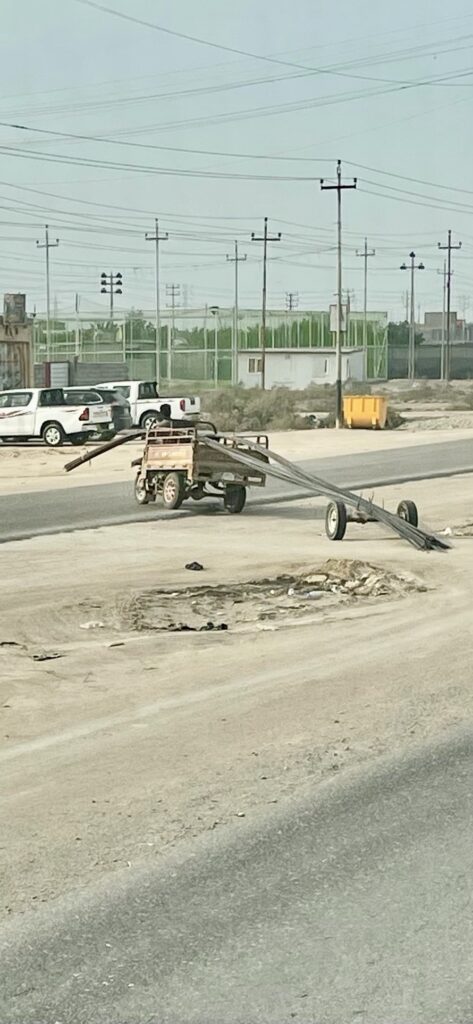
During coffee we decided that our first night would be at the Martyrs monument in the Mesopotamian Marshes about 3 hour drive from the border post. The first couple of kilometers, the road was good and not busy, but it changed once we got closer to the large city of Bashra. Traffic became hectic, roads got more pot-holes and the highway went straight through urban areas where people and traffic made sudden moves to get on or of the highway. For the first time we saw many, many tuk-tuks (little 3-wheel vehicles (mopeds) used as mini-pick-ups to transport people and goods. They often drive on the wrong side of the road, scaring the hell out of you when you see one coming strait towards you on the high way. Bridges we crossed are usually 1 or 2 lane crossings, where a 3 or 4 lane roads leads to, meaning that you have to engage in a survival of the fittest contest to get over these bridge. You are short a pair of eyes to see all the traffic around trying to pass you, especially the tuk-tuks and the mopeds. Good that we have Iraqi insurance (although I have no idea what is written on my policy).


What we read on the bloggers pages, was that there are many army and police check-points in Iraq, which is a result of the security situation in the country. These check-points can take time, although for visitors like us, its usually fast but you are still in a single lane with a lot of cars in front of you. We actually passed 7 check-points and only the last one, they really checked and photographed our paperwork. All the others the traffic was slowly flowing through. However, at one of the check-points an impressive looking soldier told us to stop. We were half way the drive-through, not realizing that the roof was slanting down on the way out. If he had not stopped us, we would have destroyed the entire check-point building by taking down the roof of the drive through (and with that of course damaging our roof and solar panels.)

When the soldier approached us, he first took his machine gun in his hands. That is the regular procedure I suppose, when approaching unknown people. We were so flabbergasted, however, to see a large, beautiful red rose sticking out of the barrel of his AK! Yup, after all, we realized, it was Valentines day! Marja is still talking about this, it made a huge impression on her. In a country where soldiers are dealing with serious stuff at all times, that this one put a red rose in the barrel of his gun when walking towards us. And approaching us because he was just helping us. Anyways, he told me what the problem was and that I had to back up. Now, then you are in for some classic Arabic traffic chaos. In the meantime a very long line of cars had formed behind us and now they had to move towards the unofficial pass through next to the drive through. Many cars did that already, but still blocked the cars behind me from doing the same. So I could not drive backwards. The soldier asked for back-up and more soldiers dressed like Nave Seals carrying big machine guns marched out of their small compound and started to shout and wave with their guns. I assume that’s the language Iraqi motorists better understand if they want to keep their cars with tires inflated, and avoid more bullet holes some cars already have.
The cool thing is, despite the chaos and “I go first mentality”, everybody smiles or laughs….
The last two check points are a mere 1 km apart (don’t understand why). The first one they took our passports to check, but at the second one I had to go into the office with the officer while other officers checked the passports. When walking out another officer came with me to check the car papers and to make a picture of these papers and the truck. All set, we were now less the 10km away from our first camp spot.
We arrived a little after 17:00 at the Martyrs Monument at Chabaish. This moment consist of a hugh mosque style structure and an artwork in front of it. It’s dedicated to the over 200.000 Marsh Arabs, who where killed by forces loyal to Sadam Hussain, after they raided up against his regime after he lost the first Gulf War. The Marsh Arabs are unique people who live in the over 10.000km2 (at the time), Mesopotamian marshes. They (used to) live in floating houses made of reeds and live from catching fish and cattle. The cattle is note-worthy, since these are water buffalos who originated from India (4000 years ago) and can swim through the marshes. Over the centuries the marshes have been an almost impenetrable hiding place for rebels and criminals. Sadam Hussain decided to remove the water from the marshes by building dikes and channels, so it was easier for his troops to get in and find rebels and anyone expected to be opposed to his regime. At the end 90% of the marshes where gone and 4/5 of the population killed. This was 33 years ago!


In the meantime, the marshes are slowly returning to their original seize. Dikes are removed and water flows more freely from the Euphrates river into the marshes. The marshes are an important biodiverse ecosystem, with many bird species and some mammals, living in some kind of harmony with the marsh Arabs.
Again through bloggers we knew this was a safe place to park for the night. More tourists come here, so the authorities made it a priority that they are safe. The monument is off the main road and surrounded by a big fence. There are about 5 or 6 policemen and/or soldiers on guard duty all the time and they leave you in peace. Before you enter, you are welcomed by a number of men and boys who try to get you on their boats to do a tour through the marshes. These guys are not allowed within the compound of the momument, so you don’t have them knocking on your door all the time.
The policemen and soldiers walked with us around he monument and in the large dome structure in which there are many portraits of killed rebel leaders. The monument is connected to the main road (which is a long dike going straight through the marshes) with a small causeway. For the rest the monument (and us) are surrounded by the endless marshes, as far as you can see, you see the horizon. You see here and there the small reed floating houses and the water buffalos. When the evening sets in, a cacophony of frog and crickets sounds start to take over the sound of the many loud conversations of the men in and around the marshes. They say women can talk, but in Iraqi men they have serious competitors.

After our diner, we walked again around the monument, listening to all the sounds from the marshes. We had a small chat with the soldiers and since the nights are becoming chilly, we moved back into the truck. Our first night in Iraq was quiet and peaceful.
During the night the wind picked up and it started to rain. We had the plan to do a boat tour through the marshes, but the next day it was still raining with lightning and thunder, so not a good day for in a boat. The boat guys were also not at the gate, so I assumed it was really not a good day. During a dry moment the soldiers let boys in to talk to us about a boat tour. They were nice and friendly but didn’t speak a word of English. Through our translation app on our phones we were able to explain what we exactly wanted. It was not that easy and sometimes you are not sure, or actually I am pretty sure, that the translations are not correct. We were able to explain the departure and return time, that we wanted a lunch and the total price and that it was for the next day. Showing them Instagram pictures of other overlanders doing similar tours, convinced me and them that we were on the same page. To be sure that we would recognize our “captain” the next day, we had to make a mug shot of him. It seems to me the guy knew what he was doing. A mug shot of me was not needed, he would recognize me……

Rain, rain, rain, now we understand why there is so much water here and why the rivers cause flooding so often. Luckily the last rain fell in the early morning and by 8.30 our captain (Martaba) was already knocking on our door (30 minutes too early). He wanted to make sure we didn’t go out with one of the other captains.
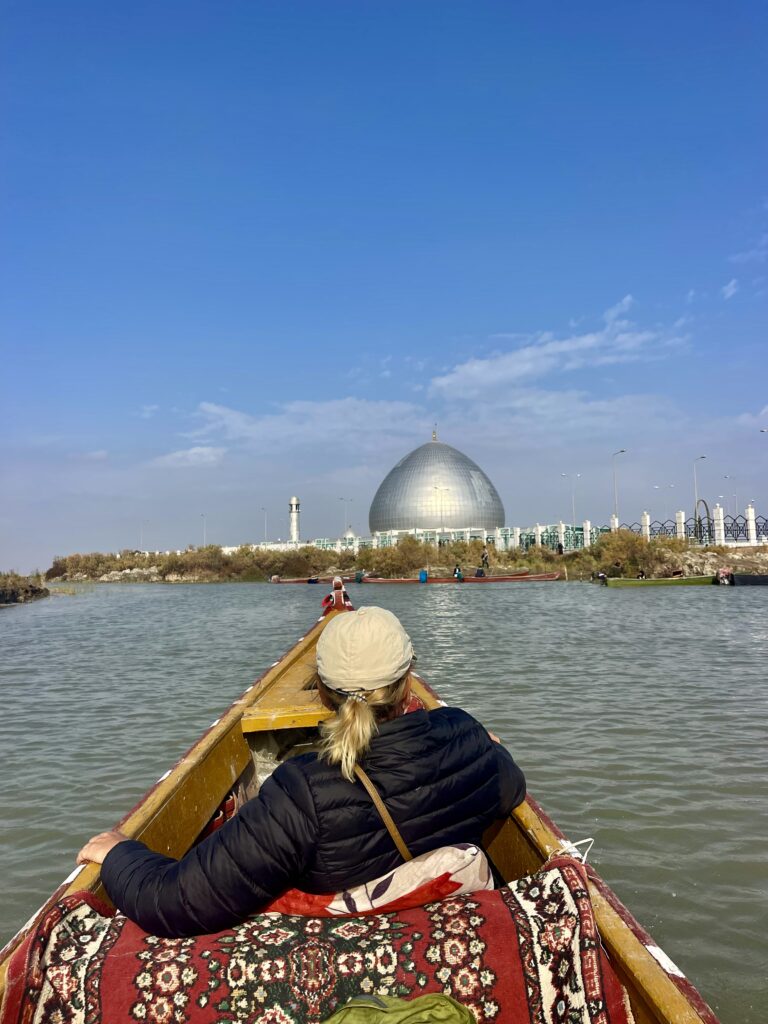
It’s Friday so also many Iraqis where on their way from the town to the marshes to do a boat ride on the weekend day off, but they would arrive much later. Since we didn’t know if we had to do any mud hiking, we put on our high rubber boots (never used before). But the captain explained he didn’t want them on the “centuries” old carpet in his long canoe (with Yamaha outboard engine). When we reached the “harbor” (just next to the monument) there were a few other guys with their canoes and it seemed like they were all a bit jealous that our captain had foreign tourists (sure we would be paying more than the locals, but we know how it goes and understand). The average salary is US$ 350,— a month in Iraq and if we can make one guy with his family happy, we are happy too).

With our butts on the carpet, a little cushion behind our backs and the legs stretched out, we embarked on our journey through the marshes, leaving our secured compound (with fences and guards) behind. We didn’t even think about the fact that our faith was now in the hands of Martaba and if we would disappear in these huge marshes, nobody would ever find us. As our under belly feeling didn’t give us any warning signs, we didn’t give that a serious thought anymore.

Right from the beginning you are treated by the scenery of many different birds calling the marshes their home. The marshes are a UNESCO site and have a very important and diverse ecosystem. Large birds of prey were constantly flying with us, as well as vultures. Many King Fisher birds were hovering over the many waterways, trying to catch their lunch and white egrets, usually near buffalos, flew up, the moment we were passing with the canoe. The first site of the water buffalo is impressive, since you don’t expect them to be in the water or even swimming across channels. But we knew they could swim, like their brothers and sisters in India (where there ancestors come from) and the African wild buffalo (not domesticated). They are mostly black and have hairy fur.

It’s winter in Iraq so the marshes are brown and grey. When its summer, the reeds get harvested for production of homes, mats, or other items. Whats left gets burned, so the reeds grow back faster. In the marshes you have thousands of little islands, where the marsh Arabs built their homes and shelters for their cattle (water buffalos). Unfortunately, many of them are using plastic tarpaulins or other left over materials as building materials, taking away the charm of the typical homes of these people. But, I understand, that a tarpaulin gives beter protection against the rain than the reeds.


Life must be harsh, especially in the summer time when temperatures are high and the marshes are infested with mosquitos. Whole families life on these islands (some of these homes are built on floating reed islands) There is no running water (and the marsh waters are murky and contaminated), no electricity (some have small gasoline generators) and there are no toilets or sewage systems. Children don’t have much space to play and do not have many pals near them. I wonder if they even go to a school. Its like time passed the marches and the people got stuck in the present past of 4000 years ago. They built their homes like they have always done, they do their fishing (they used to fish with spears only, but now mainly with nets) and herd their cattle. A big change is the outboard engine on their canoes instead of using a pole to push. In fact, the engine is an addition to the pole. The pole is still needed often, as many areas are too shallow and too full of reed, to use the engine. In one way, it is one of the most peaceful environments I have ever encountered and its hard to imagine that this country went and still is, going through so much hardship.


Unfortunately we had no wifi, so whatever our captain tried to tell us, we had zero idea what he was talking about, since we could not translate without wifi. And it seems like some people think that when you talk more and louder, the other person will automatically be able to understand Arabic. Well, not really!
Our captain showed us an old destroyed causeway through the marshes from the times of Sadam Hussain. The cause way, which used to have a 2 lane road was now a mere walkway (several floodings, bad construction and no maintenance did the causeway going thinner and thinner) and was even broken up completely at certain spots.
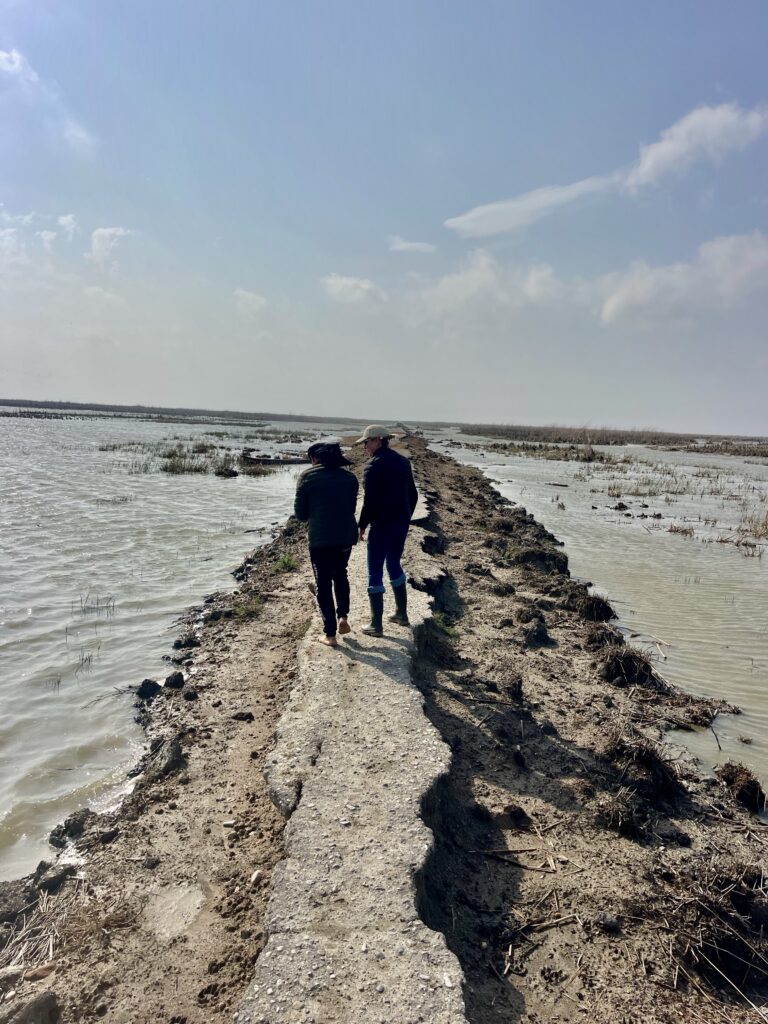
Boating along the old causeway we noticed that many marsh arabs are using it now as a building lot. A solid ground (partly tared) and high above the water, but for how long? All these houses and shelters are temporary since the marshes are changing all the time at the will of the mighty Euphrates river, which has changed its courses many times during past and even recent times.
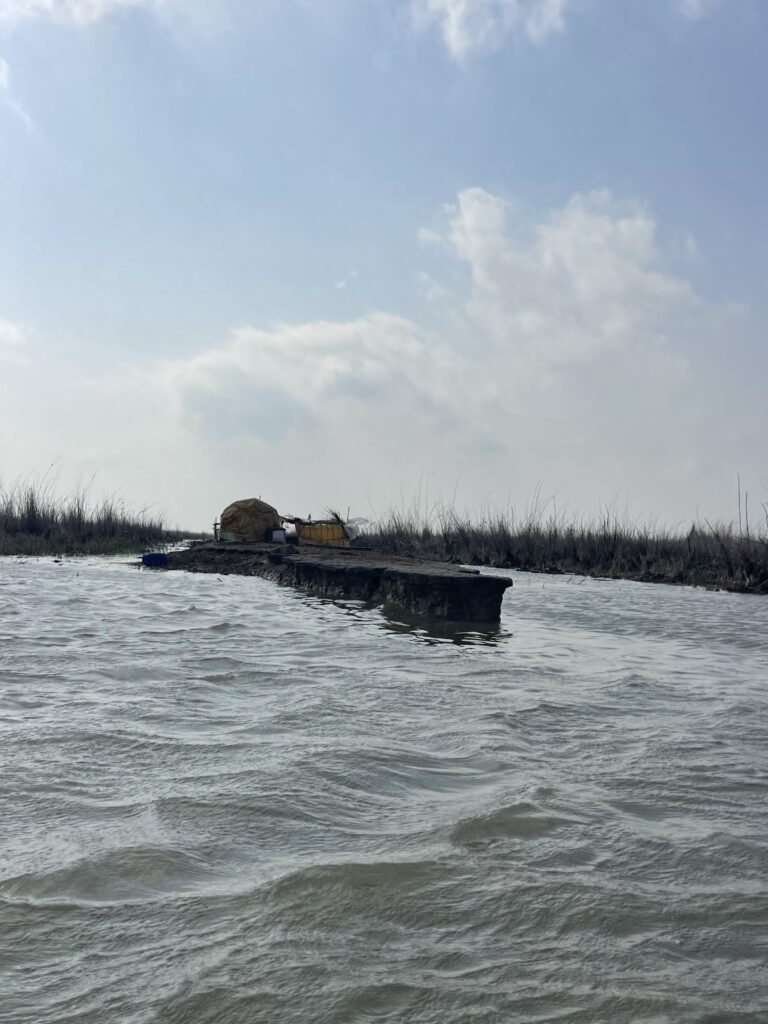


We stopped at an abandoned home to look around and make some pictures. I was shocked by the amount of garbage laying around the house and in the water (there was even a sign, sponsored by the French Embassy, to tell tourists not to leave garbage behind, but to me, it looked like it is definitely not only tourists who leave garbage behind…..


To get a little bit of the feeling of how life is in these marshes (and I say again, a little bit), we asked our captain to have lunch in one of these houses on an island. He dropped us of on an island with an almost finished little house and disappeared to get lunch for us. We spent about an our on the island, just absorbing our quiet surroundings, when we noticed more and more canoes passing by with mostly visitors/tourists (nearly all Iraqi tourists). A neighbor from accross the channel came to us with his canoe and based on the hand signals, wanted money from us for using the house. I just mentioned the name of our captain and he understood right away who to talk to.
Our captain came back, parked his boat, brought some bags with food inside the house and started to make a fire for a bbq. In the meantime our neighbor came back with a large tree log to help make the bbq. In return, our captain gave him some gasoline from his outboard engine. When the neighbor left, the captain realized that he had no lighter to make the fire. So now he went in his cano and peddled to the neighbor for the lighter and a bag of salt.


With all the dry reeds around us (yup, also that, making a big bush fire would be the last thing I wanted now), some scrub branches and a few little bits of gasoline he got the fire burning. We has fresh bream today, which he cleaned in the murky water, put in a bbq holder and kept it above the fire. At the same time the neighbor came back with a big metal plate (our captain forgot that as well). He cleaned that also in the water and dried it on his pants (his butt)!

After a while the fish was ready, put on the plate, together with some salads, rice, Arabic bread, bean soup and some pickles. No private plates or cutlery (we are used to that by now in this part of the world), so we all dug in the fish and the other food. But telling you, it was a great meal if only for the location (while we saw all the other tourists and visitors passing by, back to their cars, most probably missing out on a great lunch in the marshes. We enjoyed it very much!

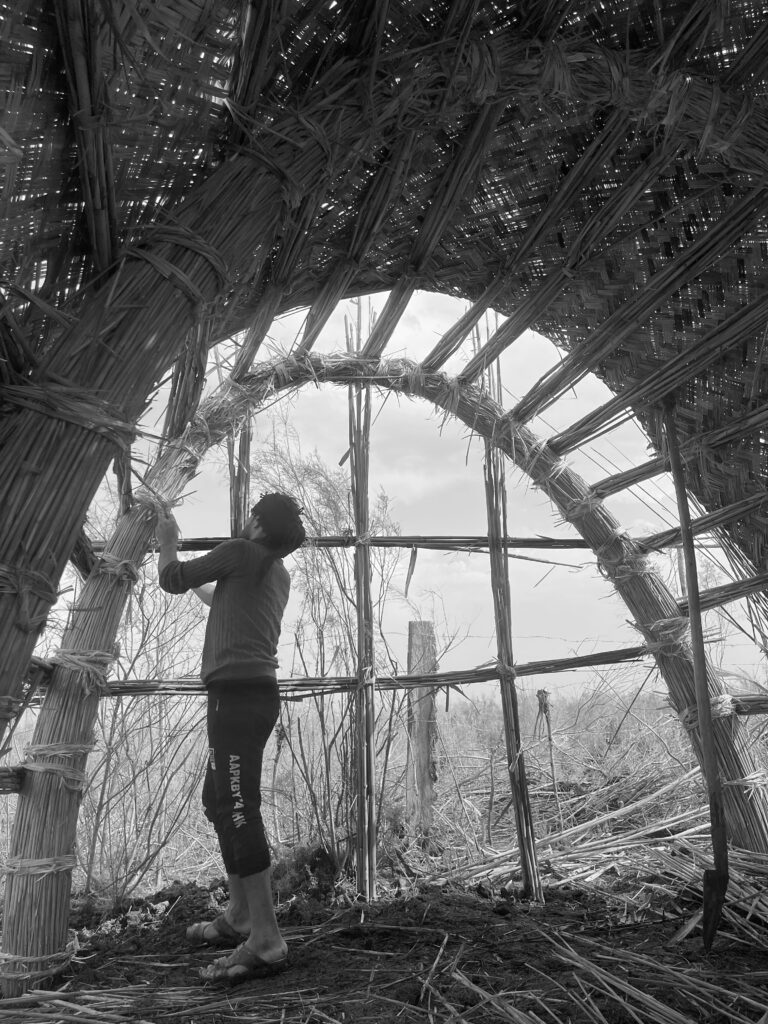
After lunch we lay down on the mats in the house for a moment, while our captain was doing some “construction work” on his house. Interesting to see how that goes. No nails, screw or other materials needed from your local hardware store, its all stuff from the marshes, all reed!
The sun was now shining, clouds were gone and the way back was great. We saw now that many of the reed houses were occupied by day trippers from the cities. Whole families were “camping” out for the day with their bbq’s. It’s Friday the day off for most of the Arabs. The men take their families (wife/wives and children) out to the outdoors, like we saw in all the other Arab countries. Iraq has no beaches and the desert is still dangerous due to terrorist activities and the millions of hidden unexploded ammunition. The marshes are one of the few options left, for a day out, out of the busy towns.
When we returned, we said goodbye to our captain and returned to our truck. We had our last struggle with our boots (because getting them on and off, every time we returned to the boat was tough) and finally had our first coffee of the day.