We left Al Ula from the view point and headed to the starting point of one of the Dakar Rally tracks. We did one already and wanted to do another one. We had a rough idea about where the start was and how the track would go. We drove on a high way passing a beautiful area of sand dunes and red sand stone rocks. Suddenly we passed a huge temporary camp with hundreds of trailers, tents, trucks, generator trucks, mobil cell towers ect. Actually in the middle of nowhere, and nothing that indicated what it was all about. I drove in where the staff tents were located (with again lots of water trucks and cooler trucks) There where many Pakistani and Bengalis coming out of their tents, but none of them could actually explain what was happening here or why they were here, except for what they themselves individually were tasked to do. (Later we found out that it was the biggest date festival of Saudi Arabia, but that it was just finished). Behind the camp was supposed to be the beginning of the Dakar track. We found it indeed and started to follow it. However, not long after, we encountered very deep sand and steep dunes. We tried a couple of times to cross or bypass via nearby routes, but we couldn’t make it. So we stopped before it was getting too dark and made camp.


Next morning we decided not to pursue the Dakar route, but instead go into Sha Aan Nature Reserve. Officially, you need permission and a permit beforehand, but the ranger at the gate was so kind as to let us in. The park – from an ecological perspective – is a very important park. It has a large variety in eco-systems and several different landscapes. In February a number of Arabian Oryx and Nubian Ibex were released in the park from a captive breading project. It’s encouraging to see that also Saudi Arabia is making efforts to protect vulnerable nature and endangered species. We drove into the park as far as the tracks would let us, until steep sand dunes in rocky valleys, made it impossible for us to continue. We stepped out and made a long walk over mountains and dunes. It’s really a beautiful park and there was nobody. We left the park and went around it, still in a wonderful area, similar as in the park itself. Underway a car wanted us to stop (which happens often), so we went aside of the road. A very nice Saudi with his family, invited us for diner, but we had to say no, since we were on our way to our next destination. His daughter wanted to make a photo with Marja, so that wish we could fulfill. The girl then run back to the car picked up a nice cake, to give it to Marja. The kindness of many Saudi’s is unparalleled. Our next destination was the old desert oasis town of Tayma. We arrived late in the afternoon and since (like in Al Ula), you have to book tickets and time slots to see the historic locations, we could not see anything that day anymore.
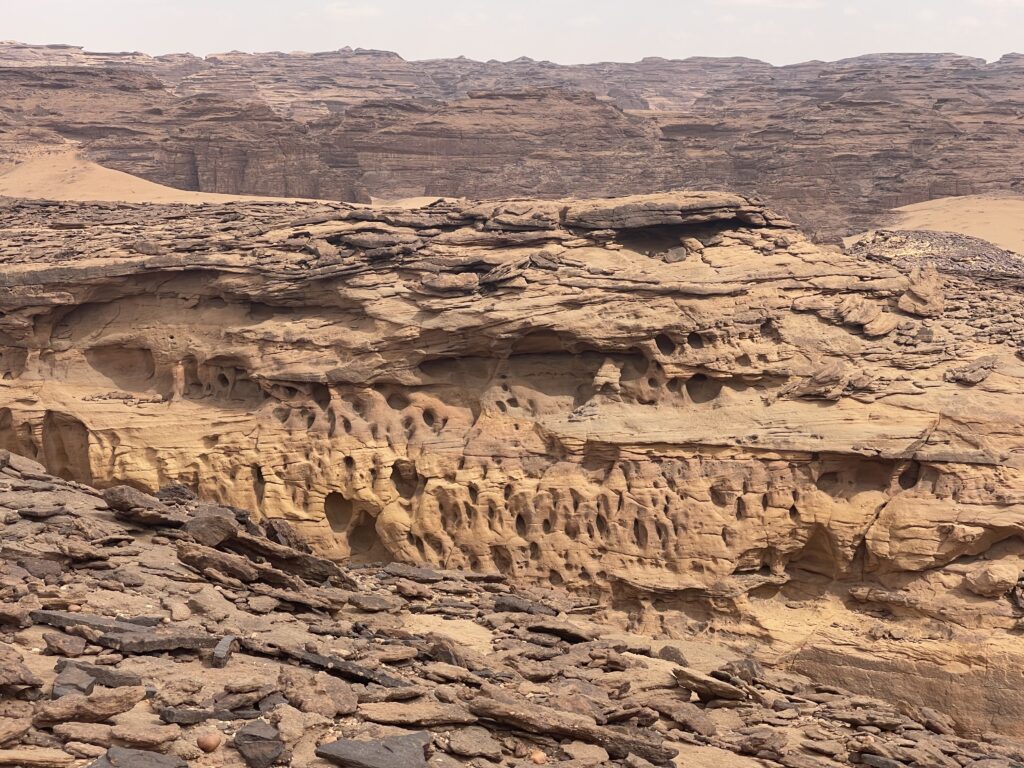
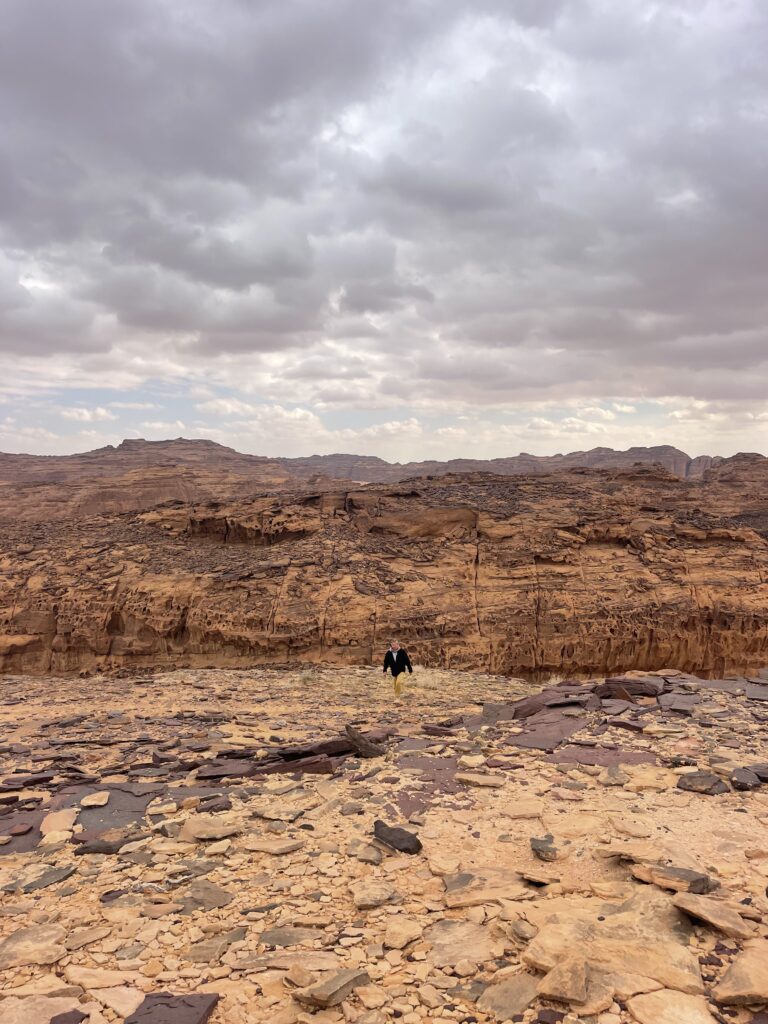

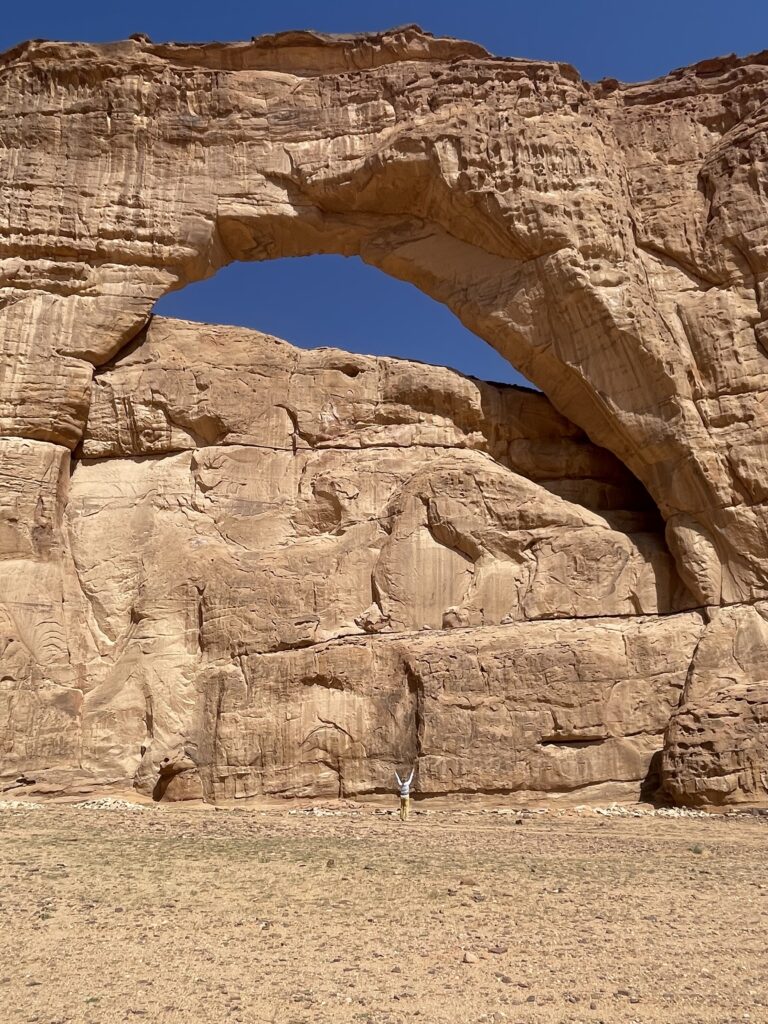

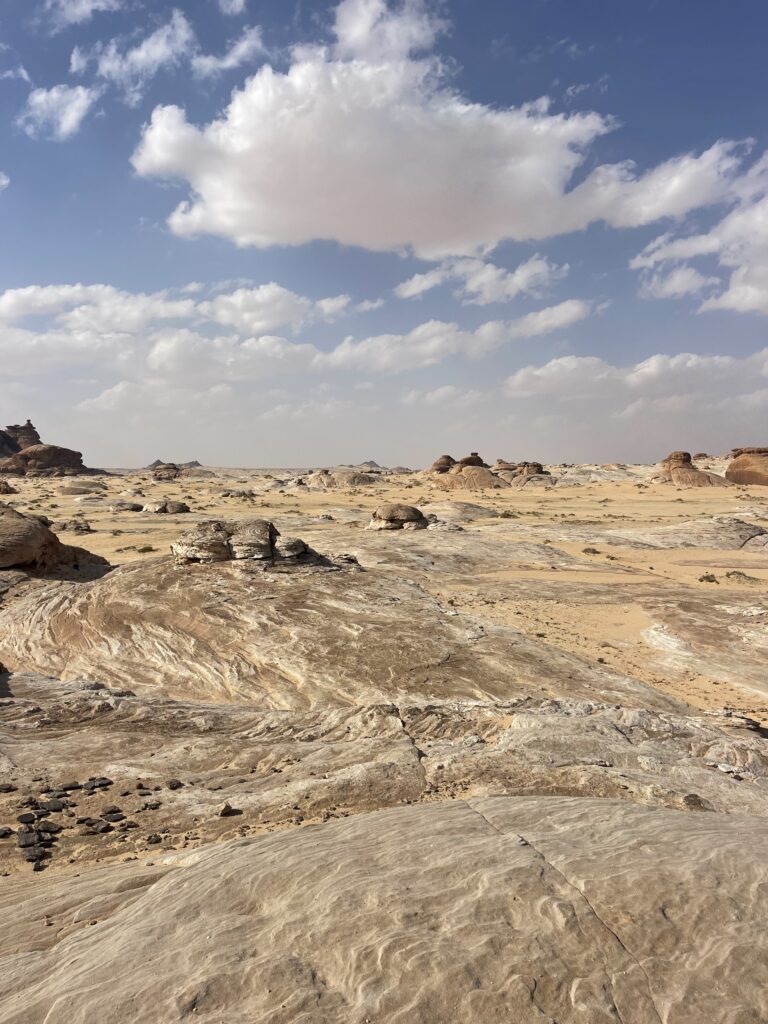

Out of town, on a higher plateau, we set up camp for the night. When the darkness set in, we saw the lights of the town in the distance. The next day, early, we would visit the old places.
We woke up from a horse. A Saudi man on a horse, he came to say hello and offered us coffee, but at 6 am, that was a bit too early. We got ready, had breakfast and moved to the first location. These were the remnants of an old temple, near a dried up lake. The temple was built by a Babylonian ruler (Nabonidus) about 550 BC. He was a great king, but nobody understood exactly why he spent 10 years in the small oasis town, instead of ruling his empire from the capital Babylon. Choosing and worshipping a different God and religion, is what the mainstream believe is (hence the construction of the temple). 80% of Tayma has still to be excavated and examined, so many ruines of an old city or cities are still buried under the sand. Further in the desert, on a rock formation a “cartouche” (Pharaonic Petroglyph) was discovered. This is like a unique “stamp” from an Egyptian Pharaoh, indicating his presence. It’s the cartouche of Ramses III and dates back 1190 BC!!!. This shows that parts of nowadays Saudi, could have been part of the Egyptian Empire(s). It’s the only one ever found in Saudi. The town of Tayma has always been a very important city on a trade route, which started in the Nile Valley, crossed the Suez and Sinai desert, into Jordan and then Saudi.


Like in Al Ula, we were requested to keep the truck at the parking and were shuttled with a brand new van to the old town of Tayma. In October 2022, the Government just finished in a record time the entire tourism infrastructure of Tayma, with two state of the art visitor centers, a fleet of mini buses, golf carts and electric bicycles. New restaurants and coffee shops and restoration of parts of the old town and souq. For all that a small army of staff members are now trained and employed. We counted over a hundred story tellers, bus drivers, golf cart drivers, rangers and visitor center staff. Tayma is also part of the Vision 2030 tourism project.
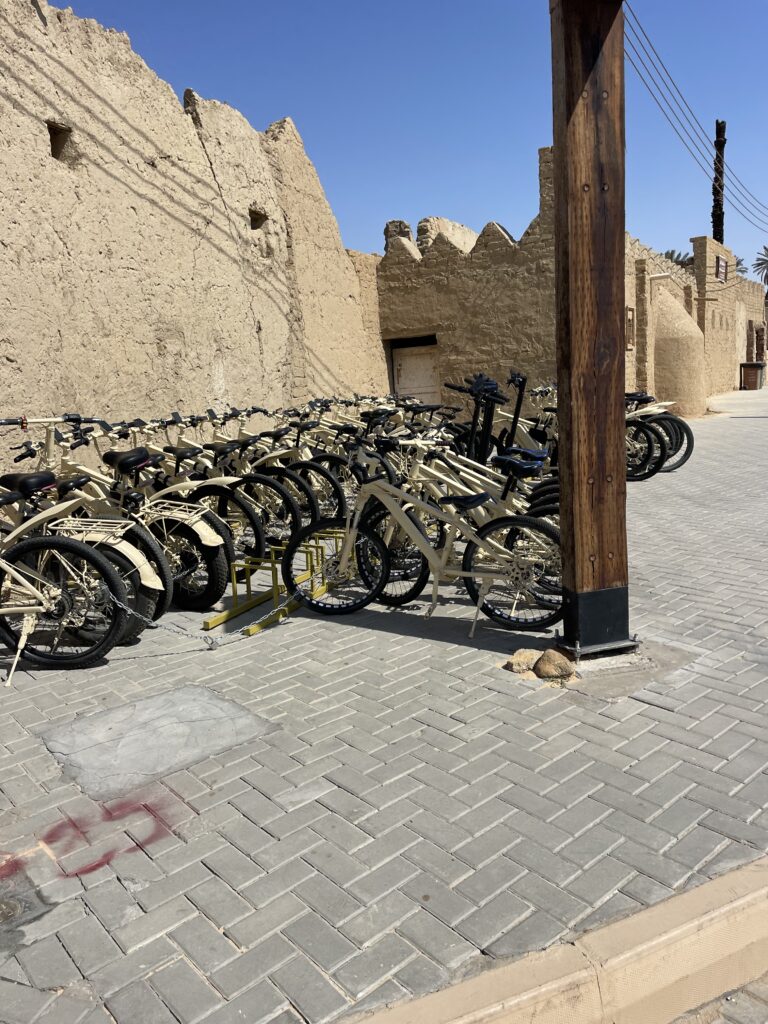
We were dropped off at the next visitors center, in front of which the impressive Bir Had(d)aj well is located. We were received by a story teller and had a look at the small exhibition about old Tayma in the visitors center. About six ladies were working at the visitor center. The moment we came in they all quickly put their phones down and welcomed us. (It’s not so busy, so what else can you do to kill the time). One of the ladies went outside with us to walk around the Bir Had(d)aj well and tell us more about it. It’s quite an impressive structure, which has been in operation for nearly 3000 years and was built by the Babylonian king Nabonidus. It’s one of largest, or even the largest, water well on the Arabian Peninsula. A lift mechanism consisting of a rope and a wheel was used and powered by camels to bring water up, this was then deposited in the small channels. The wheel is a wooden wheel called a Hadaj and there are 40 of them built around the well, meaning that 40 camels were working simultaneously and constantly, to “pump up” water from the well. You can almost say that Tayma is built around the well. Palm gardens/plantations are situated around the well, togehter with the ruines of small souqs. A souq is a market place, and in this case there were a number of them, owned by individual families. Water from the well is channelled to the houses to water the date palm gardens and fill reservoirs. A system of time slots was created to indicate who gets water when and for how long. The channels can be closed off at each house, so water was diverted to other houses. An interesting feature of the house was the entry gate. At night, unknown guests had to crawl through a little opening (first push their belongings through), to avoid that a person with bad intentions could overwhelm the guard and the family.

A young man was our story teller and he took us with a nice brand new golf cart to the old town of Tayma. He was the great grand son of a Prince who built a palace in Tayma many years ago. After we visited the old town, we walked to the palace. Well, if we talk about a palace (not castle), we have a lot of glitter and glamour in mind. But palaces in Saudi Arabia are not always like that. They are big fortified buildings, with one or more towers, multiple rooms and defense features. There is not much fanciness. However, the young man was very enthousiastic about his family history and the palace. The palace consisted of a new and an old part. The new part is open for tourists, but the old part is not. However, since we showed so much interest, he also brought us in the old part. Its is a mud brick building (walls and floors), so it needs a lot of work to make it showable to. tourists. We drove back with the golf cart to the well, and from there the mini bus brought us to the truck. We left Tayma towards Wadi Disha.


We went off the main road into the desert again. After a while, it happened….. Something I had been afraid of that one day would happen…, a flat tire. This day I had forgotten to lower the tire pressure, so now a sharp stone cut into the inner side of one of the back tires. A loud hissing of escaping air was the result and I had to act quickly, in order to be able to keep the truck straight. Luckily we were not driving too fast, so I could do a controlled stop on the track. First thing I had to do quickly was to put the jack under the truck, as long as the tire was not empty yet. We used the thick aluminum bottom plate we found at the Dakar track a while ago as bottom support for the the jack. We put pegs behind the three other tires (safety first) Then I lowered the lift at the back of the truck with the spare tires and took one off. Now it was time to remove the damaged tire. The bolts were very tied up and the moment I started with loosening them, two Land Cruiser pick-ups showed up, with three big Bedouin guys. They asked if we needed any help (and proud as I am, I said “no, it’s fine, I can handle it”). But they didn’t believe that. So, they almost pushed me aside and started unscrewing the tire. (Fortunately I had already disconnected the delicate inflation system.). Within moments, the bolts were off and the tire removed. Now I had to transfer the inflation control unit from the damaged tire to the spare one (never done that before), but I succeeded (it was the part of the operation I had the biggest worries about). Now the spare tire could go back on and with the Bedouin muscle power, the bolts were tied back on. Really great guys and after the tire was replaced, they jumped back in their Land Cruisers and left (they didn’t want anything from us). Now I only had to put everything back, remove the jack and move on again. In that process, multiple other Saudi’s passed by (mostly guys who had camped in the desert). A lot of talking, coffee and tea. One guy even brought us handful of face masks (did not understand the need for that).

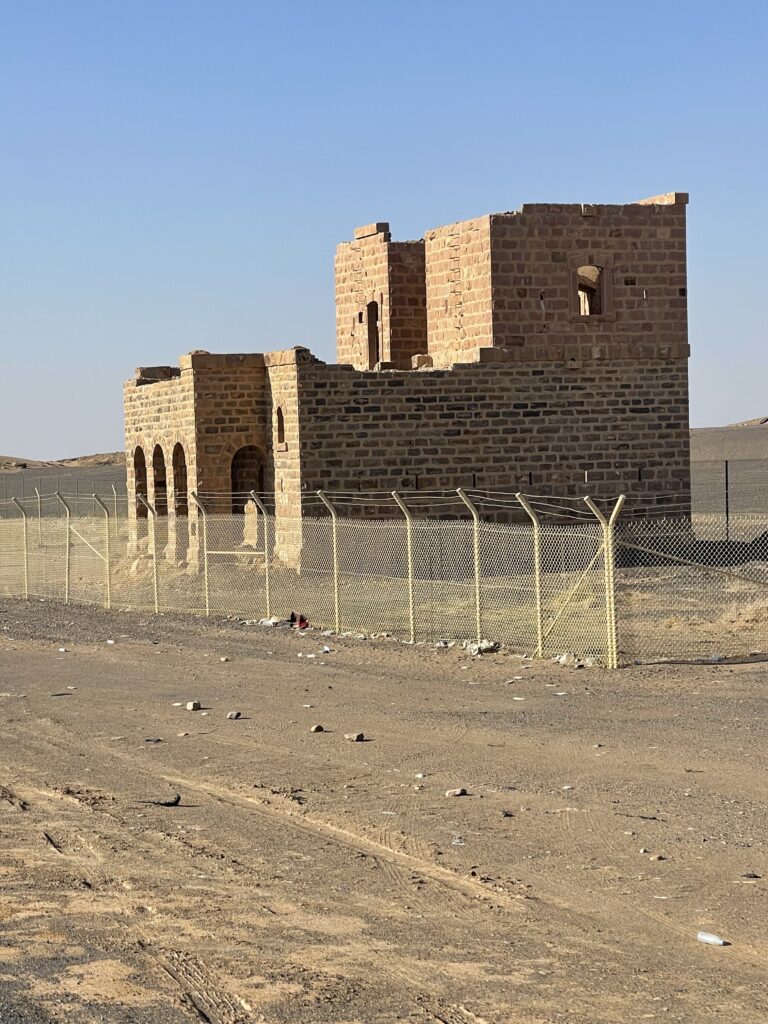
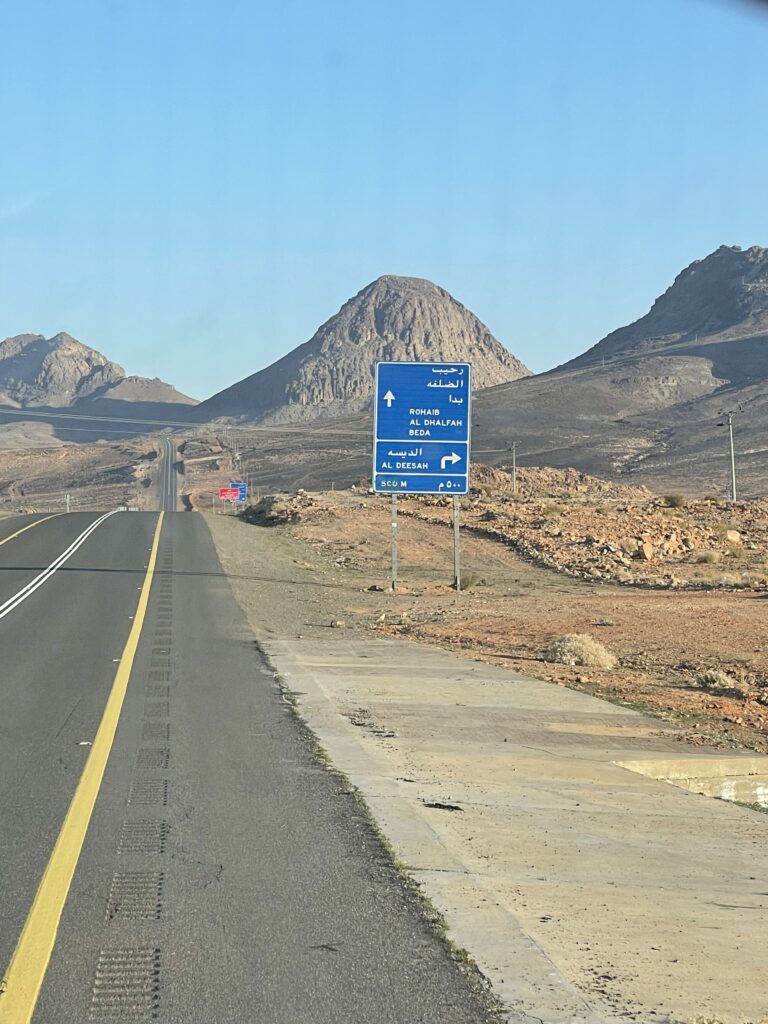
We continued our drive and hoped to reach Wadi Disha before dark. Luckily we had chosen, again, a beautiful scenic route (so much credit to my navigator!), which became more mountainous along the way. We also passed multiple bridges and fortifications along the old Hejaz railway. On our map, there was not a clear indication of Wadi Disha or at least the road to it. It seemed now we would not be able to reach it before dark on the most logical route. However, we reached a turn-off with a sign “Deesha”. We know that translations of Arabic to English come in many different forms, so we guessed here Wadi Disha was meant. Only problem now was, that the road was closed off with concrete barriers and we saw a sign “road closed”. We went around the barriers and drove towards a check point with an open boom and a police car. I stopped and waited for a while, then stepped out and went to the office where the police car was parked. I knocked on the door a few times, shouted “hello”, but there was no response. So I jumped back in the truck and we passed the check point. We drove into a protected area, and we were very happy that we did that. The ride into a marvelous mountain area, again a scenery we had not encountered before, was great, especially with the sun going down. Often its the position of the sun, which creates different views on landscapes (if you come on the middle of the day, you might experience the scenery totally different). The tar road ended in a wadi and we followed the sand track through a narrower becoming canyon. We actually arrived in Wadi Disha. We drove for a while between the red sand stone canyon rocks, it’s a labyrinth of canyons, with here and there small islands of palm trees. At a certain moment we saw two people walking into our directions, two western tourists we thought. And then we saw these people were Paul and Monique, two Dutch overlanders, we know from Holland. They also have a Bliss unit and that’s actually how we got connected. They helped us with a lot of useful information before we embarked on our Oman trip. It was for both of us a great coincidence and surprise to meet each other here in Wadi Disha. They pointed out where they had parked their truck, so we moved into that direction. We saw they had chosen a great spot in a large date palm grove with a huge canyon cliff as the back ground. The afternoon and evening we spent the together, exchanging stories, experiences and tips.



Next morning we drunk coffee together, made drone footage and another overland couple visited us, a young couple with their SUV with rooftent. So, all together we had a real Dutch Sunday morning. After the young couple left, the four of us went of a hike into the wadi. From were we started, we found more water and lots of high reeds and date palms. We walked for a good hour and a half, when we stumbled on another overland couple. And these people we knew as well, Bodu and Regina from Germany. We met them and spent a night with them all the way in the southern city of Najran a little while ago. Also they were surprised and we were happy to see each other. (Alcohol free) beer was quickly served and we all had a nice chat. We returned to our camp and spent one more night with Paul and Monique.


Early morning we said goodbye to Paul and Monique and drove out in the direction they had come from (they would later leave in the direction from where we came). We now had to drive through the water, through a narrow path in the reeds. Its was a bit of tricky labyrinth, with sometimes a lot of mud or big deep puddles of water, but the Zetros handled it with ease. Of course, this was also the perfect scenery for some nice video footage of the truck crossing the wadi. Along the way we kept being pampered by the beautiful sceneries in the wadi. Wadi Disha is truly one of the most beautiful wadi’s we have seen do far.

We came out of the wadi, stopped at a little stand where a Saudi man was selling fruit and we bought some of it. Fruit and vegetables are widely available in Saudi and of good quality. We eat fresh vegetables almost every day and Marja often makes good morning shakes with yogurt, fresh fruit and the nuts, seeds and grenola we brought from Holland. Eating fresh and healthy is a must for us to remain in good shape while traveling the way we do.

Our next stop would be on the shores of the Red Sea, where we would meet up again with Regina and Bodu. The area we were heading to is within the large Neom project. Neom is an area earmarked by the Saudi Government for extensive development. It’s an unbelievably beautiful area bordering the Gulf of Aqaba all the way up to Jordan, it covers about 26,500km2. Its sparsely populated, has a beautiful coastline, high mountains, it’s dotted with archeological sites and has stunning nature. Crown Prince Mohammed bin Salman is the visionary mind behind this mega project. It is part of his Vision2030 for Saudi Arabia, whereby Saudi Arabia is aiming to diversify away from the fossil fuel economy. Tourism is the main focus of Vision2030, but within Neom, diversification is also aiming on developing new industries, focusing on sustainability and technology. Saudi Arabia is striving to become a world leader in sustainable development for living, working and leisure. Together with their own huge oil and gas revenues and foreign investors, it has the capital to going on this wide and long path, with many uncertainties and no guarantees. But who believed 200 years ago that we would be flying in planes and go to the moon?

Finally we reached the peninsula where Bodu and Regina made there camp, right in a bay on the beach. It was stormy and cold, but very nice to see them again. Nearby, behind a dyke of sand lay the famous “Sea Plane”, a Catelina, which landed in the bay in 1963. An American business man together with his family and secretary (and her son), were making a tour around the world with this former army plane (also called a flying boat), which he restored and transformed into a flying camper.


They landed the plane in Saudi waters and spent a day on the beach, when at the end of the day, they were shot at by multiple members of a local militia, charged with border patrol. The family tried to escape with the plane, but the plane crashed on a rif and broke in two. Two of the party got injured by bullets and the plane was ruined because of the crash and the many bullets. They were all arrested and interrogated. After a couple of weeks they were evacuated back to the USA. The plane wreck remained there and became a tourist attraction overtime, but not after being stripped from all what could have some value.
We spent the night with our German friends on the beach in the breezy wind, with hot chocolate, tea and coffee.
Next morning after sharing some last stories and a good wake-up coffee, we both went our ways again. We continued our way through the Neom coast, which starts from where the Red Sea ends and the Gulf of Aqaba starts. Except for one little town, there is no habitation along the coast of the Gulf of Aqaba in the Neom section. Not far from the plane wreck, huge excavation works are under way, with hundreds of excavators and hundreds of dump trucks, to prepare for The Line Marina (which will be incorporated into The Line city). We have seen the scale models at the exhibition in Riyadh and realize how huge this marina is going to be.
After passing the enormous construction site, we continued following the coast via the Border Guard dirt road. This is used by Border Guard vehicles and is almost exactly following the waterline of the Gulf of Aqaba. The great thing about it, is that you are off the main road and have wonderful views over the (turquoise) water and the many sandy bays. Once we stopped to make photos, a Border Guard vehicle quickly showed up, asking about our intentions and to see our passports. They are extra nervous here, since on the other side of the Gulf, their is the Sinai peninsula of Egypt. For many years, rebels and terrorists have been active in the Sinai, which is a big problem for Egypt, but also for Saudi Arabia, hence the tight security.
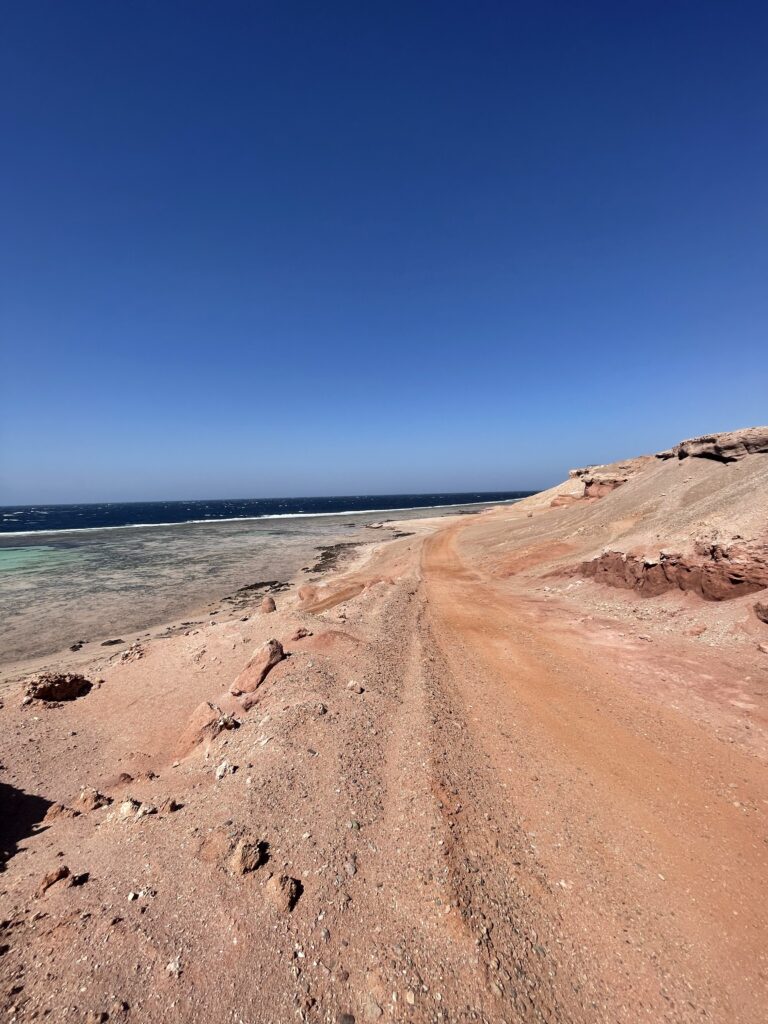

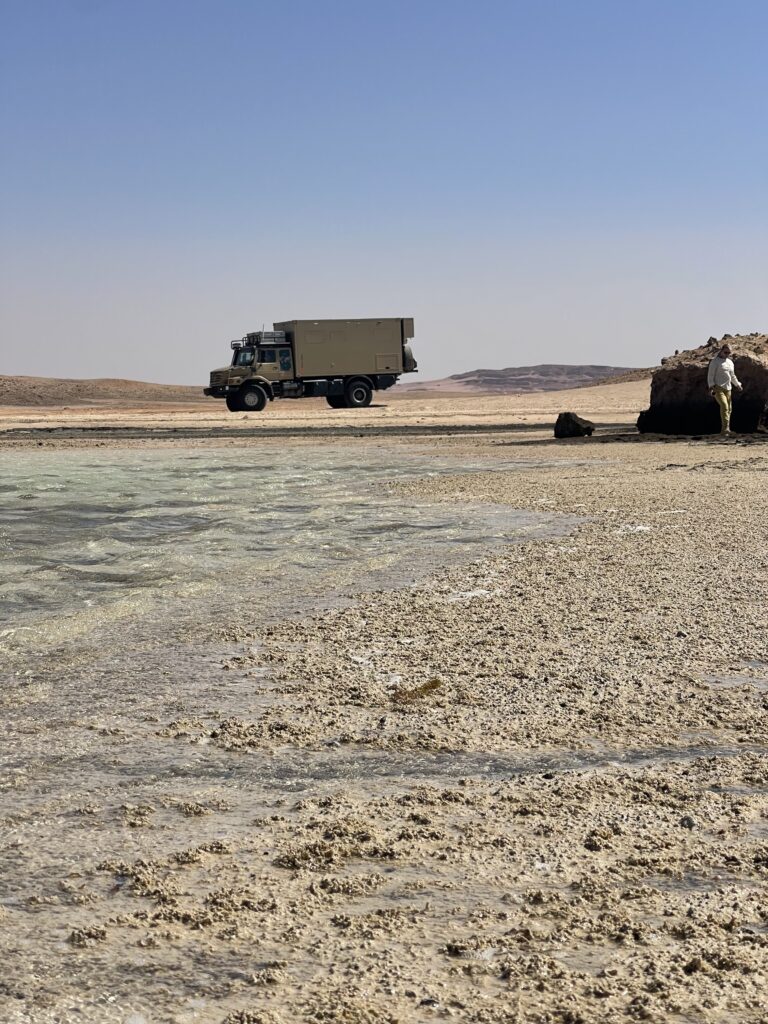
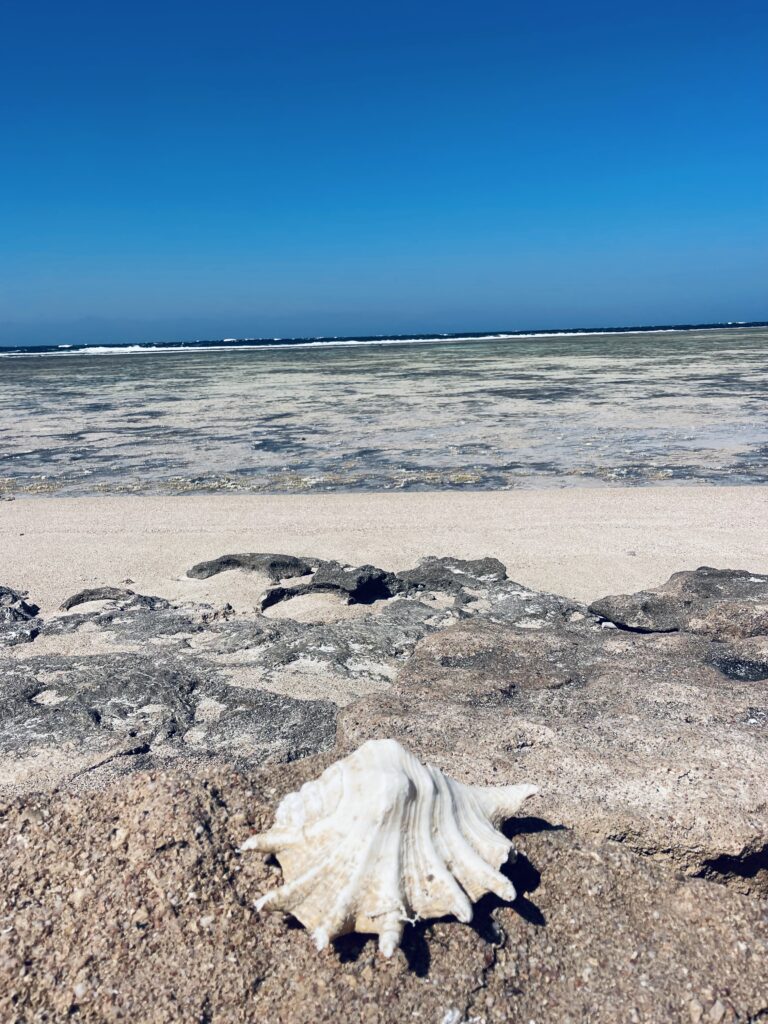
The Gulf used to be a popular area for fishermen. Many huge oyster shells can be found on the beaches (pearls), and beautiful conch shells as well. Over fishing and pollution has decimated certain species and fishing became unprofitable. Government restrictions on fishing will hopefully bring over fished species back to sustainable levels.
Near the town of Maqna we found the 12 wells of Moses. Around these wells an oasis developed over time, with many date palms. It’s said that it is here, that Moses came ashore with his people, after crossing the Gulf of Aqaba, and let water flow from out of the earth to provide water for his people. It’s therefore a sacred site for many believers.
The site is fenced off, has nice walkways and benches. It’s a garden of Eden, so green and peaceful.


Our journey continued along the coast and we tried to find a place to set up camp. It was, however, extremely windy (and therefore also noisy) and the Border Guard was watching us. They don’t want you to camp near the beach. The road stopped at a check point from where we were not allowed to continue. We had to turn around and drive all the way to back to Maqna. Along the way, we tried several spots on the other side of the road, a bit higher up in the mountains, but it was either too windy or we could not find a level place (to park the truck straight). We ended up near the town, and found an abandoned construction camp site (level and no wind).
Not being able to follow the coast, we went inland (through Neom territory) going east.
We past through the city of Madyan, where we visited a small museum. The city was once part of the Nabeteans (like Hegra) and besides the ruines of the old town, rock grave chambers with decorated facades can be found nearby. The city is also within the NEOM area, and is part of the plan to exploit its historical heritage.

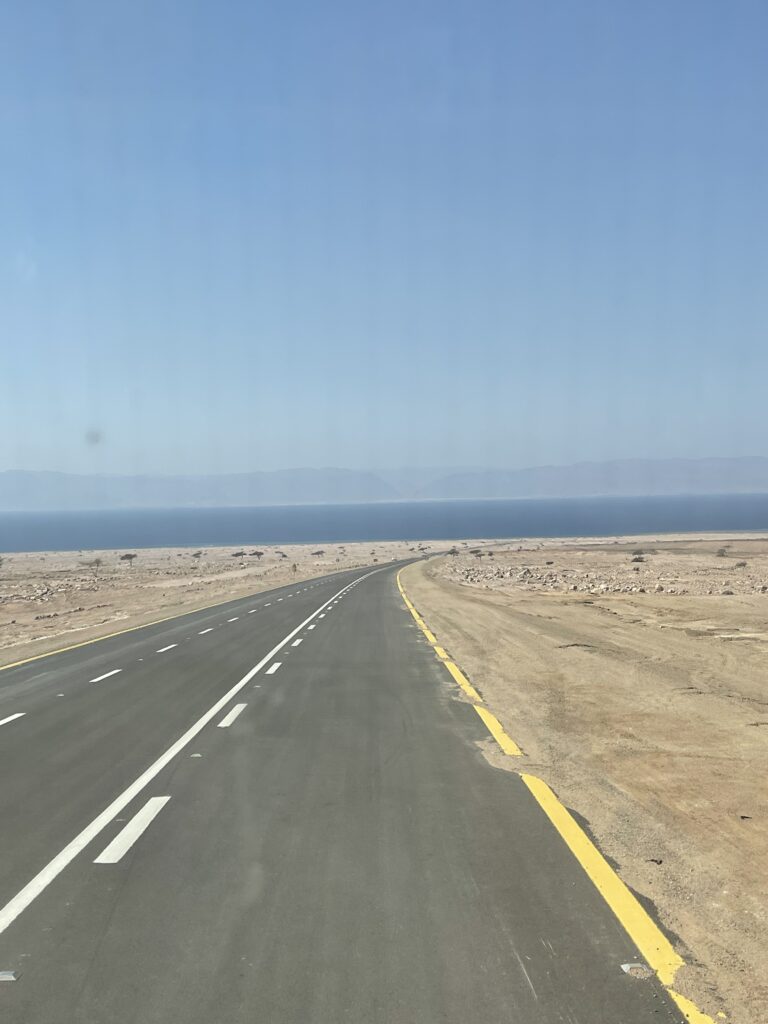
Instead of doing a big loop northwards, we found a brand new road, going straight through the NEOM area. It was closed off and so new, that there were not even tire marks on the road. So, we just went around the blockade and drove this beautiful road. We didn’t encounter any traffic and drove all the way back to the Red Sea again. Left and right at the end of the road, where plains run from mountain slopes towards the coast of the Gulf Aqaba. Opposite we could clearly see the mountains of the Sinai in Egypt. Nearby was a shipwreck we wanted to visit as well. One of these spots often visited by tourists.


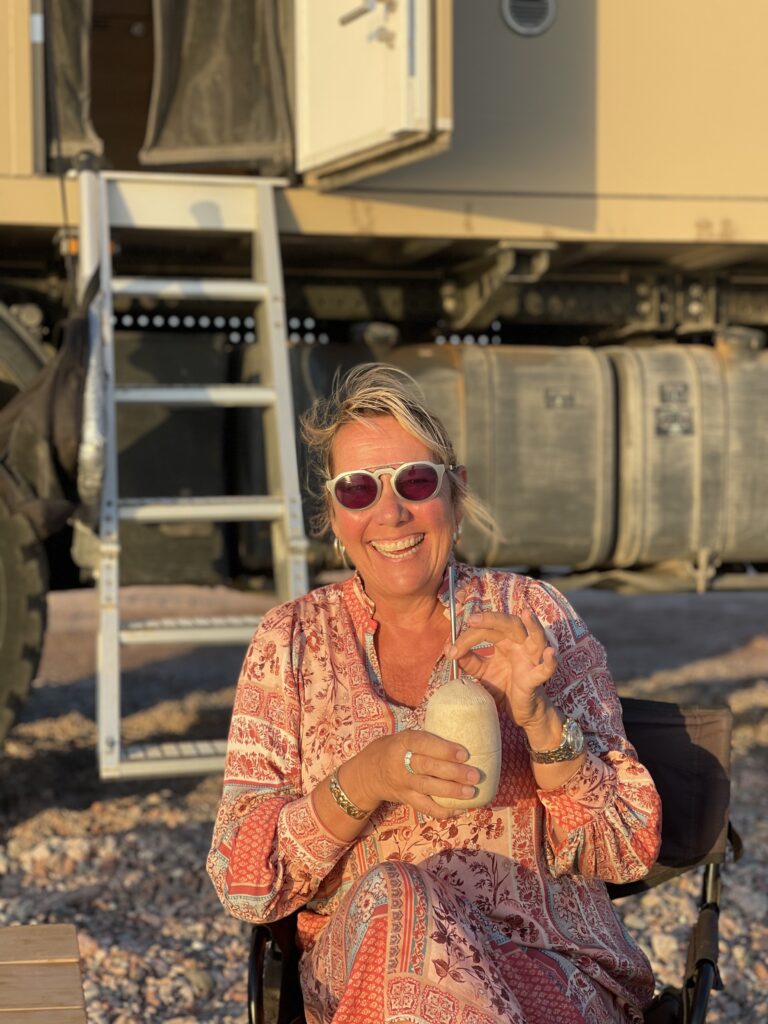
The wreck is of a cargo boat which hit the reef many years ago, then caught fire, and became beyond being salvable. It lays partly sub-merged in a sand bay in calm waters. Many people come to make iconic sunset picture of the wreck and border guards and police are constantly present, to avoid that people go swimming here. Since a Border Guard station is nearby, it’s one of the few places on the coast, where you are allowed to camp at night (but a sneaky night swim was impossible with a police car parked right next to our truck). We had a great sundowner and with some fresh coconutwater, ice and a little bit of rum, we had a bit of a Caribbean feeling, thinking of our home made pinacoladas.

Our initial plan from the very beginning was to visit Kuwait and Jordan as well, but we under estimated the distances and the number of places to visit in Saudi Arabia. Getting to the border of Jordan, was as close as we could get this time. From the shipwreck to the town of Haql, was the last piece north we would drive, until we reached the border. Again a different piece of Saudi Arabia, with many vacation homes, dive shops and hotels, a real holiday /resort area for (mostly) Saudi’s. Most hotels were empty, since it’s winter time here in Saudi. We parked the truck near the city’s small waterfront promenade, which was attached to a nice little park with big green trees, a little oasis between the mountains and urban area.

From this town, we were now about 3000km away from Muscat, where we would park the truck later. But the distance would be longer, because of a number of detours we wanted to take. And so the journey back started now from here. We drove back into NEOM to visit some little known sites like the Mount Sinai and the Altar of the Golden Calf. These are religious sites mentioned in the Bible, and scientists, politicians and religious people are constantly debating where the exact locations of these sites where. For now, Saudi Arabia, considers Mount Sinai (the mountain Moses climbed to receive the 10 commandments), to be in Saudi Arabia and hence the Altar of the Golden Calf as well, nearby Mount Sinai. We visited both holy places and even though there is no real proof on where these locations where, it might be possible and I must say that visiting these two spots is highly spiritual.
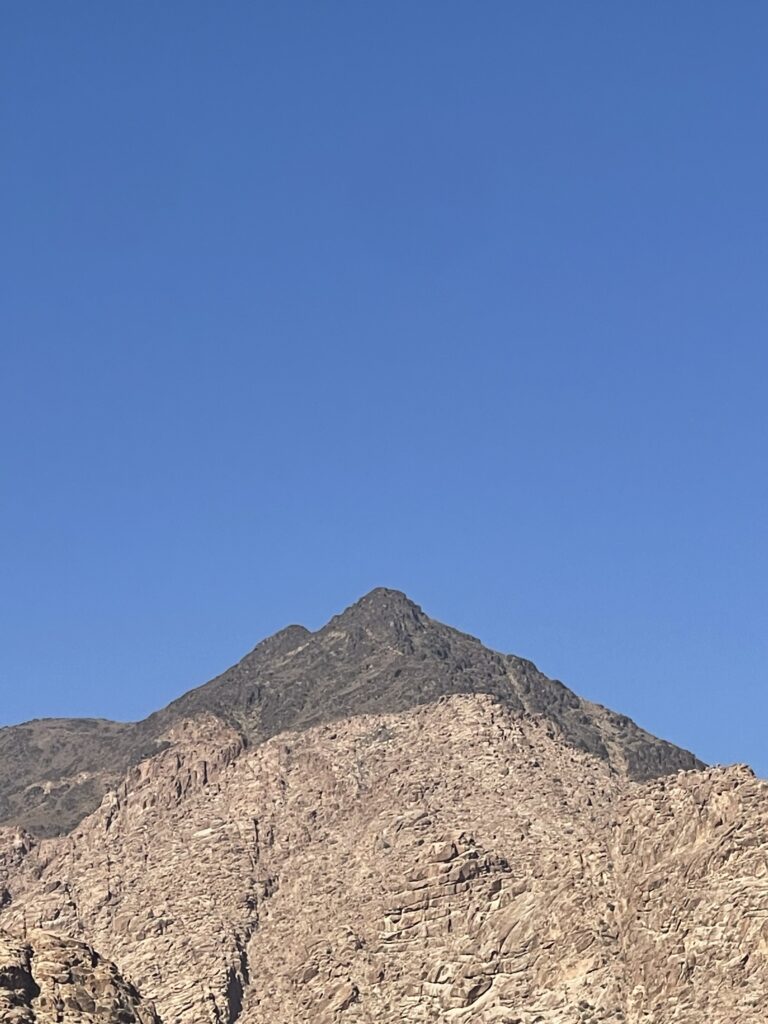
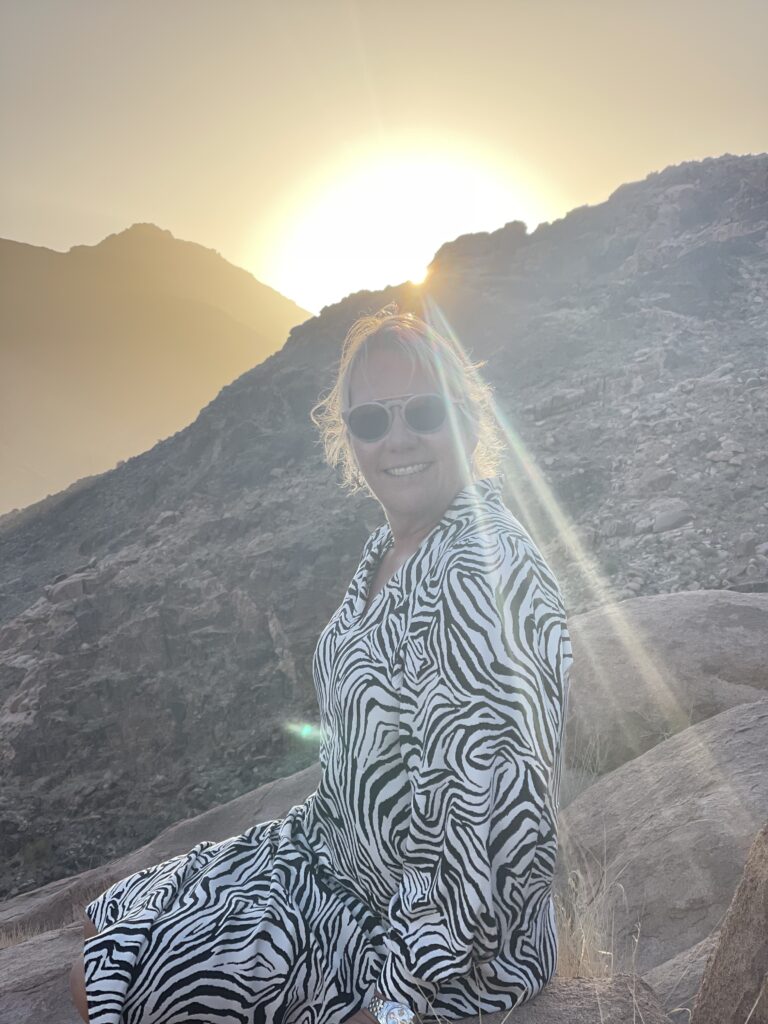
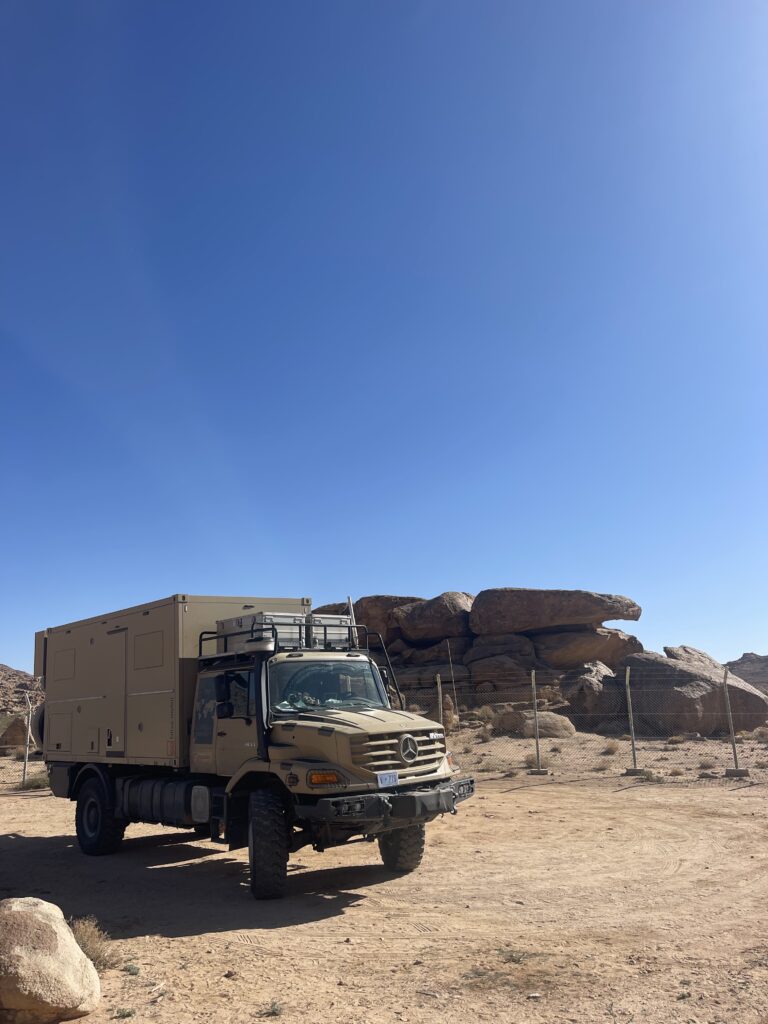
Not far from these sites, there is another huge construction site high in the mountains (Jebel Al Lawz). This is one of the other mega projects within NEOM, called Trojena. It’s a huge wintersport resort area, which is planned to be (mostly) finished by 2029, and will host the Asian Wintergames. Hard to imagine that winter games can and will be organized in Saudi Arabia, since when you think about this country, you think about sand, desert and the heat, not particularly snow! But in this mountain region of Saudi Arabia (near the city of Taif), there is snow (not extremely much). And it would not surprise me, that (like other places in the world nowadays), snow will be created to have ski slopes. We spent a last night in the cool mountains of Saudi Arabia, in NEOM. An area, which will see a huge transformation in the coming years. Where Moses came from the Sinai with his people, crossing the sea, climbing a mountain to receive the commandments from higher powers, which would be the guidance for people to live by certain rules, a new “world order” is in the making. The Golden Calf, is it coming back?


Tabuk is the next city we would visit and where we would stock with supplies and water for the last time, before we would go into the Nafud desert. Driving up the parking lot of the shopping mall with a big truck, is always a bit of a risky business. It’s often narrow, sometimes there are height restrictions and they are actually not designed to accommodate trucks. Usually we manage, sometimes by driving over dividers and parking side ways, taking up 4 to 5 regular car parking slots. Nobody makes a problem and people are usually impressed by the truck and make pictures. We got our stuff, tried to get a new sim card (but due to technicalities, failed to get one) and got a coffee at one of the coffee shops. When we left the coffee shop in the mall, the mall and parking were crowded by heavily armed police and in a wide circle around the mall, multiple police cars had taken up position. Not waiting for anything serious to happen, we threw our shopping bags in the truck, started the engine and drove away.
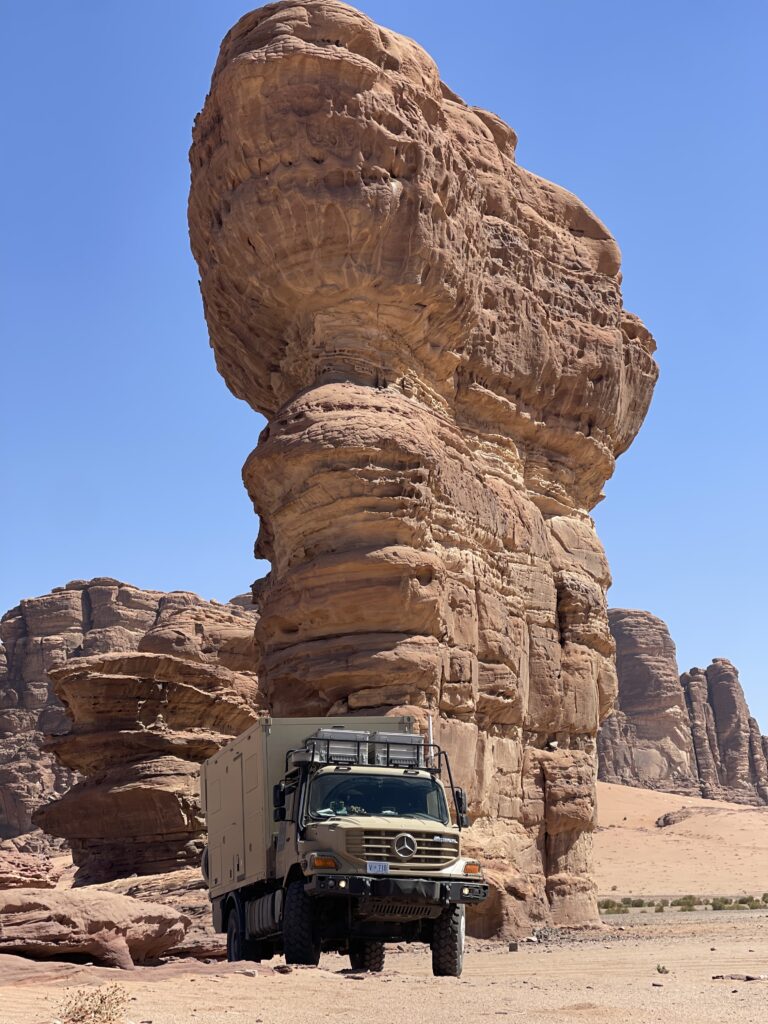
During a stop, I noticed that the other back tire (not the one we already replaced), showed a big “bubble”, which means that there is structural damage to the metal frame in the tire, which could cause the tire to explode. When this happens on the high way with speed, it can unbalance the truck in such a way that you loose control. So I decided to find a truck tire shop as soon as possible. We were about two hours from Tayma (which we already visited) so with some fear of an explosion, I drove carefully over the high way, to look for a truck tire shop. We stopped at at least five shops, before we found one, who could do the job. They were no all having either the right tools or just were not interested. The one who did want to help us, was a bit out of town (and was also our last option). It was operated by a few guys from Yemen. It was a rough bunch (but they have to be, its very heavy work and they are dealing with truck drivers of all kind).

The inflation system on the tires was new for them, so I had to be close to them to guide the process of taking it off the damaged tire, to avoid them damaging that system. The control unit of the system (mounted on the rim), had to be taken off and then be re-installed on the spare tire’s rim. Here, it went wrong with the connection hose, which got damaged. We installed the spare tire anyway and now we could only inflate and deflate that tire by using the air hose and the tire pressure gauge (so not via the onboard switch). During the whole “operation”, many “advisors” passed by, but when I asked them, if they had ever seen such an automatic inflation/deflation system, they couldn’t confirm. A truck driver from Syria (nice guy, who spoke reasonable English), was constantly trying to help, but was more in the way than being of actual help. When we were done and left, he asked if we were Christians, like him and that he would drove behind us, in case something went wrong (he had a truck with a big empty trailer, which could be used to transport our truck). So actually he was really a nice guy.
When we drove away, I heard air coming from near the tire and stopped to check it out. Indeed air was coming from the truck part of the air system. I forgot to close that off, but to do that now, I had to re-install the replaced tire, so we drove back to the tire shop. Luckily, I found out and it was an easy fix this time and done within 20 minutes.
Now we were all set for our last adventure in this trip, the Nafud Desert. After spending the night close to the Nafud, we drove a nice road along the edge of the desert, where you could still find some villages and some farms. Our first destination would be the famous desert town of Jubbah. A winding tar road over sand dunes in the Nafud, took us through a large valley with a small oasis and many camels. Continuing over a “wash-board” track, we reached the summit of a high sand dune ridge, from where you looked down on a small town, bedded in green (thousands of date palm trees). A sleepy town, once an important resting point for camel caravans and all those who travelled from the south, through the Nafud desert. Large sandstone rock formations (which caused the stop of the moving sands and hence formed an large sand free depression) on the edge of town are covered with thousands of rock carvings, going back 10000 years! These rock carvings (petroglyphs), give clues about the life of early humans and their surroundings. The entire area where the rock carvings are, is a UNESCO site and fenced in and guarded. (Jabel Umm Sinman)


We arrived an hour before closure time of the site and the care taker was already closing the gate. However, he allowed us to go in (there was still another group of tourists inside). We were very impressed with the amount of carvings, the variety and the fact that some are so unbelievably old. It shows that once there was a lake and a river in the area, different animal species were living there as well. Reflecting to today’s climate change, it makes me realize that humanity has been struggling with climate change since a long time, so nothing new in fact. You could also clearly see the differences in style and technique used over time during the further development of humanity.

Since Jubbah is surrounded by soft sand dunes, there was no option for us to get out of town or go off on one of the roads, to find a nice private camping spot. We spent some time to find alternatives, but eventually ended up following a utility road for high tension power line towers, driving away from the tar road. Despite the garbage along this road and the towers (more people use this road for picnics), the view and sunset were stunning.

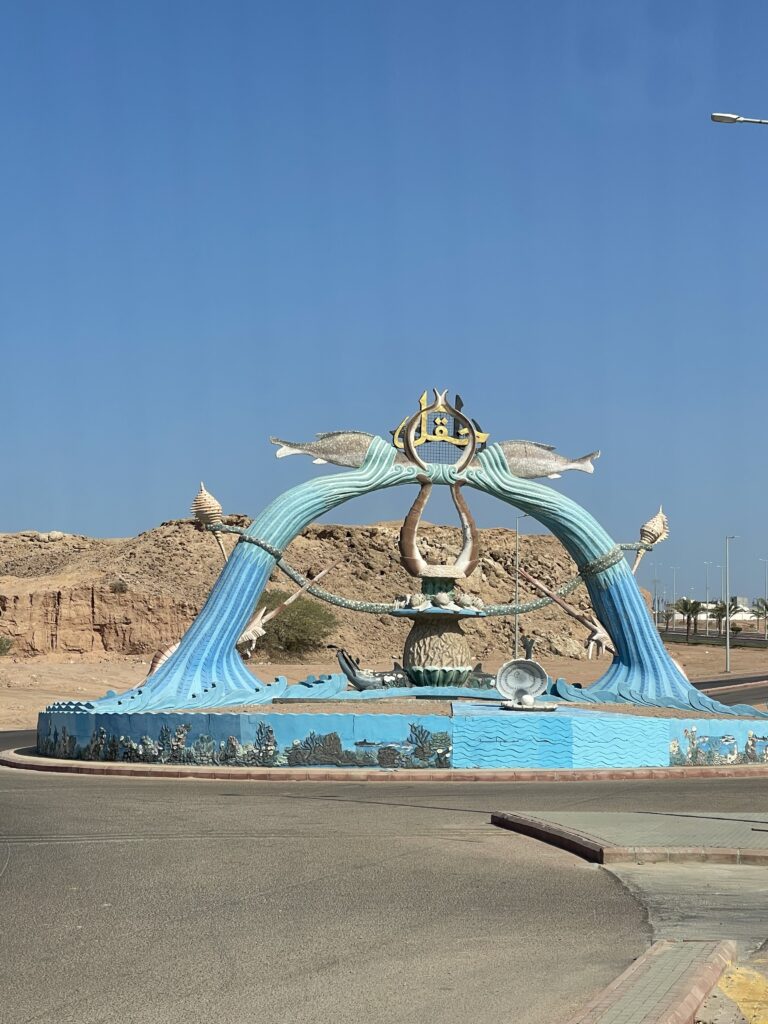
Driving back into Jubbah the next morning, we passed the entrance roundabout, every city and village has. These roundabouts are showcases of what a city/village and/or its surroundings has to offer, or just showing something to impress the visitor of the city. In this case a large artificial dune stands in the middle of the roundabout and on top of that dune stands a 4×4 vehicle. The area around Jubbah is popular for dune-bashing. (Crossing with 4×4 vehicles and buggies over the sand dunes).

We went back into the valley we drove through the day before and went to another small town in the desert. This one was more surrounded by sandrock depressions, it was the town of Al Muhaffar. From there we could pick up one of the Dakar Rally tracks, which always guarantees a beautiful scenery and of course some tough driving. The first part of the track went through a wide area of flat solid sand, this ended near two big rock columns. Here was a popular camp spot and the point where the Dakar track went deeper in the desert.


Adjusting the tire pressure and going 4×4, we followed the track through deeper sand, winding through wide canyons, high cliffs and impressive sand dunes leaning against sand rock formations. According to other overlanders, nearby should be another arch, popular for making pictures. We found it as well, but were a bit disappointed by the amount of painted graffiti on this natural sculpture and the rubbish left behind by campers and picnics. Hopefully this behavior will change in the future.

Fortunately, the greater area of the arch, was clean, undisturbed and beautiful. Beautiful rocks, cliffs, sand dunes made it a great place to make an early camp and do some rock climbing before watching another beautiful sunset. Because we did not have any wifi coverage, we tried a few times to get higher on the sand dunes to catch a signal, but every time we got stuck in the deep sand and had to reverse. After four times I gave up and parked the truck at the spot were we almost got stuck.

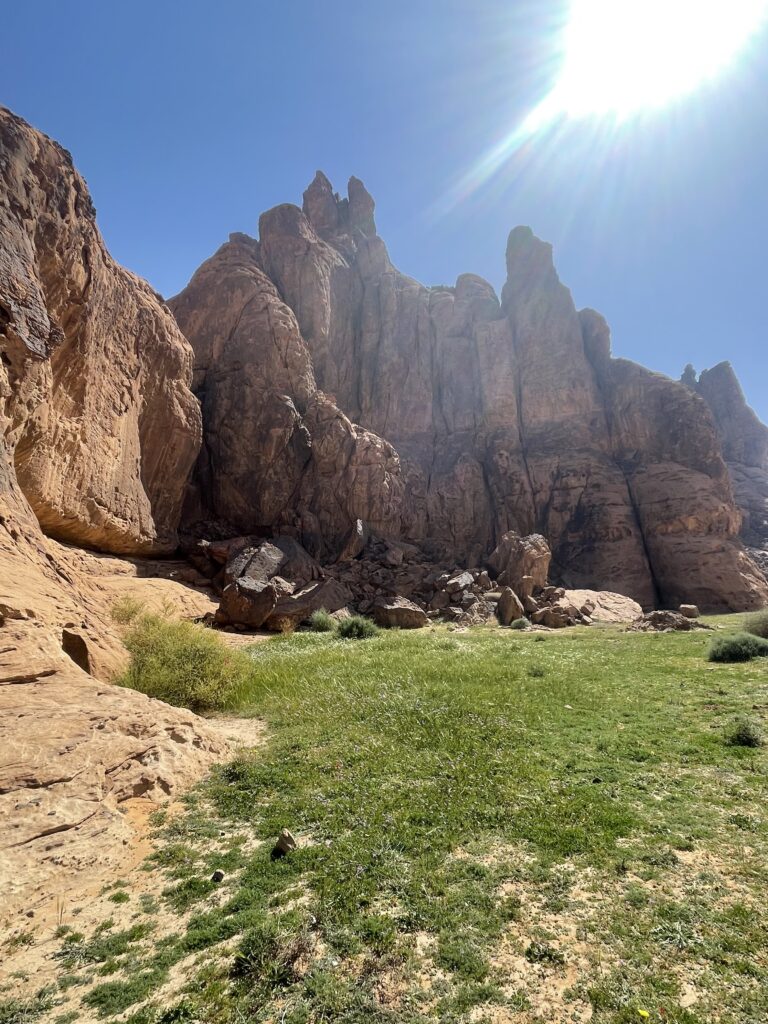
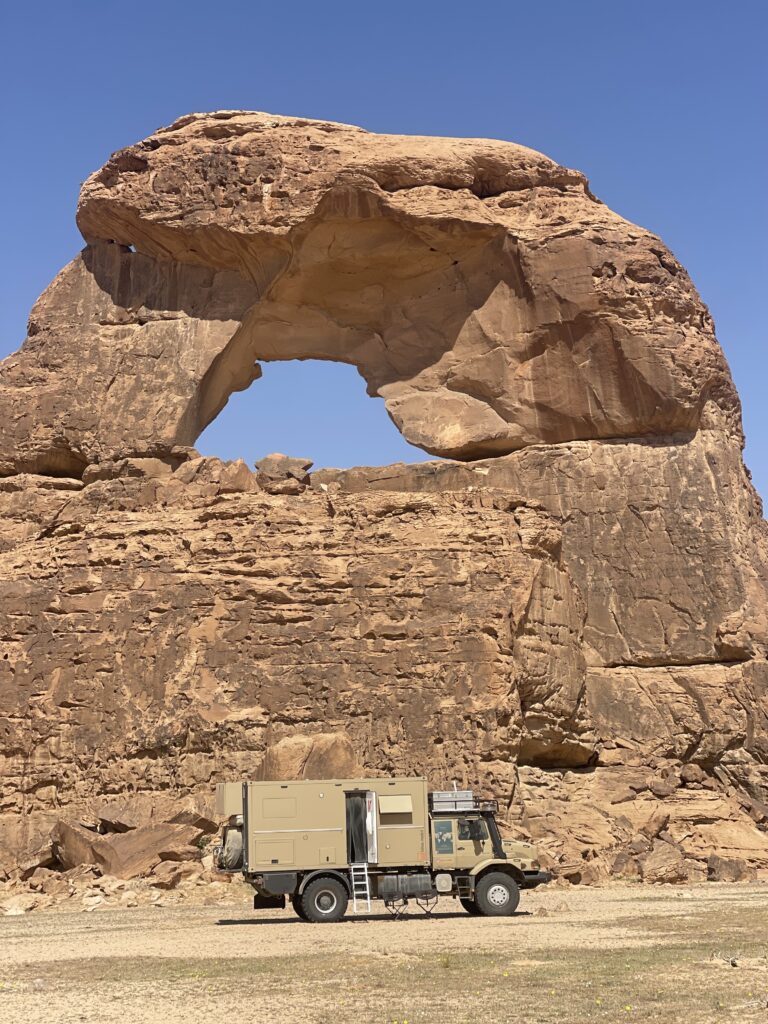
Going deeper in the desert, we arrived at another arch like rock formation, which almost looked like a “gate-way” going from one world into another world. In front you had a wide plain, which slowly “climbed” on a huge long sand dune, at the back there was this huge “square-like” area, surrounded by high cliffs. I used our drone to fly through the arch to catch that feeling of going through this “door of time”. Many birds living or nesting in the high arch started to attack the drone, among them was a bird of prey. A bit out of balance and a sudden wind gust, threw the drone against the rocks high up in the arch. I thought I lost it and that it crashed on a spot I could not reach. Luckily it still flew and was able to land safely. On of the four rotors was damaged, but with that it still can fly. In our collection of spare parts, we have these in “stock”, so it was easily fixed.
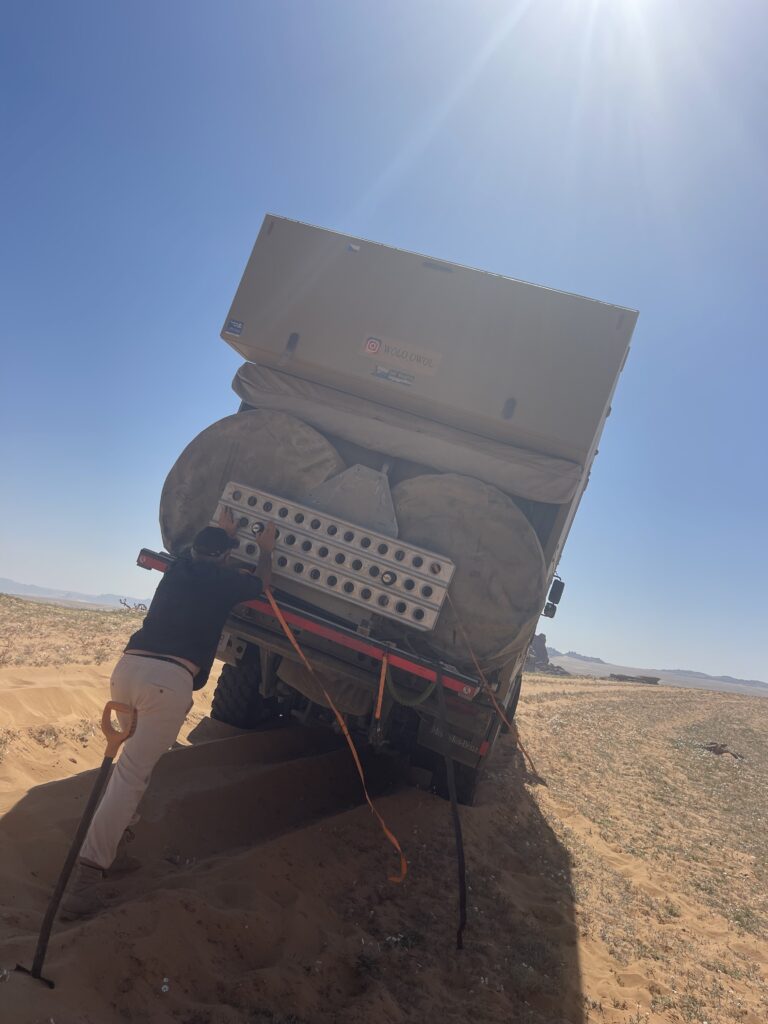
Trying to take on the sand dune was a mistake. Riding partly on a ridge up, we sunk in the sand and the back of the truck started to “sink” down. I tried to get the nose of the truck upwards, to avoid capsizing, but by doing so, I was not able to drive out. So, time for the shovels, sand ladders and more tire deflation. We had to dig a few times, re-arrange the sand ladders, and slowly after a few hours we got out. What took a lot of time after every attempt to get out of the sand, was that the sand ladders get buried deep in the sand when the truck tires drive over it. Digging in soft sand is like digging a hole in the sea, the sand keeps rolling back in. Then I saw the light……using the back winch to pull the sand ladders would be the right solution. And indeed, it worked and saved us a lot of time and effort.

We finally reached the top of the dune and were able to drive down to more solid ground. An environment almost like the Alps pasture lands with hundreds of camels was opening up to us. Hidden behind sand dunes and rocky escarpments for most of us, was this beautiful area we did not expect to encounter. The solid grounds were only for a short while and the deep soft sand was back. Carefully manoeuvering through the best parts we drove from the high sand dune into a valley. We noticed two Bedouin tents and saw more camels, but no people. Driving out of the valley, we reached another open plain, which used to be the bottom of a big lake. Away from it all again, we camped for the night in this former lake.
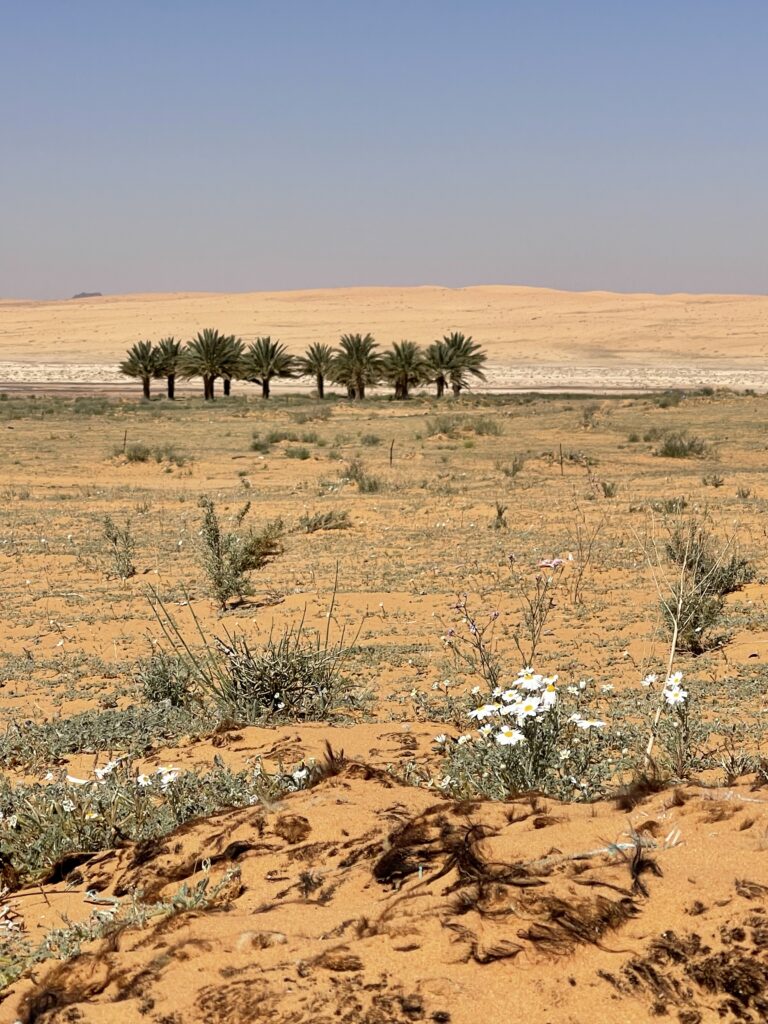
Since we actually had no idea how to move further or whether we would be able to get out of this lake (going back up the sand dune was not an option and the former boundaries of the lake were rocky escarpments), we drove further into the “lake”, which became more and more rocky. The rocky bottom however was actually a huge rock plateau which over millions of years, became a smooth “polished” surface (by erosion). The only thing, it was not even and therefore the truck had to make acrobatic moves to continue driving forward (though we moved with a snail pace). We stopped once we reached a point where we really couldn’t go any further. This was also the spot where we found a temporary (seasonal) small lake between these rocks with a few trees and scrubs. An “oasis” in a huge rock bed, something we also hadn’t seen before. This area was “useless” for humans. No agriculture, no cattle or camels. You could not make roads or build homes. Hence the purity of this area in the Nafud desert.


We had to drive all the way back to a spot close to the high sand dune, to find another way out of this old lake bed. We crossed to the other side of the lake and eventually found a passable slope on the escarpment to get higher up and away from the lake bed. Still, with all the tracks and trails we saw, it was not easy to find a way towards a “regular” road. Using the compass we stayed on track going south, where we would find a main highway.
Several tracks we took went off in other directions we wanted, meaning that often we had to go back to a split and take another track from there. A few times we got stuck in heavy sand and so we lost a lot of time digging the truck out. We eventually reached a higher solid plateau, where we also caught a wifi signal again. It was a nice spot and we thought that it would be less than a day drive back to the main tar road. We planned to leave the desert there at that tar road, and after that we would not come back for a long time. So we spent two nights on the spot, enjoying the beauty of the desert.

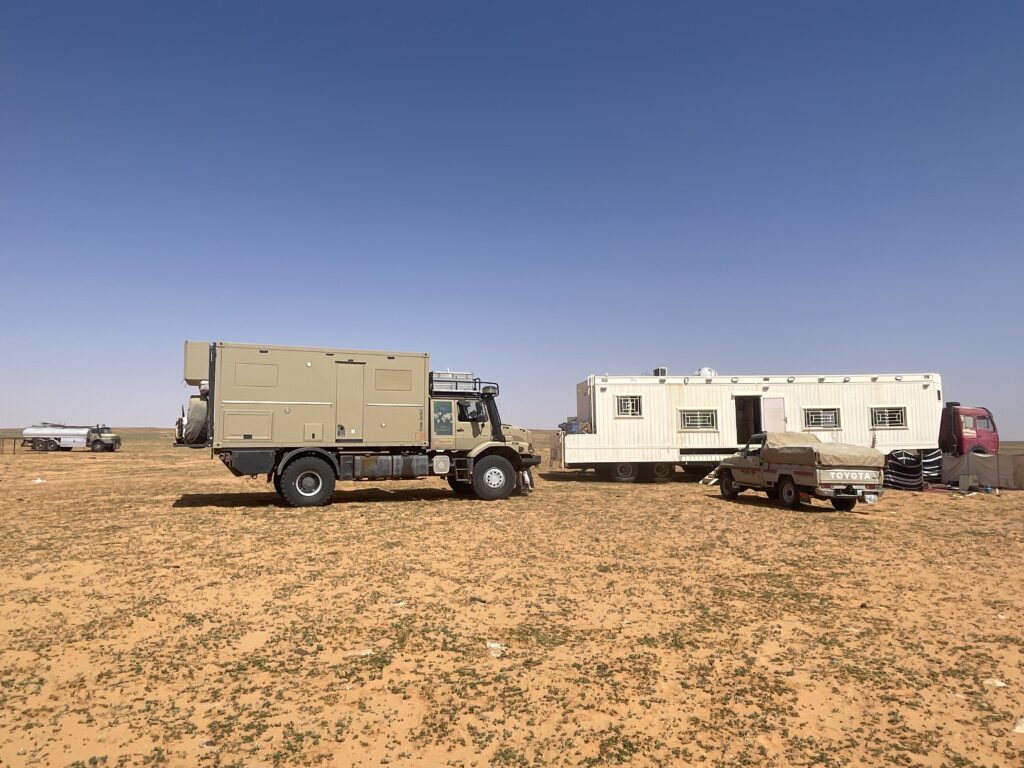
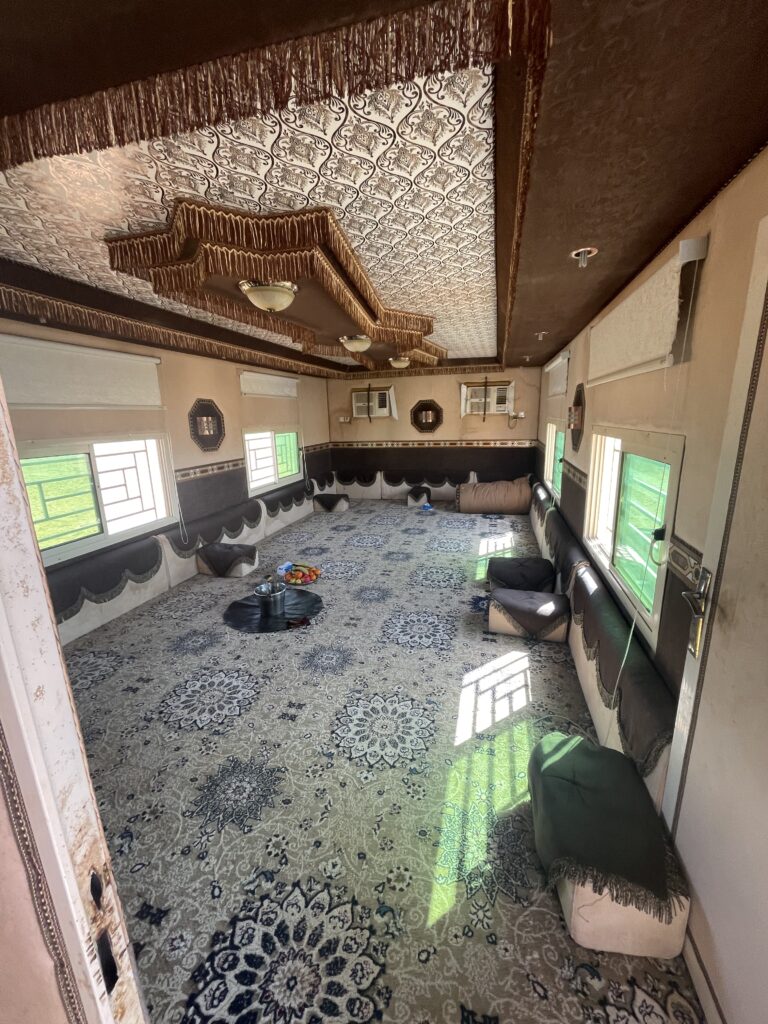
Indeed the last stretch was not much and easy to drive. We reached the main tar road and paused to inflate the tires. While waiting, a Bedouin guy in a pick-up stopped and invited us for a coffee in his camp. Since we had time now and he seemed very friendly, we accepted the invite with pleasure and drove to his large “caravan”, like the ones we have seen so often in the desert, but never saw the inside of one. The usual old Mercedes Benz trucks for water, camel food and transport were parked there as well. A servant (a young boy from Ethiopia, with a large cross hanging on a chain around his neck), was setting up a “patio” outside. The inside is just a large open space with soft carpet on the floor and many cushions along the walls (like in the Bedouin tents or in homes). There was a big flat screen tv on the wall, two airco units cut out in the back wall, some nice ceiling decoration with small chandeliers and a little gas stove for making coffee and tea. A rolled up mattrass in the corner indicates that the room also serves as the bedroom. The Ethiopian guy was serving the coffee and of course dates. A plate with fruit was placed near us. Google translate was used again, to get some conversation going, since our new Bedouin friend did not speak any English.

After a while an old Bedouin gentleman entered as well. His face worn by the sun, dry air and sand. He was at least in his 70ties, told us he was even 96, he wore a leather belt around his shoulder, holding multiple bullets and a holster with a pistol. He was a personality who could be walking straight out of a movie set. He talked a lot, but unfortunately, we couldn’t understand (too fast for our Google Translate). He walked to his Landcruiser, came back with a “boom-box”, and started to play old Arabic music. He started singing and there was a great vibe in the “caravan”. After a while both men invited us to have a look at their camels. We drove with their pick-ups into the desert, to find a large number of camels. A boy from Sudan was herding the camels for them.


We took a lot of pictures with the camels, the handsome Bedouin with his old Toyota Landcruiser and him on one of the camels. Behind some bush, there was a big used water bottle filled with camel milk. The milk was milked in the early morning and they wanted us to drink it. An old antique metal bowl was taken from a bag in the old pick-up and the milk was poured for us to drink it. I drunk at least a liter and a half, not thinking at all about any health or hygiene issues. (During the whole day and night, my stomach felt like a jacuzzi). We drove back to the caravan, where we were invited now to have lunch. A brother of one of the men had arrived with some fresh produce for the the servant to prepare a meal. Life of the Bedouin these days seems to consist mostly of socializing with friends and family, drinking coffee and tea and eating (a lot). Regularly they will go in the field to check their camels (who are guarded by servants) or go to town to buy food stuff or other things.

Knowing that most probably, after lunch there would be an invite for diner as well, we excused ourselves for the lunch. The people in Saudi are so very generous and welcoming, but we had to watch our time schedule now, since we were still thousands of kilometers away from our destination, from where we would go back home. We had to go in the direction of the border crossing. But not until after we had given our new friends an extensive tour in and around our camper, were we allowed to leave and go towards the city of Ha’il.
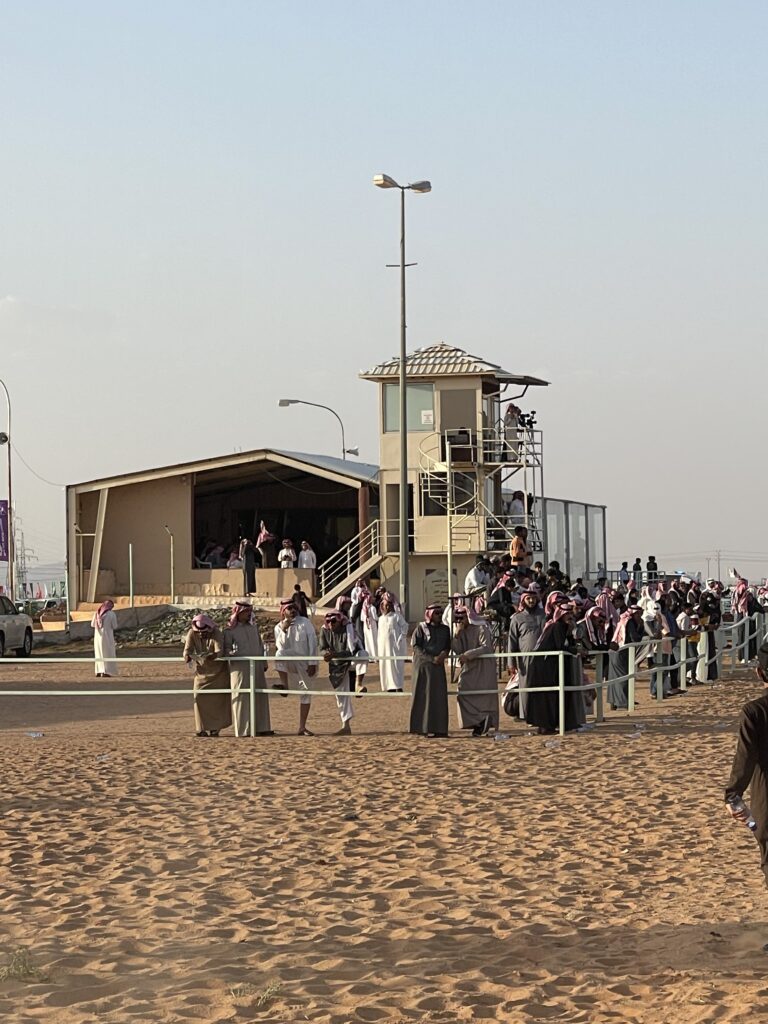
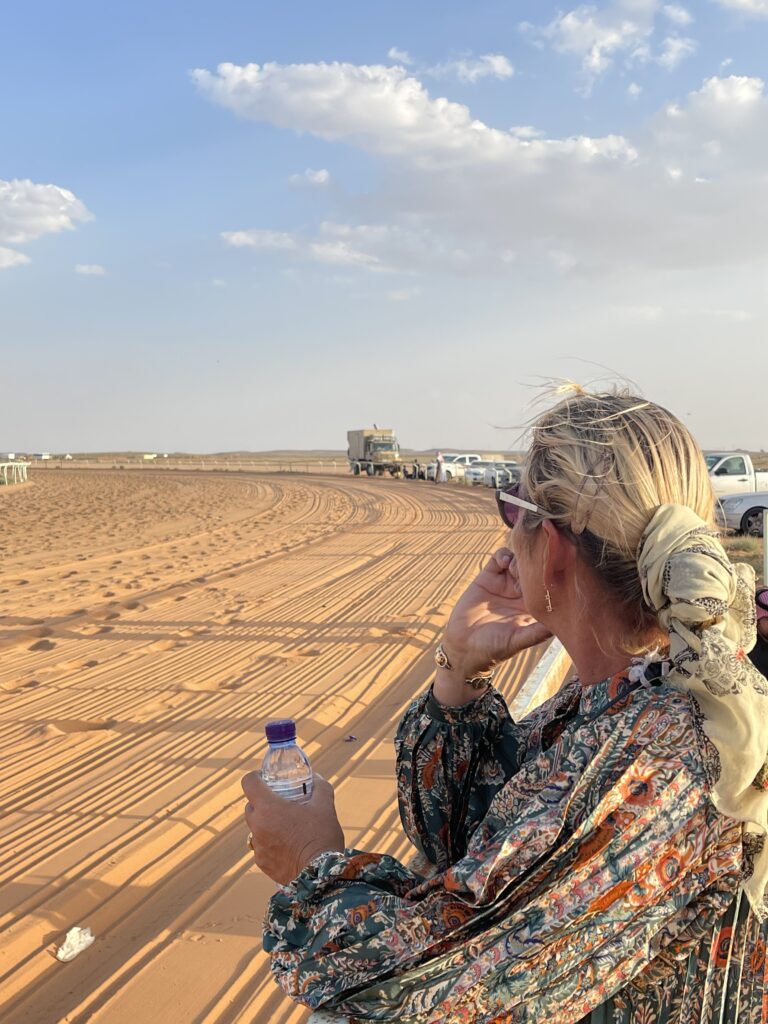
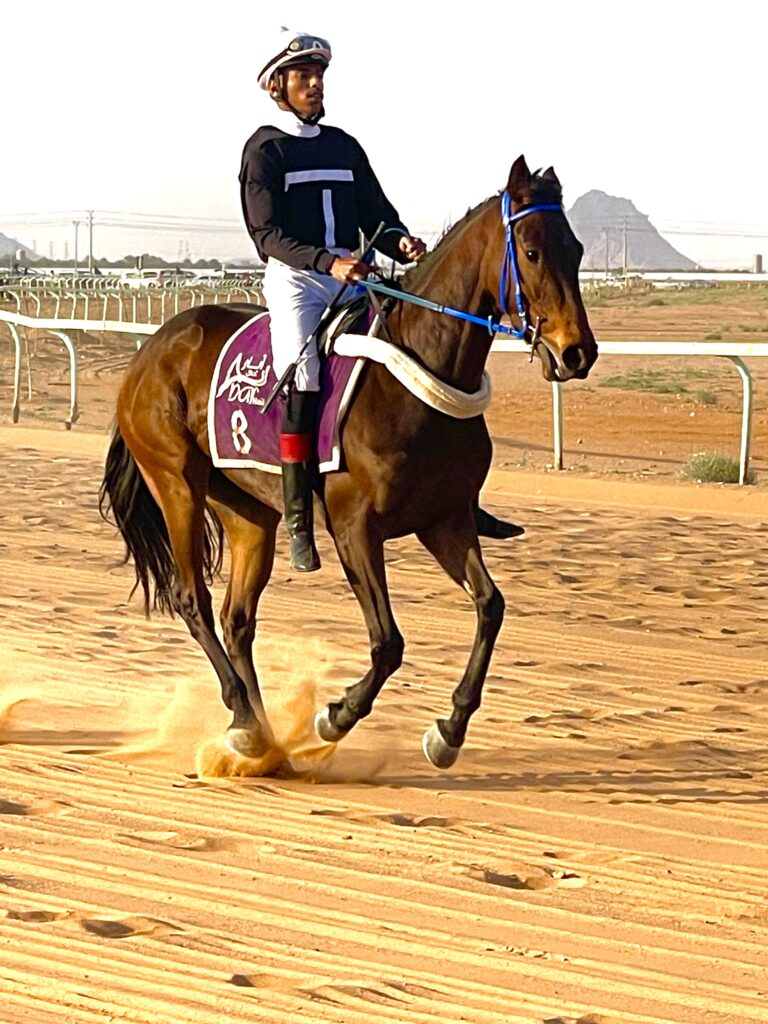
When we reached the outskirts of Ha’il, we saw many, many cars coming and leaving from a certain area. It was the horse race track where the activity was. Every month, horse races are being held on this track with full blood Arabian horses. Beautiful animals! A rich local business man is organizing these races and every month he provides five new cars for the first five camels (owners/riders) on the finish. We were just in time to see the last two races. We parked the truck near the track on a bend, so we had a very good view. A family (father, mother and 4 children) , having a picknic closeby, invited us to join them for coffee, tea and sweets. The father explained and told us a lot about the races and the horses. Horses were preparing for the race by walking around with the stable boys, so we could see them nearby. It was nice to see, that it is not all about camels in Saudi Arabia. These horses looked magnificent!

Getting dark, we drove away from the race track, towards the north, through the “small” Nafud, as it is called. It’s like the bridge between the “big” Nafud and the Empty Quarter. Its actually all one part if you would look from the skies, a long curve of red/orange sand dunes. Large parts of it have been occupied by farms, pumping up water to water the hundreds of green grass circles, grass for the live stock and camels.
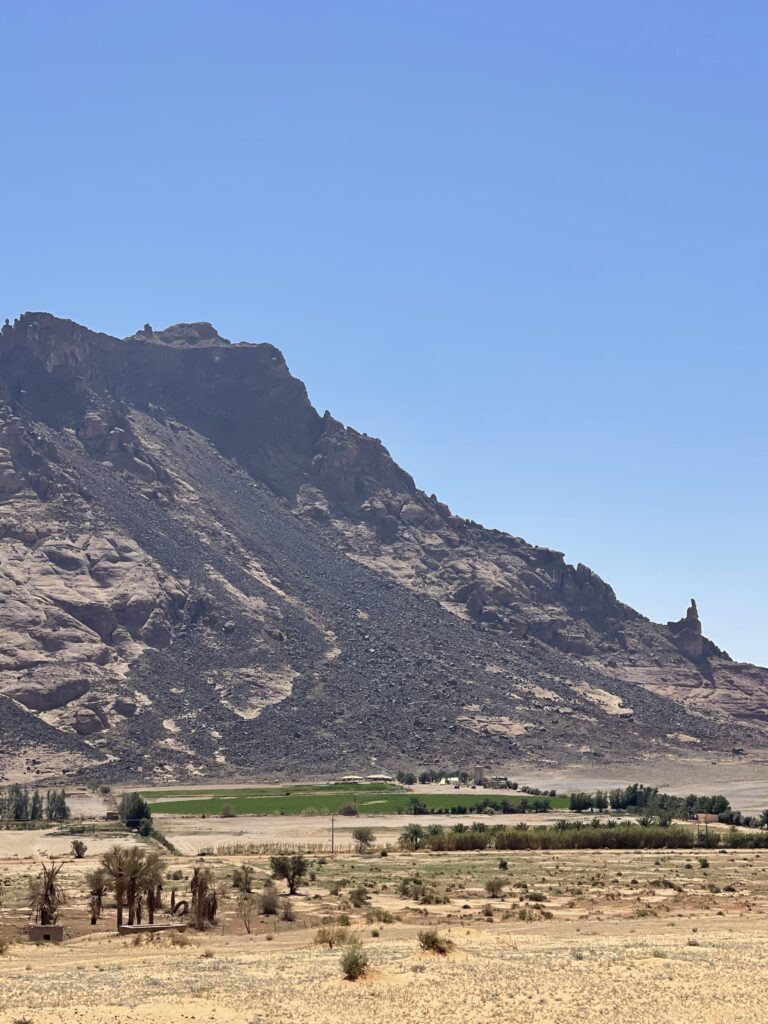
The next day we were in contact with our overlander friends, Bodu and Regina who we had met in Najran and on the Red Sea coast. We were still about 800 km apart from each other, but we were driving almost the same route, but in the opposite direction. We drove hours through the “small” Nafud in the direction of the border with Kuwait. In this part of the desert there is located the Imam Turki bin Abdullah Royal Natural Reserve and within that reserve is located the North Reserve. This year for the first time, the North Reserve has been a dedicated area for sustainable hunting. The hunting is limited to falcon hunting and this year, a hunting event was organized in the reserve, whereby 400 falcons participated in event. The hunt is a live event by falcons on real prey, which is the endangered Houbara Bustard. From an outsider’s point of view, it is hard to see what is meant by “sustainable” hunting with 400 falcons on endangered bird species like the Houbara Bustard. Can’t really give an opinion on that, but what is a fact, is that falcon hunting is a deeply rooted part of the Saudi Arabian culture.
We drove on and the gap between us and our friends got smaller. Nearing the end of the day and before reaching the next big town, we left the high way and drove into the desert. The desert here consists only of gravel plains and the views were endless. Here and there we saw small herds of goats and camels, but no buildings or villages closeby. This would be the place where we would meet up with our friends. We sent them our location, so that they could easily find us. Well, it turned out, the navigation tools they had to their disposal did not make that too easy. It took a lot longer than planned and we had to use our lights to send out signals to show where we were. At the end, it was really great to see them again. Marja had prepared diner in the meantime, so they could take a seat at the dining table right away. We were all so happy to see each other and exchange the latest stories under a night sky full of stars in the middle of the wide plains.

When they woke up, they realized how beautiful and wide the area is. Time for the drones and a good breakfast. The sun was shining, not too hot with a little breeze. It’s always hard to leave and move on, when it is so comfortable. But after a while we both packed up. They wanted to be in time at the border with Kuwait and we wanted to cover another few hundred kilometers, before reaching the big town of Dammam. Starting to know each other better and better and seeing them driving away, was this time a bit more difficult, especially since we were left alone on that huge plain.
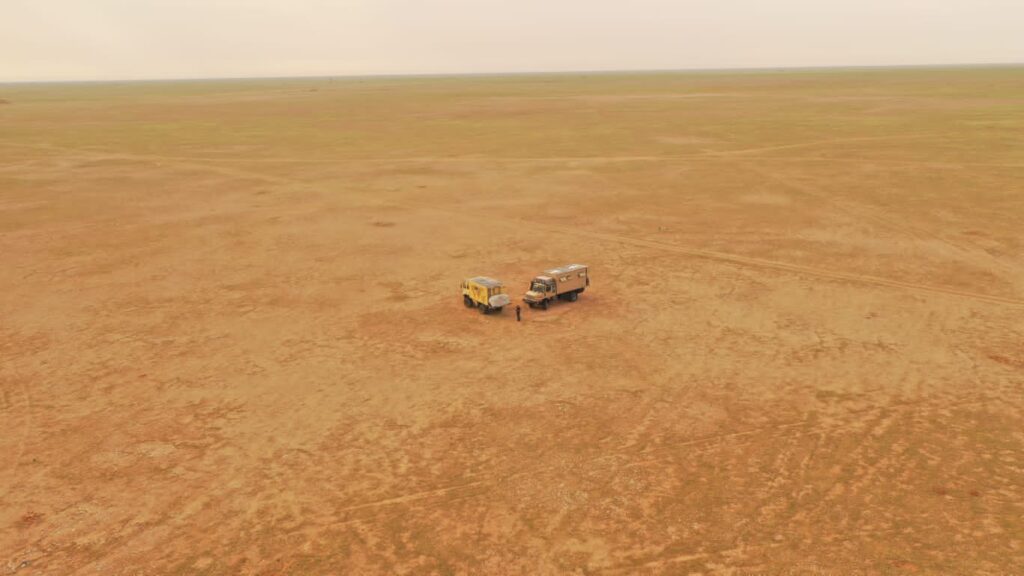

One more night camping in or near the desert and then we would be in Dammam. We drove another 350 kilometers and went back into the desert, by crossing a Camel bridge, that took us over one of the few operational railways in Saudi Arabia.
Next day we arrived in the city of Dammam where we would visit the Mercedes Benz truck dealer. The service manager there – David – assisted us in December to have the truck safely parked in Riyadh and get something fixed on the truck. It was a very nice visit. As David comes from Africa, we could also share some African stories. In the meantime the truck got a good wash. At night we went out with David and his lovely wife to a nice Arabian restaurant on the boulevard of Dammam. (We hadn’t tried such high level Arabian cuisine as yet, and it was a real pleasure).
We had parked the truck near the restaurant in town, so after diner we could just roll back into the camper. Next morning we did a long walk over the beautiful boulevards (cornice) of Dammam. Dammam is one of the largest cities in Saudi Arabia and has one of the most important harbors of the country. It’s near the land bridge with Bahrain and is developing fast, thanks to the oil exploitation in the nearby desert. Luxurious condo complexes and hotels rising up along the shores of the Arabian Gulf. Due to its economic prosperity, it’s the fastest growing city in the Arab world.
Other overland friends were also nearby. These were Chris and Miriam, who were now in Bahrain. So we agreed to meet up at an empty construction lot near the land bridge with Bahrain. However, there were issues at the border crossing, causing them long delays and uncertainty if they would be able to meet us. So we decided to go further south, to the camp spot we used when we came into Saudi Arabia in December.
We reached just before darkness fell and luckily there were enough spots on this official camper park (the only one in Saudi Arabia at the time of writing). There were more campers and caravans, but all where Saudi. People came to offer drinks and even a plate of food was brought to us by one of them.
The moment we were preparing to go to bed, we heard a heavy truck coming in. They found us, Chris and Miriam, they had driven all the way to the campsite (even diverting from their original route). Though late and almost in bed, we quickly set up tables and chairs, snacks and drinks (and they even had REAL wine, with them). We had a great night till early morning. Last time we met was in Wadi Dam in Oman, just before we left Oman for Saudi in December, and all though we stayed in touch, we had a lot to talk about.

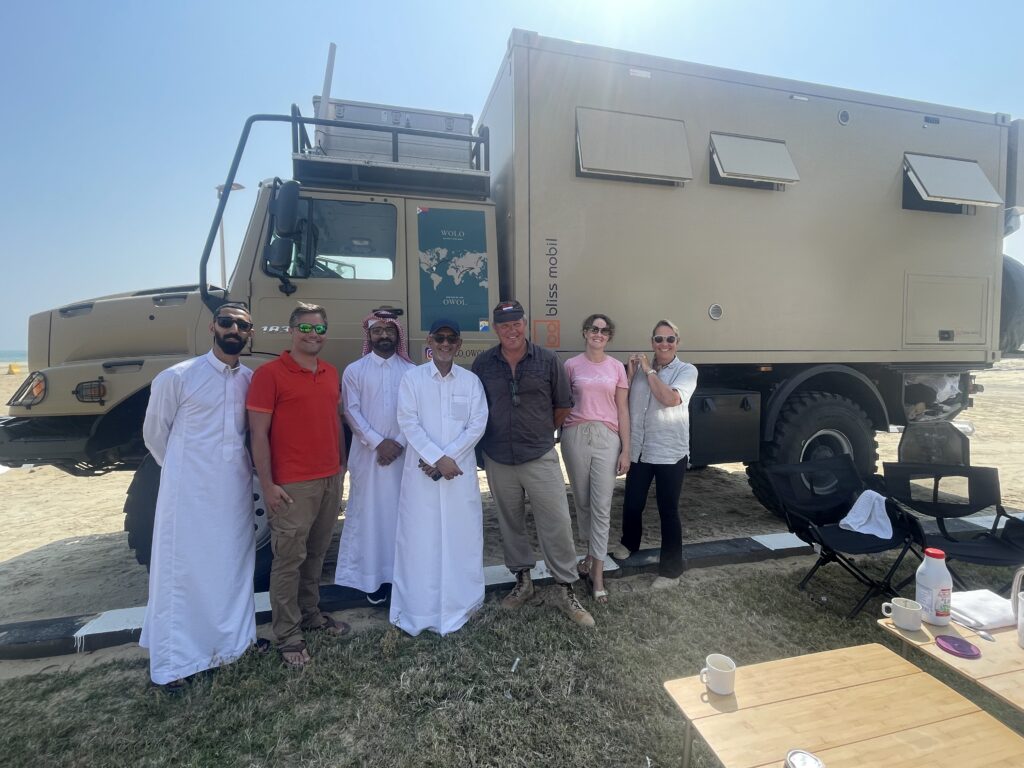
Next day we decided to stay another day. We had breakfast on the beach. For the first time we took a dip in the Red Sea (closely watched by the border guards) and had chats with other campers on the camping. We had diner together and another great night.
Another goodbye the next morning. They were going now to Egypt and we back to Oman. Life of a nomad is intense to a certain extend. We meet like minded people, share good and intens moments together and then we part.
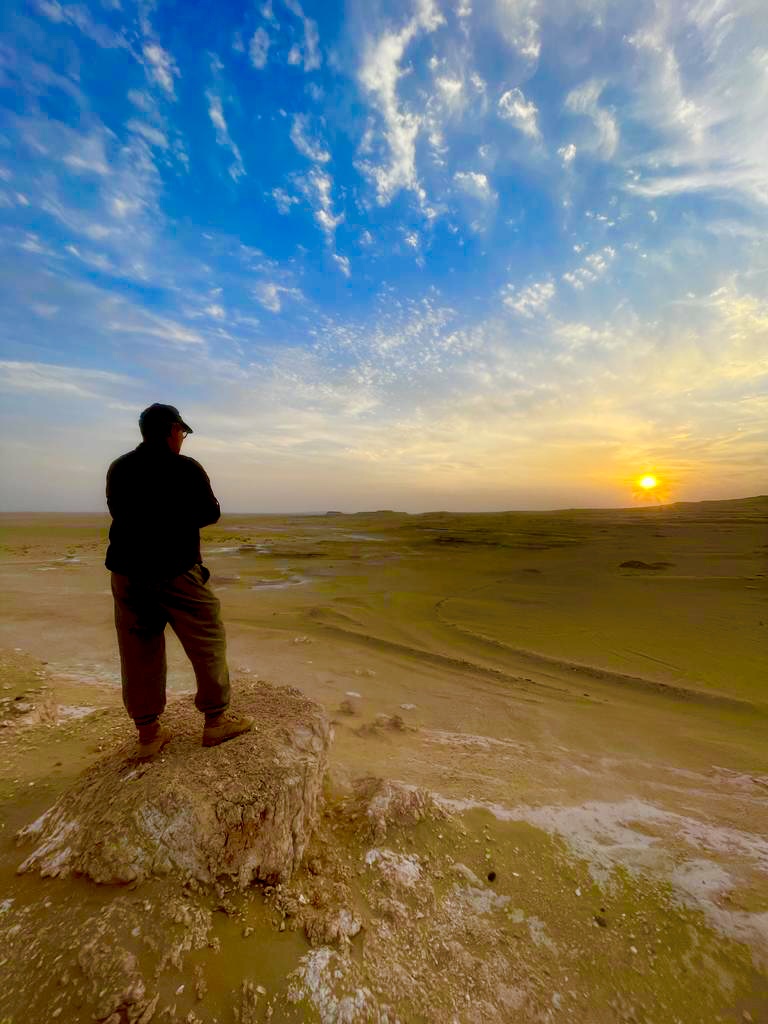
We still had a good distance to go and at least two more nights in Saudi Arabia. The remaining part was passing Quatar and then going through the Empty Quarter. We knew the route and knew more or less what to expect. We really appreciate the scenery, so we drove not fast and made ample stops. The first night we didn’t park far from the main road, but the second night we camped at the same spot as when we entered Saudi. Deep in the desert via an old Aramco oil road on top of the sand dunes. A more beautiful good bye we could not wish for, for Saudi Arabia.




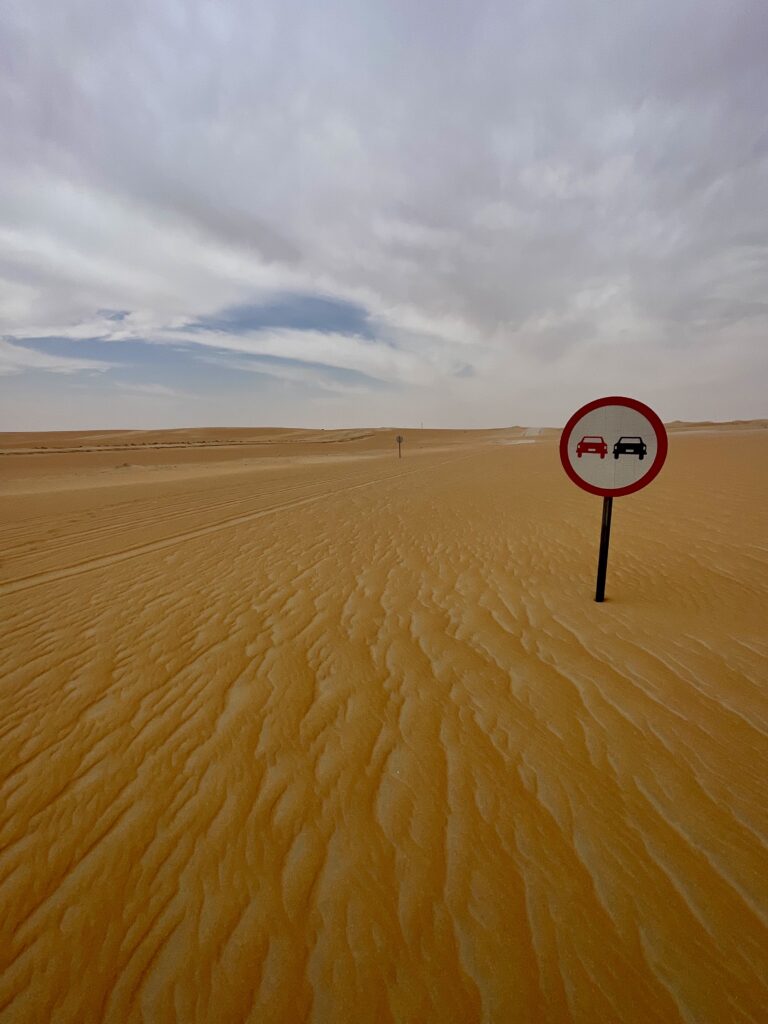
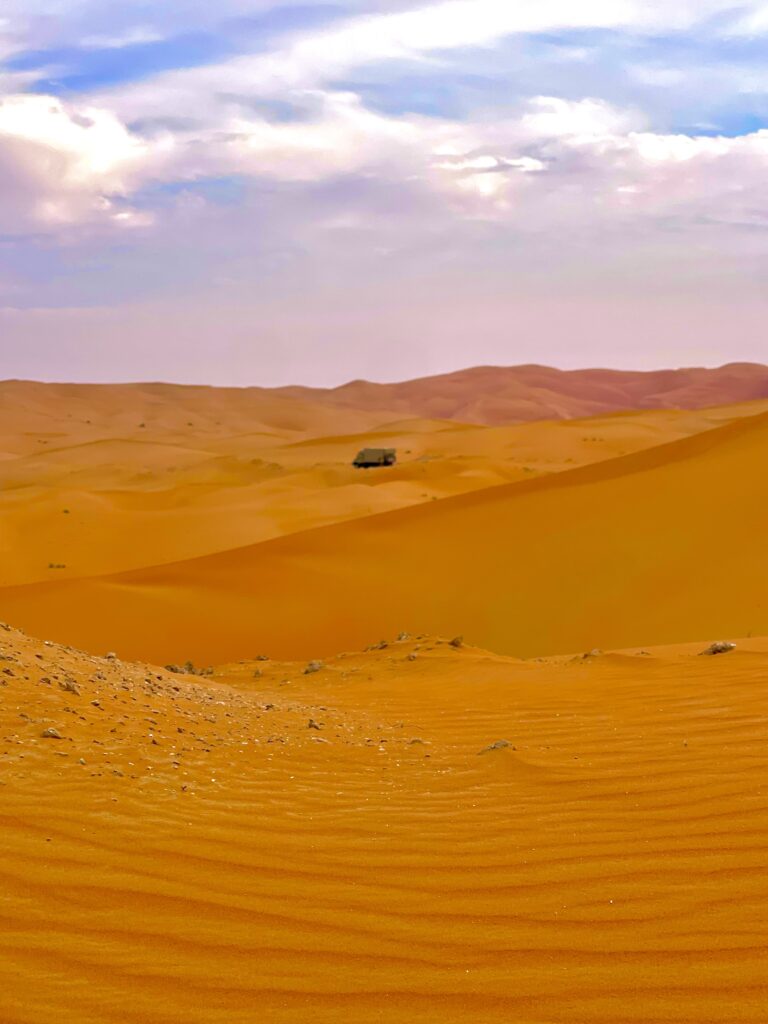


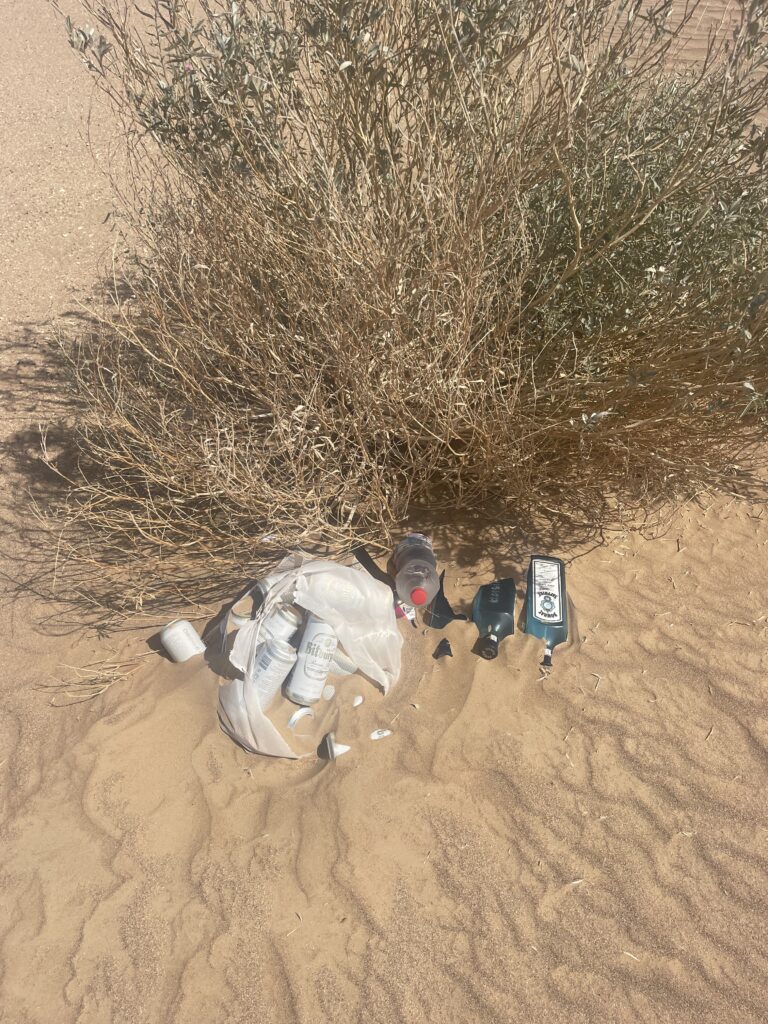
Though I am usually a bit nervous when going to border crossings (never know what exactly to expect and how long it takes), this crossing was easy and friendly. We came early (in case there were issues, we would have a day to solve it). The Saudi crossing was within minutes with big smiles. The Omani a little longer, since the Customs wanted to have a good look inside the camper. But all together, it was still less than 30 minutes. The moment we were in Oman, we took a well deserved coffee break, before moving to a spot along the road in the desert, where we had hidden some beers and spirits under the sand, before driving into Saudi. And yes, using the coordinates, we found our “stash” and although the wind had blown away a lot of sand, it was all (after 4 months) still good. Haven’t had a beer for a long time and then finding it hidden in the desert under the sand, that makes for good beer.
Cleaning and preparing the truck for storage was now on our minds. We drove to the town of Ibri and – after dropping off the laundry at the Pakistani laundry shop -, we drove to a spot where we camped already two times before. A bit out of town, but still a nice view on it, it was a great spot to camp and clean and organize the camper. We planned for two days and found out we really needed these days. The camper got through a lot and we collected a huge amount of sand and dust. Also the outside, despite a good wash at Mercedes in Dammam, needed some scrubbing and polishing. We took stock of what was left for food and non-food, made lists of what items we had and where we put it, so all was documented well, so that we know what to take and not to take for the next leg of our trip, when we come back in September.

Satisfied with the result, we now made the last trip towards Muscat, where the truck would be stored for the coming six months. At the Mercedes dealer, we presented a list of things to do (including a good service), so that when we return, we can continue enjoying, the “van-life” of the new Nomads.