After a good night’s rest (with open windows for a change and no airconditioning, but instead a really nice mountain breeze) we continued through the mountains of Jordan. 85% of Jordan consists of desert (Syrian desert), the remaining part is a long mountain range, which runs between the Jordan Valley (shared with Israel and Palestina) and the desert. That is where most Jordanians live. The mountains are cooler and the Jordan Valley is very fertile, which provides Jordan with a lot of its own fruit and vegetables. So that is why most of the Jordanians live and work there. The desert, except for some small towns, villages and Bedouin settlements, is deserted.
Along the Kings Highway, it’s one town after the other, there is almost no empty space between them. Driving through these towns with a big truck is pretty challenging. For me, that is. Marja in the passenger seat loves it. She likes to watch all hustle and bustle in such towns. Although often the main road through town is a 4 lane road with a divider, in reality it becomes a 2 lane road, due to how people park their cars. Often the space to pass is very narrow and nobody seems in hurry to move these cars. Just taking my time and sometimes folding in the mirrors, got me through. I do agree, that driving through these Jordan towns is also fun. Compared with the Omani and Saudi towns, they are much more livelier. There are many more people on the streets and a lot of little stores of all kinds. The fact that the temperatures in these mountains are a lot cooler also helps to get the people out on the street.

But its not only that. Jordan is poor compared with Saudi, Oman, Qatar and the UAE. You can see people are more in a survival mode. Most of the cars we see are old (hence the many car repair shops all over), the people dress more shabby and there are many simple stores, selling used items (shoes, handbags and clothing etc) and repair shops. There are also many shops, booths and little trucks selling fruits and vegetables along the road (brought from the Jordan valley farms). You won’t find large supermarkets like in the other countries, it’s mostly little moms and paps shops, where you actually find all you need, only less choice and often we found fresh items as well, (Like small one-man bakeries, where they make those huge thin round flat breads). We shopped frequently at these small mini-markets and were always surprised how cheap the items were. But its in line with the budget most people have here in Jordan.


Al Karak was the town of a large Crusader castle, a master piece of Middle Age engineering. A huge defensive structure – again – on a hill top, overlooking the surrounding area, which over the years was built up with houses and apartment blocks. The castle – according to web information – shares its hill top location with the old town of Al Karak, which is in the process of being restored and has many nice lively restaurants. The road towards the castle goes through narrow and very steep streets. There was no easy way back, so I had to continue driving up. At the end I saw signs of free parking, but not really for our truck. A guy waved us to come up even further, almost at the entrance of the castle. And there in front of a restaurant and opposite policemen and their armored vehicles, was a spot he wanted me to park. The guy was a waiter at the restaurant, and of course after I stepped out, he suggested to come to his restaurant. To be polite and thankful for being able to park in front of his restaurant (and it was really the only place I could have parked), we had some drinks at his place.

This castle was even more impressive then the previous one in Ash Shawbak. Not only there was a lot more left of it, but also the way it was constructed. It always amazes me how people in the past, without the technology and equipment of today, where able to build such huge complicated structures on the most difficult locations. We love to wonder around such sites and to imagine what life must have looked like back then…..
The way back, driving down through the town was very interesting, to call it that. But again, keep focussed and just go……


We had a hard time finding a camp spot and it was already late in the afternoon. We drove in the night and still, it was town after town along the main road. In the dark I don’t like to take the small side roads, not knowing what to expect and it’s hard to see low hanging cables. A narrow steep winding road, brought us down into a wadi, where we passed a heavily guarded dam.(Tannur Dam). After the dam, without any houses we found a small piece of leveled land next to the road where I parked the truck for the night. At least a safe and quiet spot to sleep. Late in the the evening a big excavator passed close to us, we most probably had taken his spot.
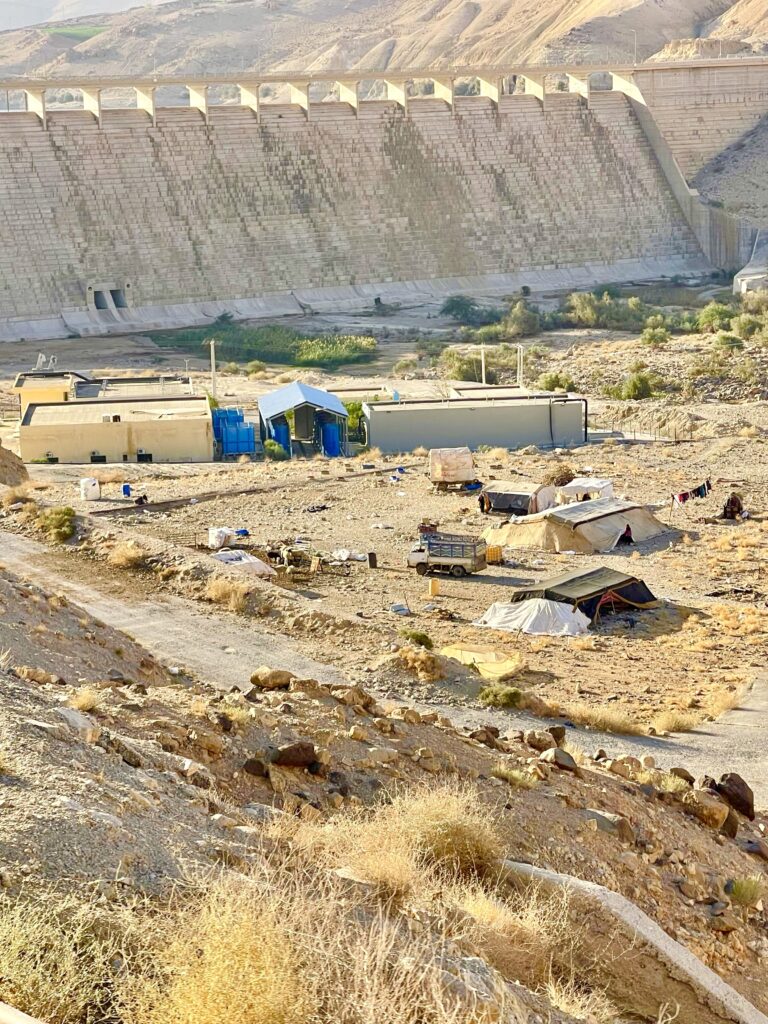
We woke up with a donkey “balking” near our truck and at the same time we heard children talking and laughing. I opened the window and we saw children coming down the hills behind and next to us. Some of them riding a donkey with a mother of father next to them. They had backpacks with them. They were going to school and were brought to the road side, where a pick-up picked them up. We thought that we were all alone when we parked the night before, but it turned out we were surrounded by Bedouin tents.

Time for a change of scenery, so we took a nice small winding mountain road towards the Dead Sea, where we arrived at the Potash City. This is a gated expat compound for people who work in the potash mining industry. Potash is one of the minerals, mined from the Dead Sea. Water of the Dead Sea is “trapped” in basins (large diked areas), where the water evaporates and the minerals (including salt), are scooped up and then going through a process of separation.


Going south of the Dead Sea, you pass large potash/salt mining fields, until the Sea ends. There you find the “Lowest Place on Earth museum”. An interestingly designed building, which mostly reflects the human history around the Dead Sea. The Dead Sea is also an area, which is the birthplace of many biblical stories, like the doomed cities of Godam and Somara, the only survivor of the cities Lot and his wife (who changed into a salt column, when she looked backed at the cities). Being part of the Jordan Valley, humans have transferred and settled here from the times Homo Sapiens left Africa, going north. Nearby the museum is the cave were Lot stayed after he left the doomed cities.

Now, with some interesting back ground information about the Dead Sea and the Jordan Valley, we drove north along the Jordan shores of the Dead Sea. Soon we saw in the distance, the “real” Dead Sea without all the mining basins. The coastal road is about hundred meters above the Dead Sea level, which gives a constant beautiful panoramic view of the Dead Sea and the mountains on the other side (Israel and Palistina). The water is deep blue and along the shores sometimes turquoise, due to the white sea floor. The story about the Dead Sea today is one of sadness. Since the last 30 or so years, the sea level is dropping constantly. The level now is about 30% less then 30 years ago. Since the sea is in a V-shaped valley, the total surface all decreased with about a third. The sea is also getting more saltier, since, less an less fresh water is reaching the sea, but the amount of minerals coming from deep earth, remains the same.

Main reasons for the sea level decline, are the amount of water subtracted from its contributors (like the Jordan river and wadi’s, like Mudjib, for agriculture and city water) the potash and salt mining industry and climate change (more heat, faster evaporation and less rain). Dead Sea tourism is an important industry for Jordan as well as for Israel. But also the potash and salt mining are mayor contributors for the economy for both countries (especially Jordan). There was a plan to channel fresh (desalinated water), from the Red Sea to the Dead Sea, but this plan has been shelved for a while. The future will tell if there will be a Dead Sea 50 years from now (or even before).
We drove along the coast, now entering the Wadi Mujib Nature Reserve. The reserve is named after the beautiful wadi, running through it. The Mujib wadi is one of the larger wadi’s contributing fresh water to the Dead Sea. At the mouth of the wadi, there is a peninsula sticking out into the Dead Sea, like a huge oasis, since it’s covered with thousands of Date Palms. That is actually a farm, which looks weird, since it’s technically in the salty Dead Sea. However, it is using an irrigation system, which takes fresh water from the wadi.

You cross a high old metal bridge, where you have a great view into the wadi on one side and the Dead Sea on the other side. After crossing, we saw a modern complex, which houses an adventure center. Of course, we had to figure out what it was about.

We ended up, buying two pairs of water shoes and renting a waterproof bag and obligatory life vests (in case of unexpected flooding) and climbed down a steep metal ladder into the wadi. For about 3 kilometers, we passed through a deep winding canyon, which has formed over millions of years. Water was flowing through the wadi with some speed and at times there were small waterfalls we had to climb to get deeper into the wadi. We were the last visitors of the day and after a certain moment, it was just us walking through these beautiful pieces of natural wonderland. At deeper water ponds in the stream of water, small fish were nibbling on our feet, which felt weird, but we had that experience before on another continent. You have to realize, these little fish only live in these small little ponds and have done so for hundreds of thousands of years. Their ecosystem is very tiny and fragile.

It was an unexpected surprise for us, to visit this wadi and being showered by the fresh cold water of the waterfalls. Something we didn’t expect when going to the Dead Sea. (But again, we went into Jordan open minded and without too much knowledge of what to expect).

Near the peninsula was a big public parking area, where people parked their cars to walk to the shores of the Dead Sea (one of the few places where it is possible and allowed to stay overnight). So that would be our camp spot for the night. We saw people floating in the water, something which is on many people’s bucket list. Too crowded for us, we decided to do that the next day, early morning. During diner outside, with a view over the Dead Sea, a group of Jordanians (2 young couples), had parked not far from us and had a picnic. After a while they came to us, with to big bowls cof home made Arabian salads. Arabian hospitality again. Unfortunately, none of them spoke English, so we couldn’t really communicate, but were still able to show our gratitude.

Before sunrise, we walked down to the waters of the Dead Sea the next day, in our bathing suites. There was nobody, we had the Dead Sea for our selves. It was a bit disappointing to see the amount of garbage left behind along the shores, of the day visitors (mostly by the local population, even the two friendly couples, left their garbage behind the night before. It’s hard to understand why they don’t see it).
Yes, the Dead Sea is salty, very salty. If you have little wounds, you feel it right away, it hurts! The water feels a bit oily, almost like a cream. And yes, you can’t sink or drown in the Dead Sea, the level of salt is so high, that indeed you float without any floating device. Once you float it is even difficult to bring your legs and feet down, to stand up again. Even swimming is hard, it’s like you don’t move. So if you drift away, you have a problem!

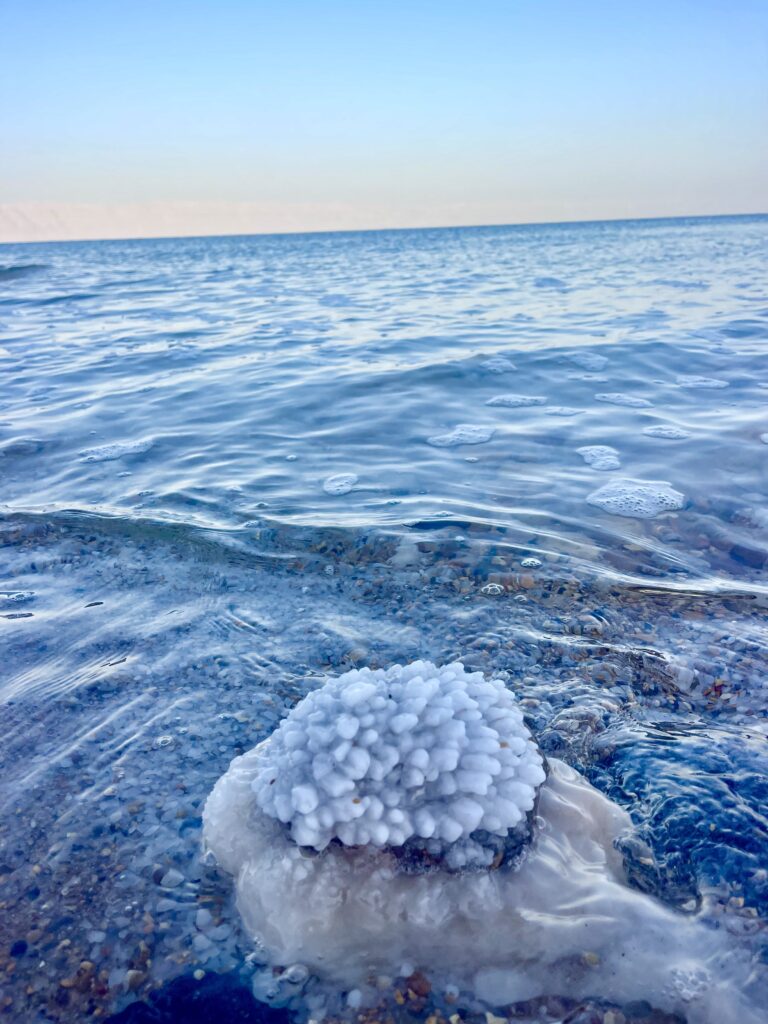
The bottom is sharp with salt blocks, big crystals, so our newly purchased watershoes, where very helpful. Sometimes these salt crystals look like flowers or living anemones. But there is nothing living in the Dead Sea, hence its name. The little foot nibbling fish from the wadi, are doomed, if they end up from the fresh water wadi into the salty Dead Sea.
Along the shore some locals made some very basic provisions for the Dead Sea bathing tourists. There are basic dressing rooms and some very simple fresh water showers, but, what a delight if you come out of that sticky salty water, and shower with fresh water, pumped from the wadi!

So, we had our complete private Dead Sea moment as the sun started to rise and brightened up the blue waters of the Dead Sea. During our breakfast the first tourist arrived and we were happy that we had beaten the crowds.
Going further north, we went back into the mountains after seeing a sign “Panoramic Complex”. A pretty steep, winding road, let the Zetros work hard, but of course we made it to the top of a mountain ridge, which overlooked the Dead Sea.

The “Panoramic Complex” was a beautiful, pretty new complex, housing a museum, restaurant, hotel chalets and conference facility. It was financed by the Japanese Government (Japan and Jordan have a strong relationship and Japan is financing more projects in Jordan).

The restaurant was of a quality comparable with restaurants in Europe. It was amazingly well situated. So, yes, we got “shipwrecked” there for lunch. Fantastic food and a nice cold beer. Only problem was the flies. Now do we have flies constantly in the desert, but around the Dead Sea it is even worse, since the Dead Sea seems to be a good breeding ground for flies. But as prepared as we are, we had battery operated fly chasers with us, which we put on the table. The waiters couldn’t believe their eyes, since they had never see something like that. Even management was informed about this amazing invention.


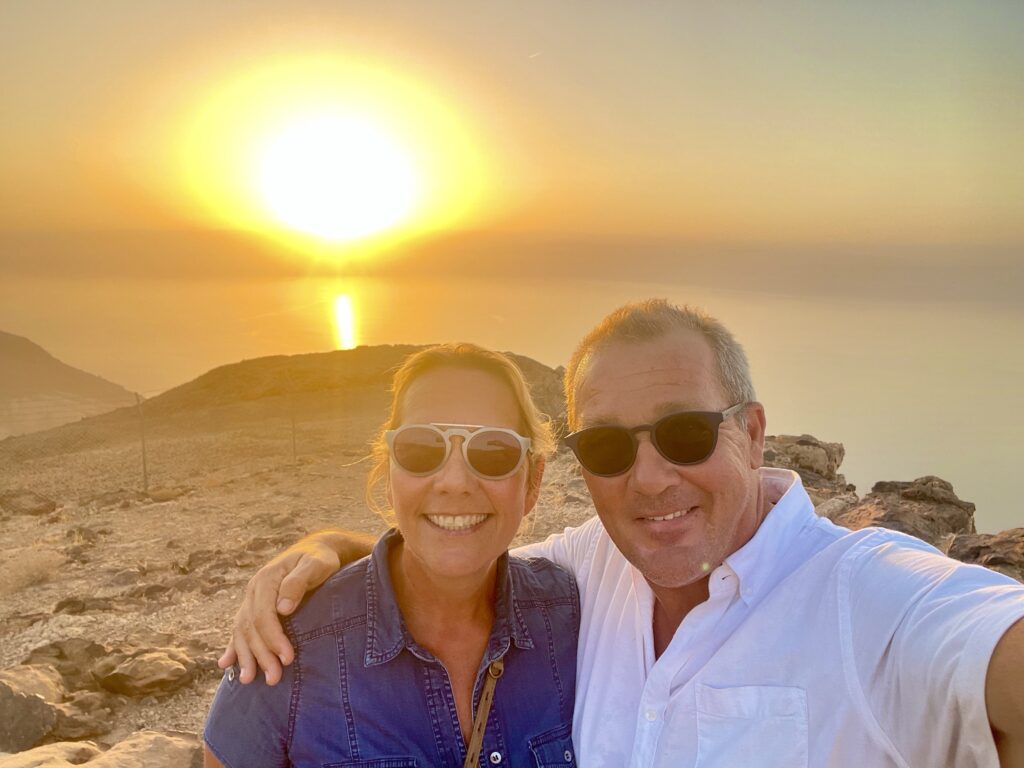
Not far from the complex, there was a path going to a plateau, with a similar view. We parked the truck for the night. And once the sun started to set, lots of lights come on, on the other side of the Dead Sea. That’s Palestina or the Westbank, as it is also called. Behind the mountain tops on the shore line, we saw even more light, the lights of Jeruzalem and Jericho. Sitting on the edge of a steep cliff, overlooking the mirror like Dead Sea with all these lights, was magical.

Some little bells woke us up the next morning. A big herd of sheep, surrounded the truck. A shepherd passed by and smiled friendly. We were probably parked on “his” land or at least on a part of his route with his sheep.
Another wadi contributing to the Dead Sea is wadi Ma’in, which also has some hot water springs. Near or on these springs a small resort hotel has been built. To reach this, we had to drive down the mountain again, but now on the other side.


We reached the main entrance and had to go through a very narrow entrance tunnel. On the top we had less then 5 cm left and I even had to lower the spare tire rack to be able to pass. A well maintained garden along a long entrance road towards the hotel, let us to the hot springs (the ones which are publicly accessible for a small entrance fee). The area has two waterfalls with warm to hot water, this water is caught in two basins. One waterfall has a small cave behind it, where the water is coming through the rocks, but is steaming hot. They called it the “sauna” since it really feels like a sauna.

When we entered the parking a security guard started to guide us and telling us he was keeping an eye on our truck as well as at us at the same time (you must be able to split yourself in 2 to do that). Even when we were at the waterfalls and sauna, he was keeping an eye on us. (The few other visitors didn’t get that “privilege” treatment.)

It was not that busy when we arrived, but quickly it became more busy. There were moslim women, completely covered up, went in the sauna and under the waterfalls. Couldn’t imagine they had the same feeling and pleasure we had. But well……
Since we saw on the internet that the hotel had a nice restaurant with a tempting menu, we asked the guard if we could go to the restaurant. Well, he had to make some phone calls first, since we needed a reservation (and for sure with the present situation, we knew the hotel was pretty empty). Yes, we could go, he said he “fixed it for us”. We came back quickly though, from the restaurant, since,we had to sit inside, with no view, no other guests and it was a buffet for almost 70 Euro per person without drinks. No view, no fun, no go.
In the meantime we decided to go back to the Panoramic Complex restaurant and have either lunch or diner there (again). That is a wonderful restaurant. When we wanted to leave now, the guard was hanging around the truck, just to wait for getting as tip for his unwanted services. A typical hustler, which should be fired on the spot, since he is employed by the hotel to do a certain job and not trying hustle money from visitors or guests. Anyways……
Back on our camp spot the second time, we spent the rest of the afternoon at our campsite. Diner at the restaurant it would be that night. A path along the mountain top and cliff went from our spot straight to the restaurant, where we enjoyed the sun-set with a nice bottle of Jordanian wine. (Didn’t know they made wine in a moslim country, hence the reason for trying it out. It was a good choice).
The same sheep woke us up again the next morning. Now the shepherd looked a bit annoyed. As if he didn’t appreciate that we were still there, or back again. Not that we were withholding an enormous amount of food for his sheep. It.s all rocky terrain, with some straws of grass popping up here and there. It’s probably more the fact that a “stranger” is on “his” ancient land. Anyway, we were planning to leave anyway again, but at a time of our choice.
Rolling down the mounting again, we first were stopped at a police road block (first time, although we passed already many road blocks). Maybe the shepherd had contacted the police that some “Israeli spies” where hanging around, watching the West Bank from the Jordan site, who knows. After convincing the plainly dressed officer (probably from the secret service), that we are Dutch tourists, spending money in his country and enjoying all the beautiful things Jordan has to offer, he let us roll on again.
The last stretch of Dead Sea coast line was ahead of us, which within half an hour was done (mind you the Dead Sea is only 50km long). It’s the area where all the hotels are located, but they didn’t look very busy.
Not far from the northern end of the Dead Sea, we turned towards the Jordan/Israeli border, this is actually the Jordan river. According to many stories and writings, there is a spot at the Jordan river, where Jezus met Johannes (John), who baptist Jezus in the Jordan river. It’s a very sacred site and there have been many arguments between Israel and Jordan about the exact location. The fact is that the Jordan River also has changed its flow during the last 2000 years. However, archeological excavations, compared with historical statements of “witnesses”, have confirmed that the location is on the present day Jordan side of the river. Due to its holy importance a few Christian churches have been built near the ruins of the old church, one is of the Orthodox Greek church. A bus brought us from the visitors center to the militarized zone, in which the Jezus baptist site is located. The border between Israel and Jordan is heavily guarded (also to avoid smuggling, illegal immigration and possible terrorists).

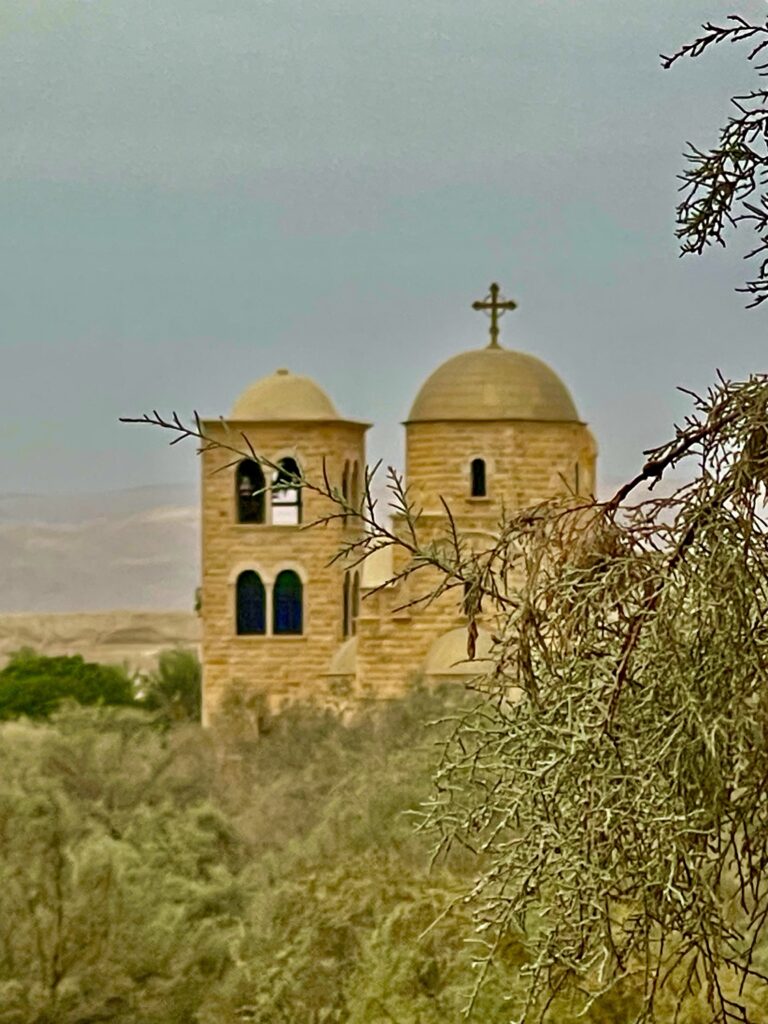

We had a compulsory guided tour with the guide who came in the bus, together with another 40 passengers. First we were dropped off at a souvenir shop and then passed a shaded wooden walkway towards the ruins of the old church built to mark the original place where Jesus was baptised. After that we walked to a brand new church, built by the Greek Orthodox Archidioces. A really beautiful church (old style) with colored wall paintings. Its a bit strange to walk through an area in a moslim country and find a couple of Christian churches together.


From the church we walked to the Jordan river where (according to historical records), on that location, Jezus was baptized. The “river” can hardly be called a river (anymore). It’s less than 6 meters wide at most and mostly hidden by the reeds growing in it. Only at the baptize spot, the reed has been removed.

Exactly opposite, at the other side of the river, is a big building under construction and Israeli flags are waving in the wind. Where we were surrounded by heavily armed soldiers, there were only construction workers on the other side. We did what others of our group did, taking off shoes and sock and stand in the Jordan river, re-doing our baptizing (we were baptized, when we were babies). The soldiers waved at us, not to go too far or stay too long in the water, as if we were planning to swim to Israel.

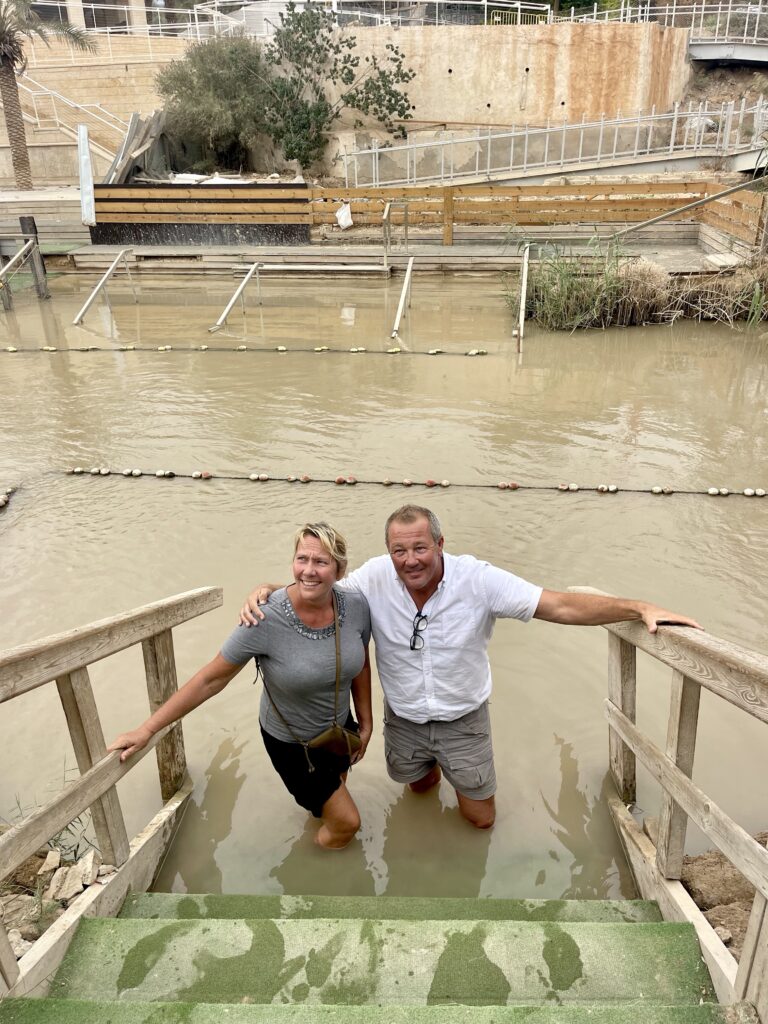
After the bus brought us back, we jumped in the truck for some coffee and to warm up a bit. It was windy, chilly and rainy. We realized that even though it was a tourist destination and also a bit of a Christian pelgrims place, we where in a place of meaning. Especially in the current polarized world.
The Jordan river splits the Jordan Valley more of less in two. As said before, the valley is a rich agricultural area, where Jordan is producing most of its fruits and vegetables. Driving the 2 lane highway through the valley, you have farm after farm on your left when you go north. There is a lot of direct sales from pick-ups and little trucks along the highway. Also here, like high on the mountains, cities and villages are glued together. We were underway to another great castle complex, but we were running out of time since it was getting dark. A flat piece of land overlooking a valley near the road was the most suitable, after trying some other dirt roads first, which often were blocked by rocks rolling down from the hills.


In the early morning, we heard some loud knocking on the door, the police arrived and wanted to know who we were, where we are from and what we were doing there. I showed our passports (of which photos where made again) and told them that we just spent the night and that we were on our way out towards the Dead Sea. After I had convinced them they showed a smile on their faces and told us that we had an hour to pack up.
We quickly got dressed and made breakfast. Then an army truck arrived. Drove around us and left. About 30 minutes later the army truck came back loaded with soldiers and a very tough looking luitenant with a big machine gun hanging on his shoulder. We both had to step out and answer the same questions and had to show passports again. The luitenant was also interested in what we were carrying in the two metal storage boxes on top of the cabin, so I showed him. In the meantime we were surrounded by all eight soldiers as if we were enemies of Jordan. It was still not clear (also not from the visit of the police officers), what the issue was. The only thing that came to mind was that we had a perfect position towards the big dam, to shoot a rocket or something, to blow it up. But only thing we shoot, are pictures.
The luitenant was also very interested in what time we arrived the night before and also pointed out to us that at three very close locations around us, soldiers were stationed all the time (most probably to guard the dam, but we hadn’t seen any of them). So to me, it looked lik some of these guys fucked up and either left their posts or were sleeping, hence the question of our arrival time. Somebody was going to be grilled that day, for sure.
Since we were finished with the breakfast anyways, we quickly packed up and followed the waiting army truck (the luitenant wanted to be sure we were leaving).
Ajlun was the next city where we were heading to. Through some narrow busy streets, we crawled uphill towards a well preserved old castle/fort. It had a modern well functioning visitors center. Near the castle some big projects seemed to have halted for whatever reason. Maybe the expectations of tourism arrivals where too high or it was still Covid related and the projects went bankrupt. Near the castle a couple of big tour buses were parked and groups of tourists were roaming around the castle with their guides. Along the entrance road a number of souvenir and coffee stands were trying to lure clients in, but it seemed like they were not so successful. The tour bus visitors are on a tight time schedule and once they came out of the castle, had to hurry to the bus.


A castle guide hooked a couple in front of us who couldn’t say no to him, and we were let go (that’s how we like it). It was again an impressive middle age architectural feats. Built by Arab Kings, conquered by Crusaders and recaptured by an Arab king again.
Nearby was a new attraction, a cable cart (telephyrique), going over a valley with a view on the castle and the nearby town. It was probably not on the list of the scheduled tours, since the parking was almost empty. Also Jordan tries to upgrade and re-invent itself to stay an attractive destination for tourists. But whether copying other destinations will do the trick, I wonder.
The town of Ajlun, looked like a nice medium size town with a pleasant centre, something we missed in the other cities we passed. So we parked the truck in town and wondered through town (also something we didn’t see other tourists do). It’s a different experience than when you drive through a town. You can focus more on the smaller details and feel more the vibe of a place. The Jordan cities look a bit un-organized. The store fronts come in all kinds of types, sizes, colors and use. The side walks are sometimes gone, leveled or you have to jump up or down because of different levels. The cities like Ajlun, are though very vibrant. There is usually a fixed large market in the center of town. Ajlun had a nice market where you can find the most unusual things, but also a lot of stuff for your daily needs. People were quite surprised to us, but were in general very friendly to us and were not pushing us to buy anything. The smells of fresh fruit, herbs, shishas and bakeries, make the city a great place to wonder around. We found a small coffee shop along the main street with two chairs outside. We popped in for a coffee (2 coffee, 2 muffins and 2 bottles of water for less than 1 Euro.) It’s nice to just sit down with a cup of coffee and see the hustle and bustle from the side line. Apart from all the small details, there is not much difference between Ajlun, Amsterdam or New York.


After finishing our mini city trip, we were now heading for another holy site, the Cave or Jezus. The cave were Jezus was buried, but stood up again, removed the big rock in front of the entrance and disappeared. A not so clear sign along the main road, lead us into a narrow country road, where we had to use Google Maps, to get to the exact location. Seeing how Jordan was treating the Baptist site of Jezus, with visitors center, big parkings, tour guides etc, we expected the same here. None of that we found at this location. A big house was nearly built on top of the actual cave. The cave itself was closed of with a big lock on a metal grill door. A huge tree was growing next to it. There was no fence around the area, there was garbage and an abandoned office container (most probably a guard or watchmen office unit). There was not even a sign indicating that it was Jezus cave or any other explanation. We couldn’t understand why such an important historical site was not better been taken care off.


A bit disappointed we left and drove away towards the next historical place called Pella. On the way we stopped at one of the many small fresh juice stands. It was harvesting time for the pomegranate and a fresh healthy juice of this fruit we like. Pressed at location we were surprised how much juice you can squeeze out of a pomegranate.

Pella (or Tabaqat Faht), is an old ancient city of which a part has been excavated by archeologists.

When we arrived we were welcomed by very friendly staff and an officer of the Tourism Police. We were the only visitors and did a walk along the ruins of the old town. When we returned, the police officer insisted that we kept the truck on the parking to camp for the night. The other three men (the cashier, a night watchman and the manager), invited us for coffee and to have a chat. I think that they receive so little visitors, that we were their entertainment for the day. We were allowed to stay in the watchman’s house (to sleep and to shower) and the watchman even offered to cook for us. The police man spoke some English and did most of the translation between us and him and the others. But this are tiresome conversations. We thanked everyone for all what was offered (since our camper offered all the comfort we need, including the food).
Next morning, we asked if we could fill up our water tank (since they wanted to offer us so many things the day before). Of course it was not a problem. The same police officer was back again (Ahmed) and he took charge of it. The entrance building next to the parking had a big watertank on the roof, but there was no tap I could connect our hose on to. Prepared as we are, we carry an electric pump with us, so I put the pump in the big water tank and so we could fill up our watertank. In the meantime, we got Arabic coffee from our police friend and we shared a coffee from our coffee machine.
Even after we were finished, they wouldn’t let us go. We had to drink tea on the terrace overlooking the historical ruins. In the meantime also the lady in charge of the bathrooms arrived and joined the tea party. This is what the people here do most of the day I thought. Drinking tea and coffee and chat about all kinds of things. Again we were the entertainment and we exchanged a lot of information about each other and each others culture. It’s funny that often the conversation is about wives and children (especially the number of children).

But we finally had to put an end to it and move on. We gave old Sint Maarten license plates to our friends and in exchange we got an Jordan flag for on the car. It was all in all a nice stay over at these ruins.

Though it was not advised by the Dutch Embassy to get near the Syrian border (same as it was not safe to go near the border with Yemen), we drove to the very end of north west Jordan, where three countries border each other, Jordan, Syria and Israel. We wanted to see a mayor historical site, the city of Gadara. It was a rainy day with thunder and lightning. We stopped on a forested mountain plateau for a coffee, near a large artificial lake. It was seemingly a popular place for the local population, due to its panoramic views, since we saw an enormous amount of picnic garbage.

With heavy rain, we arrived on the parking of Gardara. Gardara is one of the 10 ancient cities of the Decapolis. A defense line of cities on the southern border of the Roman Empire in the Middle East. These cities were way ahead of their time with for the time state of the art infra-structure. (The longest ceramic waterline in the world at that time, sewage system, paved roads and heated bathhouses). A mayor earthquake had destroyed most of these cities and they became abandoned. Only during the rein of the Ottoman Empire, part of this city was re-built in Ottoman style on top of the ruins of the old town. When you visit Gardara, you walk through an Ottoman village on top of the ruins, which is surrounded by the ruins of the old Roman city of Gardara.


A nice museum is located in one of the few Ottoman mansions, besides a few coffee shops and a nice restaurant. The restaurant has a wonderful terrace overlooking the ruins of the old town and in the distance Lake Tiberias (Sea of Galilea), which is connected with the Dead Sea, via the Jordan River. You also see the Syrian Golan Heights, which belonged to Syria, but have been occupied by Israel since the seventies. We had a nice lunch at the restaurant and enjoyed the view over a special territory.


At the end of the afternoon, we asked the Tourist Police officers if we could stay on the parking and camp for the night. However, these officers were different from the one the day before. These were either more concerned (due to the proximity to Israel/Syria) or not helpful at all. However, their supervisor (on the phone), instructed them to bring us to a safe place. One of them had to drive with us, to bring us to the safe place but we only have two seats in the cabin, and sitting on a strange woman’s lap would not be allowed by Allah, so instead they walked in front of the truck. Luckily is was not too far. They wanted us to park next to the museum, where CCTV camera’s could watch over us. The place was actually much better, since we had great view over the Golan Heights and the Jordan city of Umm Qais. There was even a nice coffee shop right here, what more can you ask for……

One of the lesser known Decapolis cities is Abila, further to the east and near the present Syrian border. It’s only partly excavated and has been looted extensively. There is compared to Gardara zero tourist infrastructure. Its surrounded by large olive tree farms (almost on top of the ruins). You can see that this must have been a large well developed city with well paved roads, large temples and many houses and public buildings. Also this city was destroyed by an earthquake and huge landslides must have occurred witnessing the thick layer of dirt covering the old main street.


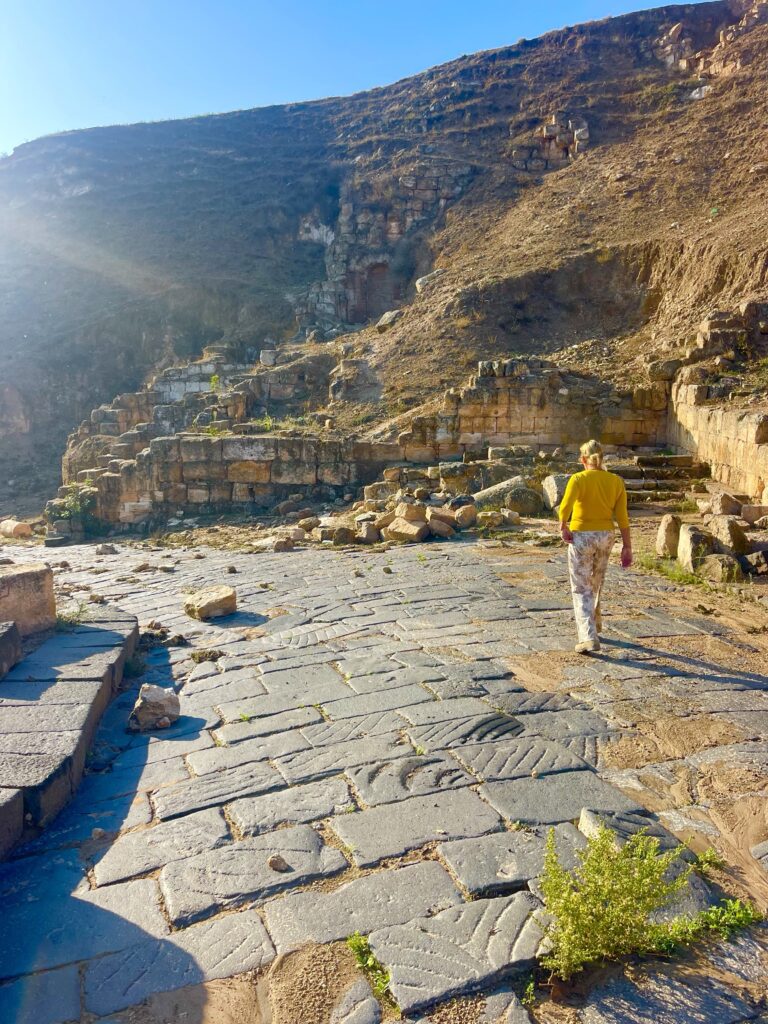


A piece of Jordan that is totally not on the list of tourists is the part wedged between Syria, Iraq and Saudi Arabia. It consists 100% of Syrian desert, which is mainly flat rock and gravel plains. Via the big city of Irbid, we drove eastwards, passing mainly inhabited areas. You also pass the areas where the Palestinian refugee camps are located. Once you pass the city of Mafraq, the habitation starts to get less and is only located close to the main road.


Finding a spot in the desert to camp came only after we drove another 50km, near a former stone quiry.
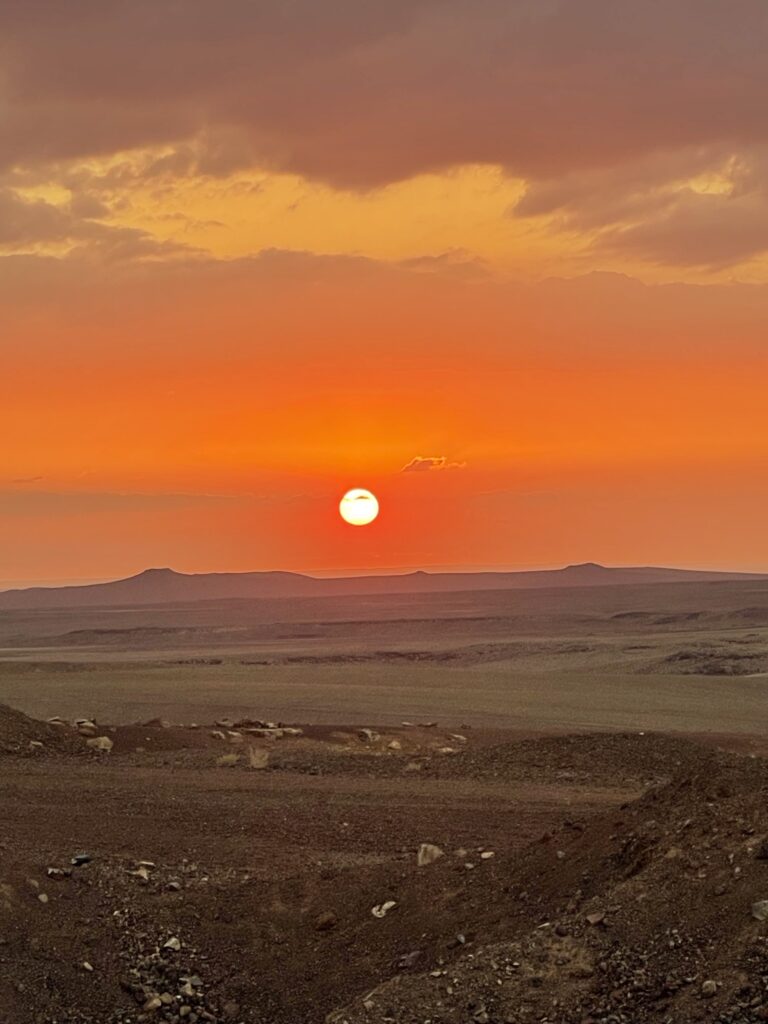
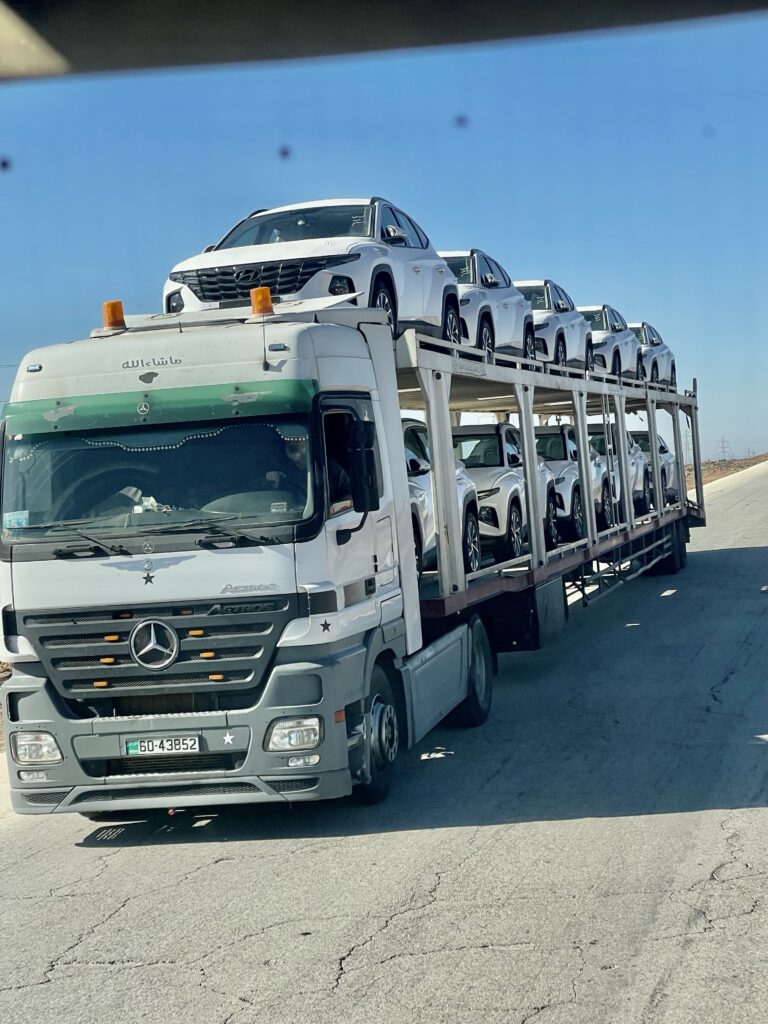
Further to the east, there was one last old desert fort/castle close to the Syrian border again. During the day we drove a straight, 2-lane crumbling asphalt road, the Bagdad International Highway. There was hardly traffic on the road, except for military and full or empty vehicle transport trucks. Brand new white little trucks and SUV’s where transported from the harbor of Aqaba, to Iraq. Most probably cheaper and/or safer than shipping the vehicles directly to the harbor of Basra in Iraq.


The heavily militarized desert town of Ar-Ruwayshid, is were we got off the highway and followed a brand new single lane asphalt road, financed by the UNHCR (UN refugee organisation). The road goes straight to the border with Syria, where a large Syrian refugee camp is located. Around the town of Ar-Ruwayshid, you find several refugee camps. People living in simple tents, with hardly any facilities. Children playing outside in the garbage and most probably not attending school.


The area had seen extensive rainfall in the last couple of days. From the UNHCR road we had to take a dirt track into the desert, towards the castle. The desert was muddy and slippery. There were still a lot of water puddles and the truck had to work hard to get through it and became covered with mud.


The area was wide and deserted, some parts were rocky. But then, from far we saw a large structure and it turned out it was a large eco-lodge complex in the middle of nowhere. Who in is right mind, got the idea of having an eco-lodge in such a remote unwelcoming landscape (mind you, in the summer it’s unbearably hot in the desert). What could you do in this eco-lodge? What kind of activities except for walking these wide open fields? We didn’t see any guest, but we did see a fenced area attached to the lodge, with sheep and goats. Had the lodge be abandoned and taken over by Bedouins?
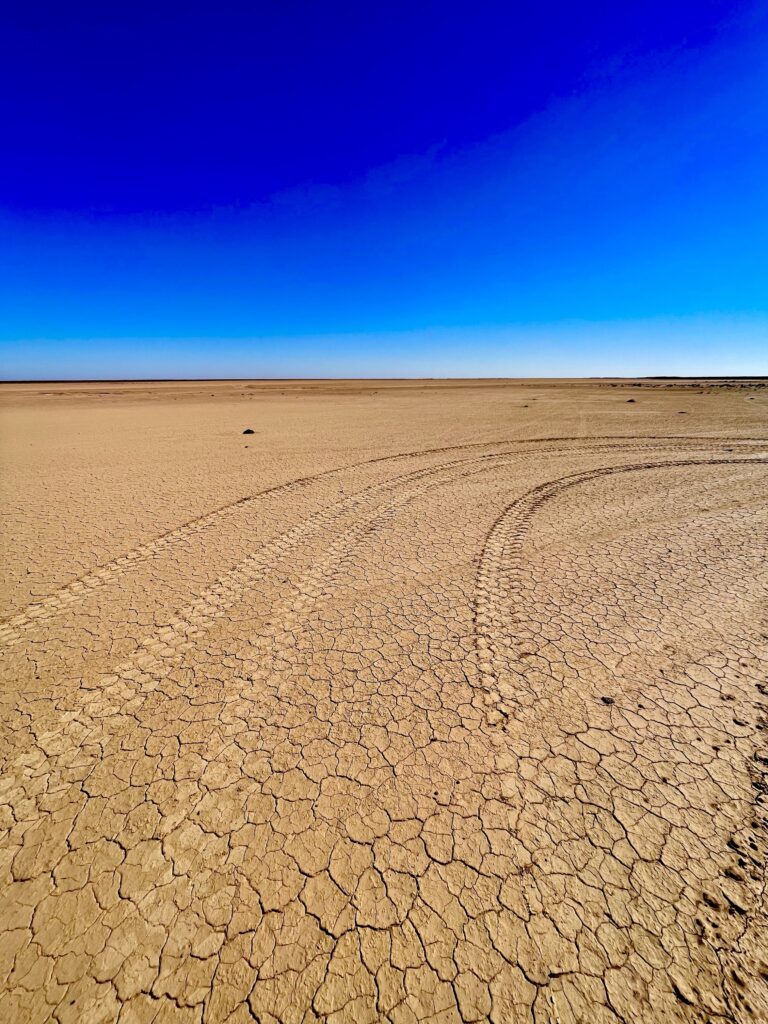
Not far from the lodge were the ruins of the desert castle, near a desert lake. A fast flowing “river” was passing the ruins, due to the heavy rains. There were even rapids and the lake was more than double its original size. It rarely rains in the desert, but if it rains it could be enormous and the desert had to absorb the water for years to come. The ruins of the small castle or actually a small fort, were made out of big chunks of shaped rocks, placed on top of each other, without cement. It’s hard to imagine at the time of construction, the hardship people went through, to build such a fort in a remote place like this. But it was about protecting that scared commodity in the desert,…water! Without water, there was no life. Protecting it from others, was worth all the trouble.


The next day we drove away from this unique place and drove further into the Syrian desert, following old tracks between rocks and volcanic fields and large open sand plateaus. We didn’t see any signs of life until far in the desert we saw a Jordanian military jeep speeding along the border with Syria, leaving a big cloud of dust behind him. Wonder if they ever noticed us. It took us a full two day driving until we reached the old Bagdad International Highway again. We ended our expedition in the far north east of Jordan, in the remote Syrian desert.

