After reaching the Bagdad International Highway again, we drove first back west, to highway 5, the lonely 2 lane highway, which is the 3rd main road going south/north or north/south in Jordan. But not before tightening some bolts under the truck, as they came loose again after two days off-road driving.


We passed a small pelgrim site, a huge, centuries old tree (Tree of Buqayawiyya or The Blessed Tree), which according to scripts, is the tree, Prophet Mohammed was sitting under at the age of 12, when a Christian monk passed by and predicted that in the future Mohammed woukld be a Prophet. I found it interesting that a Christian monk, made such an important prediction for Islam history.


The site is of such importance, that the King of Jordan decided, to declare it a protected site and ordered a number of improvements. The tree is fenced in, there is a care takers house, a police station and a mosque is under construction.

I was invited to come to the construction site and see with my own eyes how the mosque is being built the way the construction has been done for hundreds of years. A massive amount of rocks is cut by hand in suitable pieces and together with mortar carried by hand to the masons on the roof. The construction of the domes takes a lot of craftsmanship. I was very impressed!


Nearby the mosque under construction and the tree, there was a big pool of water. A Bedouin man was parked there and had a picnic with his family. Wherever we went so far, on the Arabian peninsula, wherever you go, you will find cars parked, with families sitting next to it on a carpet. Making coffee or tea on a burner, eating snacks and sweets or cooking a real meal. Children running around. If you see the Arabian cities, you understand why. The houses are often big blocks with many rooms (families can be large), built 1 or 2 meters apart from each other. There are no gardens. Escaping into the open desert, is often the only way, to find some peace and silence.

Close to the pilgrim site there was also a huge solar panel park. As Jordan has no gas or oil, it depends on its wealthy neighbor Saudi Arabia for these fossil fuels. But also, Jordan tries to mitigate the heavy cost of importing gas and oil, by implementing alternative energy sources like solar and windturbines.
Driving further south on highway 5, we drove towards another desert castle (Qasr Usaykhim). High on a hill overlooking the wide desert, we found the few remnants of what was a strong defensive structure. We could see that treasure hunters had dug up the place (its not the way archeologists would dig holes and trenches). But that was not our concern. We had a great flat spot next to the ruins for the night camp.


There were a few other castles on our way down we wanted to visit. But first, Marja wanted to do a little experiment in the kitchen, making her own chocolate covered croissants! I did not mind, of cours, it was a perfect way to start the Sunday). And wow, she did it. No bakery could have done a better job. I am such a lucky guy!

We visited the city of Al Azraq where there was a castle (Qasr Azraq) near the town center, originally built by the Romans, re-built by the Arabs and even used by Lawrence of Arabia. A few groups of tourists were just dropped off by buses, but they left quickly again. We realized why, when we were inside the castle on the castle towers. A huge cloud of dust was heading to town. We walked around, made some photos and left as well.


The weather changed completely, very fast. All kinds of stuff was drifting over the streets. Visibility became less and less. We drove towards the next castle (Qasr Amra), which we reached in the sand storm. The winds became a little less and we walked towards the castle. Again groups of tourist in winter clothing were walking around with their guides. The castle was small but well preserved. It was more like a small palace. Inside was the real reason why it is on the list to be visited. All walls and the ceiling where full of hand paintings, telling stories of the times the castle was inhabited.


The wind picked up again and all tourist were gone. We tried to find the parking again, but visibility was now almost zero. The sand was getting everywhere. Your eyes, ears and hair. It’s very fine dusty sand and not good for your lungs.

We reached the truck and quickly went inside. One window was open, so we had a layer of sand dust in the unit. Luckily not too much. We stayed inside the truck until the next day (around 24 hours we were locked up). It was really a strong storm. The truck was shaking a lot and wind was screaming around us. In the middle of night it also started to rain. Quite an experience! At least we had plenty of time to clean up the unit and after that to read. Just sit and read, we felt like we were in vacation…..
When we finally came outside, it was a lot less windy, but the truck had a lot of sand everywhere, even the cabin was full of dust. So we first cleaned out the cabin, to make it more comfortable when we were driving.
The next castle (Qasr All Harrana) was about an half hour drive. We were early, so not too busy. It was still windy and even cold. A group of Italien tourists walked around like they were coming from the Mount Everest. The strange weather brought us a beautiful rainbow behind the castle. You could see that we were in a very different climate zone, compared with Saudi Arabia. Going north, means, colder temperatures and more rain.

We drove back to the city of Al Azraq which is home to many Jordanians and Tsjetsjenen or Chechens. In the 19th Century the Russian Tsar expelled many Chechens for their homeland Chechnya to the Ottoman Empire of which Jordan was part. Chechnya is a moslim republic within the Russian Federation. Chechens are known for their military skills and therefor well presented in the Jordan military (leadership). So they are not Arabs but people from the Caucasus.
The mainstreet of Al Azraq Is full of goat and sheep meat traders. Along the road you see small cages with these animals and often slaughtered goats and sheep next to them. Not a nice sight if you see “your brother or sister” hanging next to you complete skinned and beheaded!

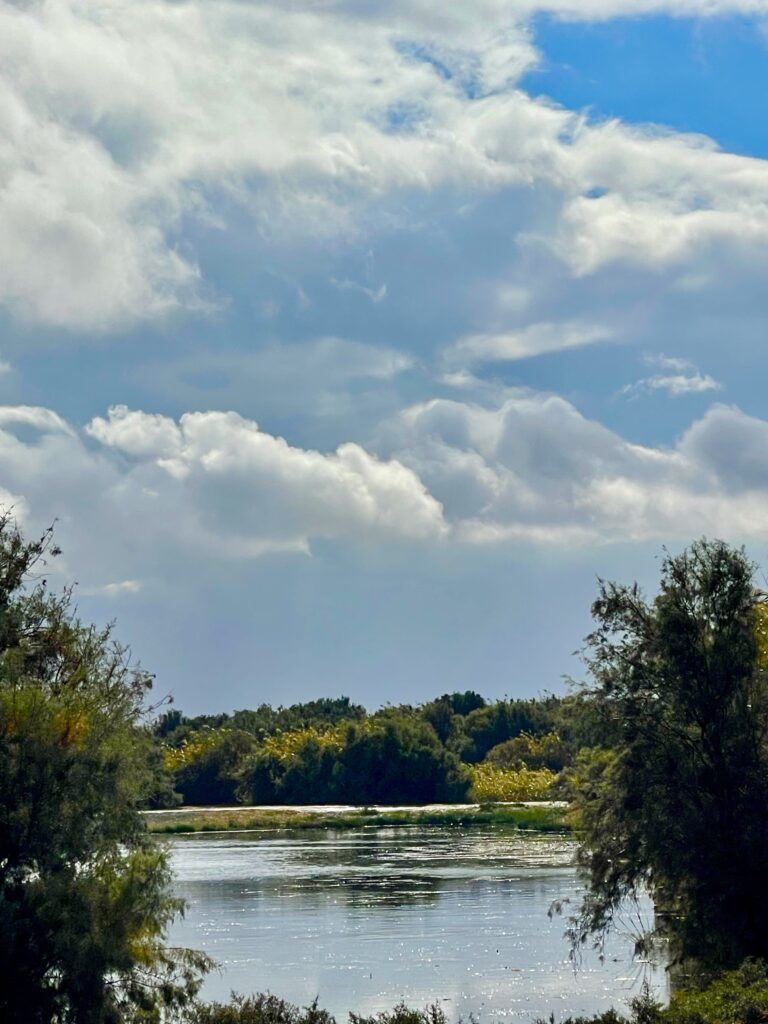
Near the town is a small reserve (Al Arzaq Wetland Reserve), which contains the only wetlands area of Jordan, or actually what is left of it. A large inland delta, which contained lots of fish, was an important stop over for migrating birds and provided water for animals and Bedouins in the area. However, due to extensive pumping for the growing cities in the area and agriculture, the watertable dropped significantly and the delta is now only a shadow of its former self. A rehabilitation project is ongoing with support of a number of international donors. Water is pumped back into the delta, but still by far not enough to bring it back to its original size. A state of the art visitors center with a small exhibition about the wetlands is located at the entrance. There is a well designed wooden walkway through the reserve and a picnic area with a kids playground, with animal theme games. You can see that western organizations designed the whole set up. I wonder if there will be click between what they want to say and what the Jordanians want to hear.


It was still very windy and driving south the sand storm picked up again. We had driven straight into the next big cloud when we arrived on our next stop, the Shaumari Wildlife Reserve.

This reserve is a large fenced off area, part of the Syrian flat land desert. The reserve offers a breeding program for vulnerable species, like the Arabian Oryx, the Somali Ostrich, the Arabian Wild Ass (this is a donkey) and the Houbara Bustard (a large bird). We reached the entrance gate where we were the only vehicle at the parking. The sand storm was now almost over. A sleepy park ranger was surprised to see us. Didn’t expect people to come to the park in this weather. All activities of the park were closed. Even a walk through was not possible. Only the visitors center with an exhibition was open and from there, through big windows, you could see enclosures with some of the animals. We saw a few Oryx’s , some Ostriches and the Houbara Bustard. There was a big restaurant on the first floor of the building, but it looked like it was closed since a long time. Maybe intrest in the park was not that big (anymore).


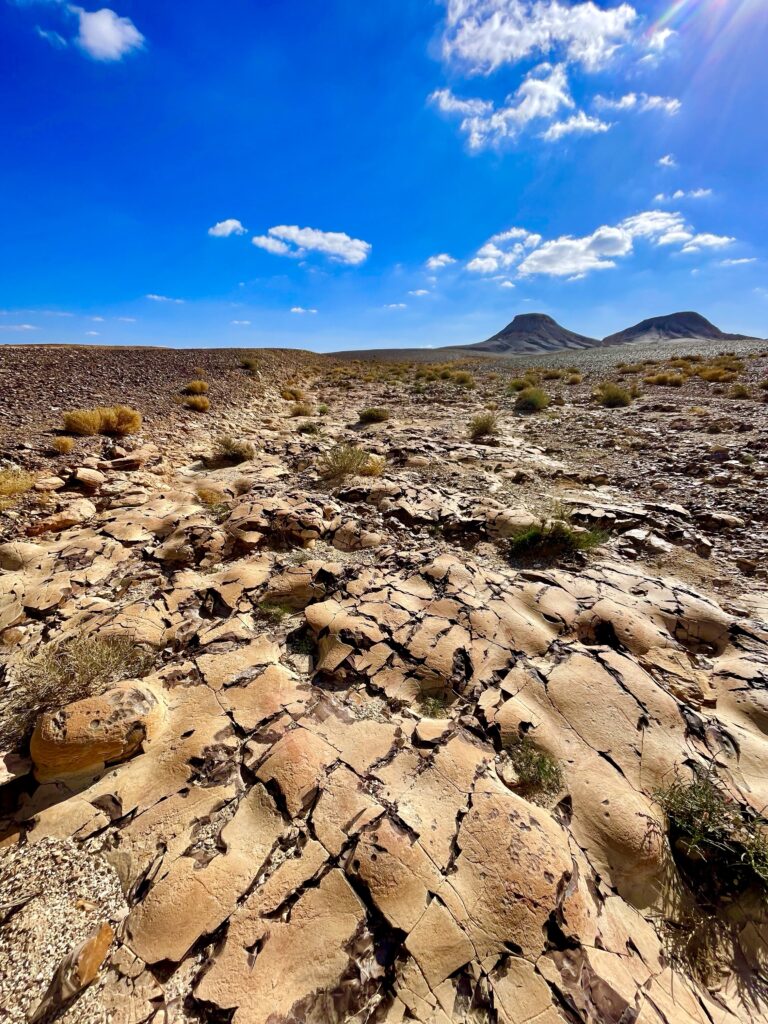
From here we drove further down on the lonely highway. A couple of hills which looked liked volcanoes from a distance, took us off the highway. Between these hills was a pan-like large area. A great campsite and with these hills nearby, a nice hiking area. We spent 2 days here and did a couple of hikes. To receive WIFI we had to climb these hills to catch a signal. On the last day we went for a picnic on the highest hill. This was one of the best camp spots we had.


Highway 5 is a wonderful highway going to an almost completely empty desert. There is hardly any traffic and the road is in very good condition. A last desert castle (Bayir) was on our list, pretty far into the desert towards Saudi Arabia.
A long drive on a dirt track took us westwards. We reached a lush green wadi with palm trees and high grass and reeds. Water was flowing which we had to cross, scaring the camels that were drinking. A castle like structure was visible on a hill, but it looked like being occupied. We passed it and indeed, we saw people, jeeps, flags etc. Not sure if this was the castle we were looking for, we continued for a kilometer or 2, but were then stopped by a jeep. A uniformed and and non-uniformed man came out of the vehicle and asked the usual questions. They were from the Bedouin police force. A special police unit consisting of Bedouin tribes men. They patrol the desert and the borders, since they are familiar with the terrain. They also police the Bedouins and try to solve issues between the Bedouins.


The man without uniform looked like the man in charge. He explained to us that we were not allowed to go further into the desert. We tried to explain him that we were looking for a castle. He first didn’t understand, but then asked us to follow his jeep. We drove back to the castle-like structure we passed initially. We were invited inside. Left and right men came out of tents and rooms. They wore a rag tag collection of uniforms and Bedouin clothing. This was the Bedouin police Squad, in charge of the protection of Jordans borders in the desert. The chief took my phone and started to make pictures of us with the “castle”. The “castle” was indeed a castle with 2 towers and walled around. It was built many years ago on top of an old ruin of a Roman fort (the one we were actually looking for). We were served with tea and got a tour over the entire “police station”.

When we left we saw a very old Mercedes fire truck (the Bedouin fire brigade), using its pump to pump water over a freshly seeded piece of land. We went to have a look at this antique truck, which was still in perfect working condition, though 50 years old. I wonder whether our Zetros will still be around after 50 years. The Bedouin police and fire men working the truck were proud to show it to me and wanted to see our truck as well. Nice detail was the 911 emergency number on the truck. A fire truck in the middle of the desert, is like an ice cream truck on the North Pole!


We headed back to the 5 and drove towards the border. But not before making a crossing through Wadi Rum again. This time we drove the back road, which goes through a secured area. Two check points we had to pass and indentify ourselves before we could pass. The road had high fences on both sides and on a mountain we saw a very big house. We assumed it might a be palace for the King of Jordan.
Via the village of Manshir we could enter Wadi Rum from the back. There is no tourist entry here with gates and visitors center. Just a similar dirty, chaotic little village like Rum. Also here lot of the inhabitants depend on tourism from the Wadi Rum park, with their small Bedouin tent camps and doing tours with their converted “safari” pick-ups.


Early morning we drove through Wadi Rum again towards the official gate. The first few hours (it was early) we didn’t see anybody. Around our coffee break we parked the truck in the middle of the main valley where most of the safari tours pass and we saw the first little pick-up trucks with their guests entering the valley doing the usual tour. Sitting on our comfortable chairs with a good cup of coffee, watching the tourists passing, bumping their butts on the hard simple seats in the pick-up trucks. Sorry, but those are the moments, I am happy, that we travel with our fully equipped hotel room on wheels. A small canyon with rock inscriptions we forgot to visit the previous time, was near us. Some Bedouin police men on camels where on patrol nearby. They liked to get a lot of attention from tourists, who made pictures of them.


We drove out of Wadi Rum and nobody stopped us or asked questions. The last stretch of Jordan was in front of us. Back to where we entered Jordan, at the city of Aqaba. One more stop at the supermarket and then to the same beach where we were when we came into Jordan. This time no other overlanders and far less western tourists. At night we had a diner at the same restaurant with the same horrible holy speaker singing every 10 minutes. The good thing was, that the owner allowed us to fill up our water tank the next day.


Leaving Jordan at the border was a bit chaotic, the same way as we entered. First you have a pre-exit check where you give back the blue temporary import permit. Now they are sure that the truck left the country and is not sold illegal without paying import tax. Again also on this site nothing in English, so you look what other people do. You just park you car or truck at the closest empty spot. You follow the guy in front of you to a window at a container like office. You show all the papers you have and see what the officer wants. We had to pay departure tax. We had just finished our last cash Jordan money at the restaurant the night before and now, at the Jordan border they are not so sophisticated that they accepted credit card payments. So like when we entered Jordan, we had a long walk to the money exchange office. The guy recognized me from a few weeks ago (not sure because of my look and me being so nice, or that he ripped me off so friendly). Anyway, we still had some Oman money as well, so we exchanged that (he took a 100% profit on that, so for sure he will recognize me next year again).
So we paid the departure fee, but now the officer really woke up and realized that we drove a truck with a non-Jordan license plate (there was a 99% chance that we, as foreign tourists, would not drive a Jordan licensed vehicle). So again we had to visit the money exchange hustler. Playing on his little calculator he came with the same robbery rate again (at least he was consistent).
So after paying a total of about US$ 100.00 in “ransom” money, to get out of Jordan, we had to go to the immigration office. We had to show that we had paid. Then to the next window to show our truck papers (to check out the truck). So now they were all sure we would leave Jordan. I still had the CdP to stamp out, and that had to be done again at the very first window. The officer was not really familiar with this paper work, so I had to show him what to do, where to stamp and what paper he should keep for his administration. After all that, we could slowly crawl out of the packed parking area, pushing other people to move their badly parked vehicles.
Via the usually piece of “no-mans land” we left Jordan behind us and drove to the Saudi border post.
